Baring-Gould’s sources: Gallo-Belgian and Cologne Martyrologies. Two lives of S. Gudula exist, besides notices of her in the lives of other members of the family of saints to which she belonged. One life, by a certain Hubert, was compiled after 1047, the other is anonymous, given by Surius. That of Hubert is an amplification of an older life, written in simple and rude style. He did not apparently add anything to the history, except the account of the various translations of her relics, up to his time; but he re-wrote the life in more pedantic and florid style.
The date of the birth of this holy virgin is uncertain. During the reign of King Dagobert, or of his son Sigebert, there lived in Brabant a count named Witgere. His wife Amalberga, who is said to have been the sister of Pepin of Landen, presented him with many children; Rainilda, Pharaildis, and Emebert, who occupied the episcopal throne of Cambrai, and was afterwards elevated to the ranks of the blessed. Amalberga was again pregnant, and an angel announced to her, in a dream, that the child that should be born to her, would be a model of sanctity. A few days after, S. Gudula was born, and her relative, S. Gertrude, was her sponsor, and took charge of her education.
When Gudula was still a child, she longed to fly the world. She and her sister Rainilda betook themselves to Lobbes, and asked to be admitted into the monastery. But as women were not permitted to invade its precincts, their request was denied. After waiting three days at the gates, Gudula turned away sorrowful, but her sister Rainilda, more persevering, remained undeterred by repeated refusals, till, overcoming by her persistency, she was allowed to live under the rule of the monastery. Gudula returned to her parents; but living at home, she lived a recluse. In those wild times of civil war and general violence, it is not surprising to see gentle spirits flutter like doves to the convent gates, as to an ark of refuge, from the storms raging without, which they were so powerless to withstand.
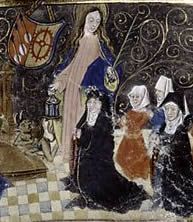
About two miles from her parents' castle was a little village named Moorsel, where was an oratory dedicated to the Saviour; thither went S. Gudula every morning at cock-crow. And now follows an incident similar to that related of S. Genoveva. One wild night, the Prince of the Power of the air extinguished the light which the servant girl carried before the Saint; and she, in profound darkness, on a barren heath, knew not how to find the path. Gudula knelt down and prayed to God, and the light rekindled in her lantern, so that she went on her way rejoicing.
At early mass, one frosty morning, the priest, as he turned towards the people, noticed Gudula wrapped in devotion, and her feet were exposed from beneath her gown; he saw with dismay that there were no soles to her shoes, so that though she appeared to be well shod, she in reality walked barefoot. The good priest, pained to think that her tender feet should be chilled by the icy stones of the pavement, as soon as he had unvested, took his warm mittens, and put them under the feet of the young countess; but she rejected them, much distressed that her act of penance had been discovered. On leaving the church, she met a poor woman, with her crippled dumb son on her back. The boy was bowed double, and was so deformed that he could not feed himself. The Saint looked at the poor mother and then at the unfortunate child, and actuated by a movement of compassion, she took the cripple into her arms, and besought God to pity him. Instantly the stiff joints became supple, and the back was straightened, and the child, feeling himself whole, cried out: "See, mother! see!" Gudula, abashed at the miracle, implored the poor woman to keep what had taken place a secret; but she, full of gratitude, published it abroad. When S. Gudula died, all the people followed her body to the grave. She was buried on the 8th January, 712, according to the general opinion, in a tomb before the door of the oratory of the village of Hamme, near Releghem. On the morrow, a poplar that stood at the foot of her grave was seen, in spite of the season, to have burst into green leaf. [36]
The body was afterwards transported to Nivelles, Mons, and Maubeuge, through fear of the Normans; and then was laid in the oratory of Moorsel, which she had loved so well in life. When Charlemagne [king of the Franks, crowned emperor in 800] came to Moorsel, he built there a monastery, richly endowed; but the convent disappeared in the times of anarchy which followed the death of the founder, and the body was finally taken from the robber baron who had appropriated to himself the lands of Moorsel, and brought to Brussels; where, since 1047, a magnificent church has eternalized the memory of the daughter of Witgere. The site of the chapel at Hamme is now a kiln.
Gudula; French , Gudule; Flemish , Goole.
Relics, at the church of SS. Michel et Gudule, Brussels.
Patroness of Brussels.
In art, represented with a lantern, and an angel kindling it.