Read Baring-Gould’s full account
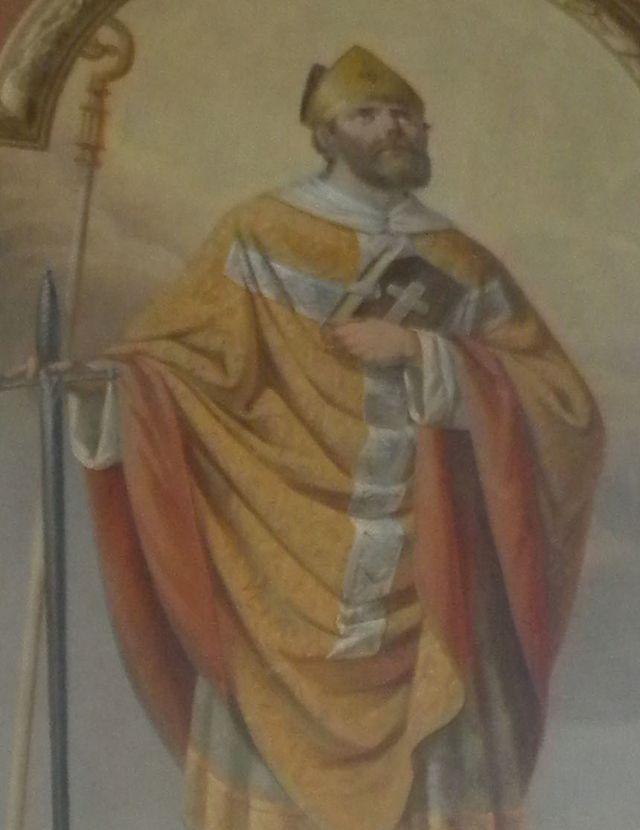
Baring-Gould’s sources: Gallican Martyrology. Vannes Breviary 5 those also of Saint-Polde-Leon and Quimper. Authority A Life given by Albert le Grand from the old legendaries of Landevenec, Vannes, and Quimper. Also a Life, written about 818 by an unknown author, inserted by Menardus in his Benedictine Martyrology, 1629, p. 365, &c.] GwenjEL or Gwen-ail, which means u the White Angel,” was the son of Runelin, a noble in Western Brittany, and his wife Levenez. They lived at Quimper. When he was a child, S. Winwaloe happening to pass that way, Gwenael ran to the abbot and knelt to him for his blessing. The holy man was pleased with the boy, and asked him if he would come to him in his monastery of Landevenec. The child readily replied that he would do so. “ You are too young now,” said the abbot; “ when come to years of discretion, you will find your way to me.” The boy was, however, so earnest in his desire to follow him at once, that Winwaloe asked his parents if they would allow him to follow his vocation, and when they consented, he took Gwenael with him to Landevenec. There he surprised all by his fervour. He adopted a system of mortification which was much in vogue among the Irish and Scottish saints. On winter nights he plunged himself up to the shoulders in the abbey fish-pond, and remained in the water till he had recited the seven penitential psalms. After having spent forty-three years in the abbey, S. Winwaloe died, and S. Gwenael was elected abbot in his room. Gwenael remained abbot for seven years and then resigned, that he might visit the saintly abbots of Britain. He took with him eleven monks, and crossed the sea to Cornwall and Wales, and spent four years in Britain. Then, warned by an angel to return to Brittany, he set sail and reached the islet of Groix, when the bells of the monastery rang of their own accord on his landing. He did not remain there long, but came to the mainland, and revisited Landevenec, but could not be persuaded to resume the abbatial authority for longer than three years. Then, desiring retirement, he went to an islet with two companions only, and built three cells in a wild and lonely spot. As there was a deficiency of water, he made the sign of the cross on the ground, plunged his staff into the soil, and a fountain gushed forth as he withdrew it As he was one day visiting a hermit named Caradoc on the mainland, a deer, pursued by the hunters of Hoel I., took refuge under his mantle. The huntsmen told their prince what had occurred, and he sent for the saint Gwenael went to him, and Hoel endeavoured to persuade him to remain with him. But Gwenael sought solitude, and no promises of favours could induce him to leave his loved isolation for the noise and distraction of a Court The chief having reluctantly permitted him to depart, he retired to Vannes, where he died shortly after. The date of his death must be fixed by that of S. VVinwaloe, which took place some sixteen years before that of S. Gwenael. S. Winwaloe died on Saturday, the 3rd of March, in the first week in Lent; a date which may be either 507, 518, or 529. Probably it was in one of the latter years. If so, Gwenael died in 534 or 545. It is impossible to say in which. Albert Le Grand fixes his death in 467, but his dates are not in the least to be relied on. Ix)bineau gives 580; the Paris Breviary 570; Dom Morice, in the notes appended to his History of Brittany, gives 518. He was aged seventy-five when he died. The body of S. Gwenael was taken to Vannes and buried in the cathedral, where his tomb is still shown, near an altar that bears his name. In 956, for fear of the Danes, his relics were transported to Paris. They were afterwards S. Winefred.
…taken to Corbeil. The cathedral of Vannes possesses a portion of the relics [the bodily remains of a saint, or objects they used, kept with honor]. Those at Corbeil were lost at the Revolution. A chapel dedicated to the saint exists at Ploneis near Quimper; another near Saint- Pol-de-L^on; a third near Landivizian, and a fourth half-way between Landemau and Plougastel, where there is an ancient statue of the saint