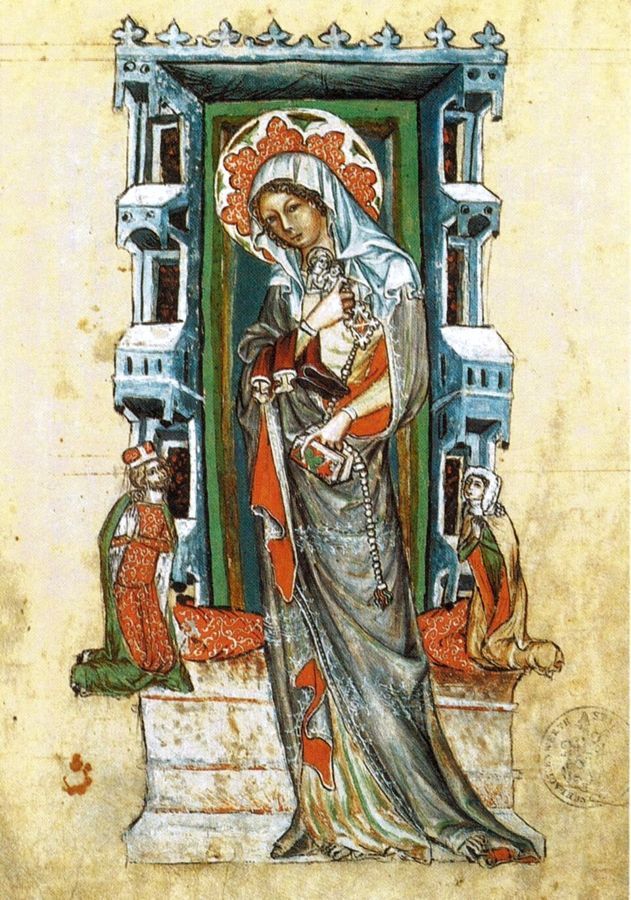
Baring-Gould’s sources: Roman and German Martyrologies. Authority: — A Life written shortly after her death.] Berthold XI., Count of Andechs, Marquis of Istria, Duke of Dalmatia and Meran, by his wife Agnes of Rochlitz had four sons, Egbert, Bishop of Bamberg; Berthold, Patriarch of Aquileja; Henry, who succeeded to the marquisate of Istria; Otho I. who inherited the duchy of Meran, and three daughters, S. Hedwig, the subject of this memoir; Agnes, who became the wife of Philip Augustus of France; and Gertrude, who married Andrew King of Hungary, to whom she bore S. Elizabeth.
S. Hedwig was born in 1174, educated at Kitzingen, and married at the age of twelve to Henry I., Duke of Silesia. She became the mother of three sons, Boleslas, Conrad, and Henry, and of three daughters, Agnes, Sophia, and Gertrude. Boleslas, Agnes, and Sophia died early. Gertrude became Abbess of Trebnitz.
Under the notion that it was pleasing to God that she should treat her husband with icy coldness, she avoided his society by every means in her power, never would speak with him privately, or associate with him, except to keep up appearances, in public. Whenever she condescended to address any words to him, it was to ask for his charity in behalf of some convent or pauper, or to give him moral advice, and then, not unless there were at least two witnesses present to testify, that no word of affection had passed between them. For thirty years she occupied a different part of the castle, so as to be wholly removed from his society, and •S'. Hedwig.
when possible she visited and lived at Trebnitz, in the convent, sleeping in the common dormitory with the sisters. S. Hedwig had been married to Henry in 1186. In 1201 his father Boleslas died, and Henry succeeded him. His reign was tranquil till 1212, when, having divided the duchies between his sons Henry and Conrad, the brothers engaged in fratricidal war. Henry I. was most attached to the younger son Conrad; he married him to the daughter of the Duke of Saxony, and gave him Lubek and the Lausitz. Henry, at Hedwig’s instigation, for he was her favourite, was given the Duchies of Silesia and Wratislaw. This Conrad resented; he took up arms and fell upon his brother’s duchy. Henry the Bearded, his father, and his mother Hedwig, remonstrated, but in vain. Henry, the son, collected an army to oppose Conrad, and met him at Studnitz, between Legnitz and the Golden Mountain, and routed him. Conrad fled from the field, and took refuge with his father at Glogau. A few days after he fell from his horse whilst hunting in the forest of Tomau, and broke his legs. He was carried to the abbey of Trebnitz, was nursed by his sister Gertrude, and died in her arms.
In 1227 another series of calamities came to trouble the duchies. Wladislas Odonicz, Duke of Greater Poland, had been restored to his paternal inheritance in 1 216 by Henry I., Duke of Silesia. Wladislas, assisted by Swentopolk, governor of Pomerania, now attacked his uncle Wladislas Laskonog (Bigshanks), Duke of Poland, who appealed for assistance to the Duke of Silesia. A meeting of princes was summoned for S. Martin [St. Martin of Tours (d. 397), soldier turned bishop]’s day, Nov. ii, to concert defence. Swentopolk and Wladislas Odonicz heard of the proposed assembly, and when it met at Gonzaw near Bromberg, surrounded it whilst the princes were resting after their consultation. Henry of Silesia was in his bath when the enemy burst in. He caught up a sword and defended himself but was wounded, and would have been killed, had not a faithful attendant interposed his body and received in his breast the fatal blow. Wladislas Laskonog effected his escape, but Henry was conveyed wounded to Wratislaw. Wladislas Laskonog was shortly after murdered. The vacant throne of Poland, and guardianship of the children of Laskonog, were claimed by Henry of Silesia and by Conrad, Duke of Mazovia, brother of the deceased Wladislas. Henry and Conrad flew to arms, and Conrad was defeated in two battles. Henry accordingly assumed the government of Poland and sent his son back into Silesia, disbanded his troops, and settled at Cracow. Conrad, however, had his spies watching, and a portion of the population in Cracow favouring his claims, he resolved on surprising Henry when least expecting danger. He surrounded the church of Spetikow with soldiers one morning early, whilst Henry was within hearing mass, and carried him off a prisoner to Masow. Henry, his son, at once gathered an army to attack Conrad and recover his father, but S. Hedwig went herself to Masow, interceded for her husband, and concluded an arrangement, whereby Henry renounced his claims on the duchies, and a marriage was agreed upon between Constance and Gertrude, her grand-daughters, and Casimir and Boleslas the sons of Conrad. Henry solemnly swore to abandon his claim and to keep peace with Conrad, and was released. In 1230, however, Gregory IX. sent Henry absolution from his vow; and Henry took advantage of it to resume his attempts on Poland. Under the influence of S. Hedwig, Henry lived almost like a monk; he was tonsured and bearded.1 But for all his piety and liberal donations to churches and convents, he did not escape excommunication. He had somehow infringed on the liberties of the bishopric of Gnesen, where1 “ Tonsuram rotundam et barbam fere bat non quidem Ion gam, sed moderate pilorum precisione decenter aptatum.” — Vit. S. Hedw. S. Hedwig.
fore William Cardinal of S. Sabina, apostolic legate [an official representative sent by the pope] in the north, cited him to appear before him, and answer the charges made against him, and when he refused to appear, pronounced his excommunication. Henry appealed to Rome, but died before the case was heard.
S. Hedwig bore his death with the utmost composure. As she had seen little of him, and scarcely spoken a word to him for thirty years, it cannot have troubled her much. So great was her humility that when she was in the convent church she kissed the seats of the stalls which had been pressed by the persons of the nuns, and the boards on which their feet had stood. This conduct was so gratifying to the crucifix over the high altar, that the figure of Christ detached its hands from the wood and blessed her— at least, so said a nun who watched her through a chink. Nor was her devotion limited to the choir stalls. She also kissed, “ most humbly and devoutly,” the stools by the bedsides of the nuns, and the steps by which they went up and down to their dormitories. The arrival of a beggar was followed by a rush at the chair or bench on which he had sat, that a kiss might be imprinted on the consecrated spot. The kissing of the chairs, performed daily, filled her, we are confidently informed, with “ admirable internal sweetness.” 1 Not satisfied with kissing the chair-bottoms, she also kissed the dirty towels with which the sisters wiped their hands after they had washed. If she found a specially dirty rag, in the ecstasy of her delight, she made the sign of a cross with it over her eyes and heart, as though it were a most precious relic. When tubbing-day came, she eagerly treasured the 1 " Sororibus quoque, bora corned end! congregates, in choro ad stall os singulis sororum sedibus oscula imprimebat Ascend ens ad dormitorium... scabellos positos ante lectos... deosculabatur humillime et devote... loca in quibus sederant egeni, dcosculando labiis tetigit.... Veniens ad pannos, quibus sorores, postquam se laverant, manus tergebant, ubi in ipsis pannis vidit majores sordes congregatas ab extersione jam dicta, ibi pm amoris dulcedine oscula fortius intulit,” &c [Oct. X7 water in which the sisters had washed their feet, and bathed with it not only her own face, but also her little grandsons, who would perhaps have preferred cleaner water, not knowing the holy efficacy of that in the foot-bath of the nuns. Crusts of bread which old monks could not eat, having lost their teeth, and which would have been given to the poor, were first “ venerated by her with abundant kisses.” Monks or priests visited the nunnery occasionally, and some of these crumbled their bread at table. S. Hedwig collected the crumbs and treasured them, “as if they were relics [the bodily remains of a saint, or objects they used, kept with honor] of saints.”
She was so composed in manner that nothing put her out. Her chamberlain lost three silver cups which belonged to her, and instead of scolding him, and dismissing him, she said, “ Go and look for them again, you have probably mislaid them.” When informed that her husband had been nearly killed in his bath, and was lying grievously wounded at Wratislaw, she merely remarked, “ I hope he will soon be all right again.” When he died, the only dry eyes in the nunnery were her own, and she rebuked the sisters for giving way about so trifling a loss.
Probably he would have been glad to be solaced on his deathbed with some of those kisses so lavishly bestowed on dirty linen and the seats of chairs, but they were denied him.
She never ate meat. On Sunday, Tuesday, and Thursday, she had fish and salad, on Monday and Friday only dry vegetables. On Wednesday and Saturday bread and water. But after a while the bishop of the diocese and her confessors interfered and ordered her beer on high festivals and Sundays. When she became very weak she had pulse cooked in beer. Her husband being informed that she drank only water, was vexed, and invading her part of the castle where she was dining privately, took up her cup and S. Hedwig, drank from it, and found it was not water at all, but excellent German wine. This, of course, was a miraculous conversion of the water Hedwig drank, into wine, to disarm the opposition of the duke. + She would not wear good clothes, indeed shecould scarcely endure to wear any at all. She would put on her absolutely nothing but one old gown, which fitted her so tight that all her bones were visible through it, and she would go thus “ half nude and barefoot,” whilst all the ladies of the court were dressed in splendid attire. Her shoes she carried under her arm, she wore no stockings, and only sat down and pulled them on when she saw “venerable persons” approaching. As soon as they had passed, she pulled them off again. Her husband was annoyed at her going about with naked feet, and she was afraid of his forbidding it. One day she met him in the road, she had her shoes under her arm. She was sure he would be angry. There was not an opportunity of putting them on, so she dropped those she carried behind her back, and her servants picked them up and secreted them. Fortunately her husband did not look at her feet The biographer of the saint, however, assures us that she was divinely supplied with a pair of shoes for the occasion. Her confessors, very sensibly, remonstrated with her, and the Abbot Gunther even made her a present of a pair of new shoes, and insisted on her wearing them. She took them with many thanks. A year after, the abbot met her, and saw that she was barefoot. He was indignant, and rebuked her sharply. “ Here are the shoes,” said she, producing them from under her arm, quite sound and unworn, “ I wear them always there.” Her feet, the enthusiastic biographer assures us, from going in the mud and dust, were very dirty, and rarely washed.
Naturally in winter she suffered frightfully from broken chilblains, “which signs of sanctity, although she tried carefully to conceal them, were often seen by her servants.” As she went on all fours in the snow to say her prayers, her hands also suffered from chaps and chilblains. Her son Henry remonstrated with her, but all in vain; she delighted in going in rags and starving herself. She would not sleep in her bed without planks laid over the mattress; once only, when she was ill, did her servants succeed in making her lie on a feather-bed; as soon as she was aware of it, she had it removed. She would hear as many masses as possible every day, and no priest could come to court whom she did not insist on celebrating before her. Whereupon a certain clerk made on the subject some lines: — “ Plenty of priests and plenty of masses ! A mass a day will never suffice; A duchess who saints of old surpasses, And zeal to melt a mountain of ice.”
One day the duchess sent her chaplain named Martin, afterwards canon of Wratislaw, to find her a priest to say a mass before her. He went away in ill humour, and finding a man with a bald patch on the top of his head, said to himself, “ This fellow will do,” and brought him before the duchess. But she began to question the man, and found out that he was not a priest at all. She dismissed him, and only gently rebuked her chaplain.
She used to be dreadfully frightened at thunderstorms, and the moment she heard the first rumble sent for a priest, and having knelt down, made him hold his hands over her head till the thunderstorm rolled away, believing that the lightning could not strike her through the consecrated palms. When the storm was over, she covered with kisses the hands which had shielded her.
She had a great number of images of saints and relics in her room, and when she went to church all her images and relics were carried with her, and arranged round her in a •S’. Hedwig.
circle as she prayed, to stimulate her devotions. If she saw two pieces of straw in the road across one another, she fell on her knees before them in adoration, kissed them, and removed them to a place where the sacred sign of the Cross could not be trampled on.
From continuous kneeling she got two hard lumps on her knees as big as eggs, “ But,” says her biographer, “ she hid this treasure, so that it was not known till after her death, except to a few of her attendants. With these pledges of love did the friend of God appear before her Beloved, adorned with these pearls, to wit, the hard lumps on her knees and the chaps in her hands and feet.” There was an old washerwoman who washed for her. S. Hedwig discovered that she was ignorant of the Lord’s Prayer. She therefore took her in hand. The old body had a bad memory, but the duchess went on patiently instructing her during ten weeks. She made the old woman sleep in the same room with her, that night and day they might go over the petitions together, and she might drive them into the washerwoman’s memory. A far more touching anecdote than any of the various details about dirty towels and chilblains.
There was a lazar-house full of squalid women, shunned by everyone. The duchess visited them diligently, supplied them with clothes, looked at their shoes, and, if they were in want of it, had them mended. She gave them meat and fruit, and flour. If one of her servants were ill, she sat with her, and talked to her as a sister. Women in childbirth she attended with the utmost tenderness, lending or giving them what they needed for the new-born children. She visited the prisoners, and interceded for those condemned to death. A priest lying under capital sentence was released at her prayer. She is said to have performed many miracles. A sister once got a fishbone in her throat at dinner, and ran out of the hall to cough it up, but not succeeding she ran into the room again; S. Hedwig made the sign of the cross over her throat, and she got the fishbone up into her mouth. A sister came in with a little hedgehog in her hand; she had drawn her sleeve over it to conceal it, intending to play a practical joke with it on the other nuns. But S. Hedwig was miraculously enlightened, and she said, “What have you got a hedgehog hidden in your sleeve for?” She also prophesied that one of her servants would come to beggary, and advised her to learn a trade. And what she foresaw came true. When she was dying, her daughter Gertrude asked if she would not like to be buried beside her husband. Hedwig refused; she had dissociated herself from him as much as possible in life, and she hoped they would remain divided in death. She died on October 15th, and was buried at Trebnitz. Twenty-four years after she was canonized by Clement IV. Her festival was fixed by Innocent XI. for The biographer says that no sooner was S. Hedwig dead than the nuns of Trebnitz, conscious that she would sooner or later be decreed a saint, “ running up with great desire and greediness of mind, carried off as many relics of her body as they could lay hands on. Some cut off* her fingernails, others her toe-nails, and some her hair.” The greater bones remain at Trebnitz, but some are scattered throughout Silesia. Her cup is preserved at Loreto. S. Hedwig is represented in art crowned, with veil, and her shoes in her hand.