St. Heimerad

A life spent serving ordinary people.

Read the essentials →
June 28 · Priest

St. Heimerad

St. Heimerad

A life spent serving ordinary people.

Traditional feast

June 28
1914 / pre-1969 calendar, per Baring-Gould (1897)

Current feast

Not verified yet

Represents

Priest

Early life

The book says little or nothing about early life. This is how the account begins.

Thin entry · the 1897 book gives only 0 words. We have not filled the gap with invented detail.

What they represent

How they teach us to live

Drawn from themes in the original account

Learn from the kind of life it was. A life spent serving ordinary people.

Keep their day. Remember them on June 28 with a short prayer, and ask for their help.

Read more

The full original · 0 words

Read Baring-Gould’s full account

Baring-Gould’s sources: German Martyrologies. Authority: — A life by Egbert, monk of Hersfeld, written by order of Abbot Hart wig, about 1070.] Heimerad was born in Swabia on the estate of a lady, whose serf he was. He was ordained priest, but could not leave her service till he had gained her consent, which was accorded him with some readiness when she had procured another chaplain, as his eccentric and dirty habits made him anything but acceptable to his noble mistress. He made a pilgrimage to Rome, and thence to Jerusalem. On his return to Germany, finding that “a prophet is without honour in his own country,” he did not return to his native village, but led a vagabond life in Germany. He settled himself for some time in the abbey of Hersfeld, in Hesse, and lived on the bounty of the monks. But the abbot, heartily tired of his presence and offensive habits, bade him become a monk, so as to be under rule, or depart Heimerad refused to join the Order, and was accordingly thrust out of the monastery. He did not go far, but VOL. vl 27 lounging against the stable door muttered to himself, “ This is pretty treatment for the emperor's brother to endure! Little know the monks what is my rank, when they turn me out of doors.” His words were overheard, and the abbot ordered him to be well beaten. After this Heimerad thought advisable to depart, and he presented himself before the Empress Cunegunda, who is numbered with the saints. She treated him as an impostor, and ordered him a sound whipping. Then he went to Bishop Meinwerk of Paderbom. “Who is that devil?” asked the holy bishop. “ Ha 1 the vagabond Heimerad. A hypocrite and a deceiver of the people. Let him be well cudgelled.” Heimerad then rambled off into Westphalia, and obtained a dilapidated church at Kirchberg. But when his wild ways, ghastly face and fiery eloquence attracted all the congregation from the parish church, and the offerings of the faithful poured into the lap of the wandering mad priest instead of into that of the incumbent, the latter would not endure it. and drove Heimerad away. He died at Hasungen, and received popular canonization, but has not been included in the Roman Martyrology. There can be little doubt that the man was deranged. S. PETER.

Feast days

Feast: June 28

Nine days · Free

Pray the novena
with us.

One short email a day for nine days. The day's prayer, a line from St. Heimerad's story, and a nudge to keep going.

Also on June 28
L

St. Luperculus

June 28 · Bishop, Martyr
P

St. Pappian

June 28 · Martyr
St. Mary, the Mother of Mark

St. Mary

June 28 · Feast
← All 1726 saints in the library
Sources & notes

Feast-day sources

Sources

Credits

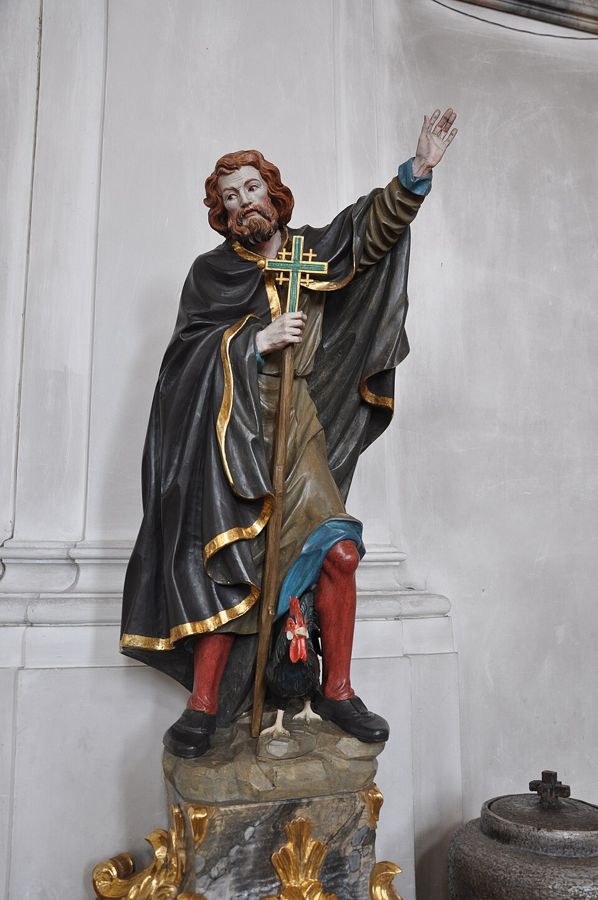
Image: Messkirch Pfarrkirche Figur Heimrad 02.jpg · Photo: Andreas Praefcke · CC BY 3.0, via Wikimedia Commons

From Sabine Baring-Gould, The Lives of the Saints, new edition in 16 vols. (London: John C. Nimmo, 1897–98); text from the Internet Archive scan (OCR, lightly cleaned; errors possible). Public domain.

Image: Photo: Andreas Praefcke, Wikimedia Commons (CC BY 3.0)

From Sabine Baring-Gould, The Lives of the Saints, new edition in 16 vols. (London: John C. Nimmo, 1897–98); text from the Internet Archive scan (OCR, lightly cleaned; errors possible). Public domain in the United States. Reproduced unedited, except for short bracketed notes in grey that we added to explain names and terms (“S.” is the old abbreviation for Saint). Some history and judgments reflect 19th-century scholarship.