St. Heribert, Archbishop of Cologne

Heribert was born at Worms around 970, the son of Duke Hugo of Worms.

Read the essentials →
March 16 · —

St. Heribert

St. Heribert, Archbishop of Cologne

Heribert was born at Worms around 970, the son of Duke Hugo of Worms.

Traditional feast

March 16
1914 / pre-1969 calendar, per Baring-Gould (1897)

Current feast

March 16 (also listed: August 30)
Secondary source · Wikipedia

Represents

Feast

Their story

Adapted in modern English from the Catholic Encyclopedia (1913) · original text below

Heribert was born at Worms around 970, the son of Duke Hugo of Worms. After studying at the cathedral school of Worms and spending some time at the monastery of Gorze, he became provost of Worms cathedral. He was ordained priest in 994, and in the same year Otto III made him chancellor for Italy, and four years later for Germany as well. He was the young emperor's most influential adviser.

In 999, while he was in Italy, he was elected Archbishop of Cologne. Pope Sylvester II gave him the pallium at Benevento, and he was consecrated at Cologne that Christmas. In 1002 he was at the deathbed of Otto III at Paterno. On the way back to Germany with the emperor's body and the imperial insignia, he was held captive for a time by the future Henry II, whose claim to the throne he had at first opposed. Once Henry was elected, Heribert recognized him and served him faithfully, but he never won the king's full trust until 1021, when Henry saw his mistake and humbly asked the archbishop's pardon.

Heribert founded and richly endowed the Benedictine (monks following the Rule of St. Benedict) abbey of Deutz, where he is buried. He died at Cologne on 16 March 1021. He was already honoured as a saint in his lifetime and was canonized (officially declared a saint by the pope) by Gregory VII.

Early life

Selected sentences from the original account, unaltered.

Heribert was born at Worms. His father was a gentleman of rank. His mother had been carried off into captivity by the Huns, and had been sold to an honest and good man, who restored her to her parents.

What they represent

How they teach us to live

Drawn from themes in the original account

Keep their day. Remember them on March 16 with a short prayer, and ask for their help.

From the Catholic Encyclopedia

1913 · 307 words

Archbishop of Cologne; born at Worms, c. 970; died at Cologne, 16 March, 1021. His father was Duke Hugo of Worms. After receiving his education at the cathedral school of Worms, he spent some time as guest at the monastery of Gorze, after which he became provost at the cathedral of Worms. In 994 he was ordained priest; in the same year King Otto III appointed him chancellor for Italy and four years later also for Germany, a position which he held until the death of Otto III on 23 January, 1002. As chancellor he was the most influential adviser of Otto III, whom he accompanied to Rome in 906 and again in 997. He was still in Italy when, in 999, he was elected Archbishop of Cologne. At Benevento he received ecclesiastical investiture and the pallium [a woolen band the pope gives to archbishops as a sign of their authority] from Pope Sylvester II on 9 July, 999, and on the following Christmas Day he was consecrated at Cologne. In 1002 he was present at the death-bed of the youthful emperor at Paterno. While returning to Germany with the emperor's remains and the imperial insignia, he was held captive for some time by the future King Henry II, whose candidacy he first opposed. As soon as Henry II was elected king, on 7 June, 1002, Heribert acknowledged him as such, accompanied him to Rome in 1004, mediated between him and the House of Luxemburg, and served him faithfully in many other wys; but he never won his entire confidence until the year 1021, when the king saw his mistake and humbly begged pardon on the archbishop. Heribert founded and richly endowed the Benedictine [monks following the Rule of St. Benedict] monastery and church of Deutz, where he lies buried. He was already honoured as a saint during his lifetime. Between 1073 and 1075 he was canonized by Pope Gregory VII. His feast is celebrated on 16 March.
Read more

The full original · 328 words

Read Baring-Gould’s full account

Baring-Gould’s sources: German Martyrologies. At Cologne the festival of his translation is observed on August 30th. Authority:—A Life, by Lambert of Deutz, written twenty years after the death of Heribert.

Heribert was born at Worms. His father was a gentleman of rank. His mother had been carried off into captivity by the Huns [nomadic invaders from Central Asia, led in the 5th century by Attila], and had been sold to an honest and good man, who restored her to her parents. She was grand-daughter of Reginbald, count of Swabia. Heribert was educated in the abbey of Gorze, in Lorraine, in the diocese of Metz. His father having recalled him to Worms, the archbishop Hildebald was so pleased with the young man, that he made him dean of his cathedral, and destined him to become his successor, but his death before Heribert had sufficiently established his reputation prevented the fulfilment of this design. Some years after, Otho III., who had not as yet received the imperial crown, having been informed of the merit of Heribert, made him his chancellor, and perceiving his great virtue, obtained his ordination. Shortly after, the archdiocese of Cologne became vacant, and this gave rise to party contests, productive of schism in that Church. The contest was brought to a conclusion by an almost unanimous election of the chancellor Heribert. He received notice of his having been chosen, with great regret, and on his induction, on Christmas-eve, walked barefoot to the cathedral. His reign was a true blessing to the diocese, through his wise regulations for the maintenance of discipline among the clergy, and for the systematic relief of the necessitious. He built and endowed the abbey of Deutz, on the opposite bank of the Rhine to Cologne; he rebuilt the church of the Apostles, at Cologne, and the chapel of S. Stephen. In a time of great drought, when the country was suffering great distress, and the cattle of the poor were perishing, he went in procession to the church of S. Severinus, and kneeling before the altar, bowed his head on his hands, and weeping for the misfortunes of his people, did not raise his head till a thunderstorm broke over the church.

March 17.

Feast days

Feast: March 16

Nine days · Free

Pray the novena
with us.

One short email a day for nine days. The day's prayer, a line from St. Heribert's story, and a nudge to keep going.

Also on March 16
H

Sts. Hilary

March 16 · Bishop, Martyr, Deacon, Martyrs
St. Julian of Anazarbus

St. Julian of Anazarbus

March 16 · Martyr
P

St. Papas

March 16 · Martyr
← All 1726 saints in the library
Sources & notes

Feast-day sources

Story sources

Sources

Credits

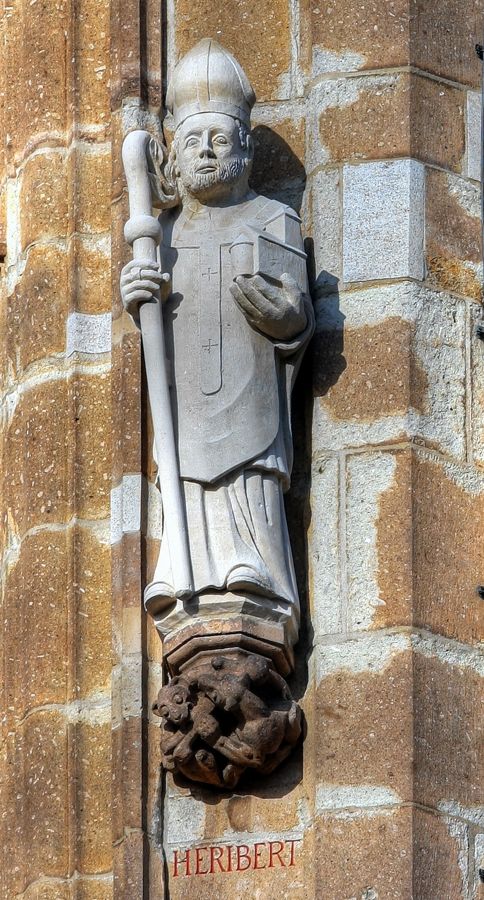
Image: Rathausturm Köln - Heribert (detail).jpg · Raimond Spekking · CC BY-SA 4.0, via Wikimedia Commons

From Sabine Baring-Gould, The Lives of the Saints, new edition in 16 vols. (London: John C. Nimmo, 1897), digitized text from Project Gutenberg. Public domain.

Image: Raimond Spekking, Wikimedia Commons (CC BY-SA 4.0)

From “Catholic Encyclopedia (1913)/St. Heribert,” The Catholic Encyclopedia (New York: Robert Appleton Company, 1907–1914), via Wikisource. Public domain. Matched by name and feast date; text unedited except for our bracketed notes in grey.

From Sabine Baring-Gould, The Lives of the Saints, new edition in 16 vols. (London: John C. Nimmo, 1897), digitized text from Project Gutenberg. Public domain in the United States. Reproduced unedited, except for short bracketed notes in grey that we added to explain names and terms (“S.” is the old abbreviation for Saint). Some history and judgments reflect 19th-century scholarship.