St. Hermione

Whether Hermione was a virgin and a martyr is doubtful.

Read the essentials →
September 4 · —

St. Hermione

St. Hermione

Whether Hermione was a virgin and a martyr is doubtful.

Traditional feast

September 4
1914 / pre-1969 calendar, per Baring-Gould (1897)

Current feast

September 4 (also listed: April 14)
Secondary source · Wikipedia

Represents

Feast

Early life

The book says little or nothing about early life. This is how the account begins.

Thin entry · the 1897 book gives only 55 words. We have not filled the gap with invented detail.

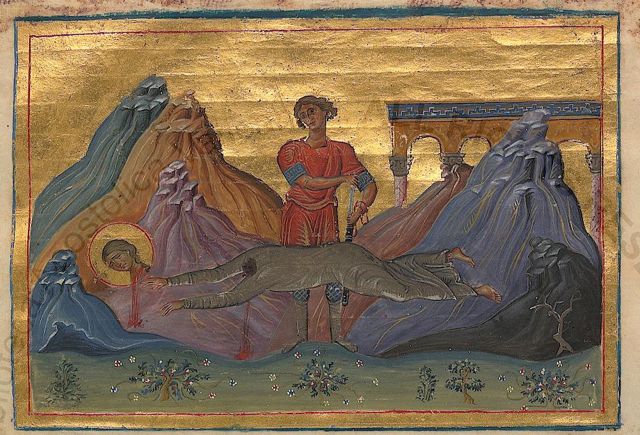
Whether Hermione was a virgin and a martyr is doubtful. Clemens Alexandrinus tells us in his Stromata that “ Philip married his daughters to husbands/' According to the longer Mensea, as Hermione was being led to execution she prayed God to release her, then she knelt down and gave up her soul with a sigh.

What they represent

How they teach us to live

Drawn from themes in the original account

Pray a little every day. Prayer runs all through this account.

Keep their day. Remember them on September 4 with a short prayer, and ask for their help.

Read more

The full original · 55 words

Read Baring-Gould’s full account

Baring-Gould’s sources: Greek Mencea and Menologies. Authorities: — Mention in the Menologies and the Greek Acts, which however contain much fable.] AINT HERMIONE was one of the daughters of S. Philip, but whether of the apostle or of the deacon is not clear. The Menology published by Sirletus says of her, “ She was one of the four daughters of Philip who baptized the eunuch of Candace the Queen. This S. Hermione after having witnessed a good confession with courageous mind under Trajan the emperor, enduring torments, having wrought many miracles, migrated to the Lord.” But the menology of the Emperor Basil does not altogether agree with this. It says, “ On this daughter of S. Philip the Apostle. She flourished in the time of Trajan. She had a sister named Eutyches, and with her she went to Ephesus to venerate John the Divine. ^ut 1 York, Sarum, Hereford, and Durham Kalendars. they found him not, he had been translated. And Trajan came to Ephesus on his Persian expedition, and heard the name of Hermoine celebrated, as that of a prophetess. She was therefore seized to be forced to renounce Christ, and was smitten on the face. Then the Lord appeared to her and encouraged her to bear her torments bravely. But because she prophesied that Trajan should conquer the Persians, he released her. Hadrian, the successor of Trajan, had her again taken, and when she would not sacrifice to idols, ordered her to be decapitated. The executioners’ arms became rigid, and they believed and were also put to death.1' It is clear that the Emperor Basil confounded S. Philip the Apostle with S. Philip the deacon. Little or no reliance can be placed on his account.

Whether Hermione was a virgin and a martyr is doubtful. Clemens Alexandrinus tells us in his Stromata that “ Philip married his daughters to husbands/' According to the longer Mensea, as Hermione was being led to execution she prayed God to release her, then she knelt down and gave up her soul with a sigh.

Feast days

Feast: September 4

Nine days · Free

Pray the novena
with us.

One short email a day for nine days. The day's prayer, a line from St. Hermione's story, and a nudge to keep going.

Also on September 4
M

St. Marcellus

September 4 · Martyr
M

St. Monessa

September 4 · Virgin
St. Grata

St. Grata

September 4 · Virgin
← All 1726 saints in the library
Sources & notes

Feast-day sources

Sources

Credits

Image: Menologion of Basil 011.jpg · Authors of Menologion of Basil II (circa 985 AC, Constantinople), Byzantine manuscript illuminators[1]: Pantoleon with G · Public domain, via Wikimedia Commons

From Sabine Baring-Gould, The Lives of the Saints, new edition in 16 vols. (London: John C. Nimmo, 1897–98); text from the Internet Archive scan (OCR, lightly cleaned; errors possible). Public domain.

Image: Authors of Menologion of Basil II (circa 985 AC, Constantinople), Byzantine manuscript illuminators[1]: Pantoleon with G, Wikimedia Commons (Public domain)

From Sabine Baring-Gould, The Lives of the Saints, new edition in 16 vols. (London: John C. Nimmo, 1897–98); text from the Internet Archive scan (OCR, lightly cleaned; errors possible). Public domain in the United States. Reproduced unedited, except for short bracketed notes in grey that we added to explain names and terms (“S.” is the old abbreviation for Saint). Some history and judgments reflect 19th-century scholarship.