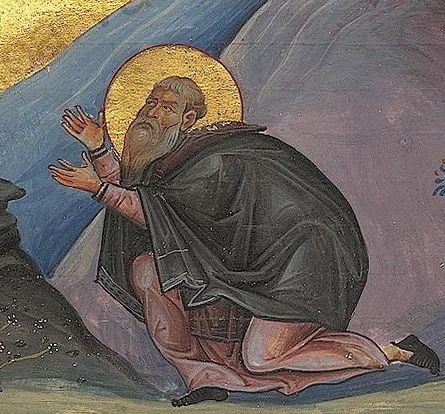
Baring-Gould’s sources: Roman Martyrology. York Kalendar, not Saram or Hereford Kalendars. Melchite Syrian Kalendar. Coptic Kalendar. Constantinopolitan Kalendar. Menology of the Emperor Basil, Menaea. Russian, and other Sclavonic Kalendars. The Martyrologium Parvum, Ado, Hrabanus, Usuardus, &c. Authority: — A Life by S. Jerome, in Latin; this was translated into Greek by Sophronius in a.d. 390. Sozomen also collected information concerning him. S. Epiphanius also wrote his life, having much associated with S. Hilarion; 1 but the extant life of S. Hilarion attributed to S. Epiphanius is fabulous, full of chronological errors, and is the work of a later hand, or else the original has been so interpolated and altered as to be worthless. The following is a condensation from the Life of the saint by S. Jerome, from the translation by Canon Kingsley.8] S. Jerome gives the following account of Hilarion: — “ Hilarion was bom in the village of Thabatha, which lies about five miles to the south of Gaza, in Palestine. He had parents given to the worship of idols, and blossomed (as the ’ “ Epiphanius. bishop of Salamina, in Cyprus, who had much intercourse with Hilarion, has written his praise in a short epistle, which is commonly read; yet it is one thing to praise the dead in general phrases, another to relate his special virtues." These are the words of S. Jerome, and they do not apply to what passes as the Life by S. Epiphanius.
8 “The Hermits." Macmillan, 187X. GoogI Oct. ax.] S. HUarion. saying is) a rose among the thorns. Sent by them to Alexandria, he was entrusted to a grammarian, and there, so far as his years allowed, gave proof of great intellect and good morals. He was soon dear to all, and skilled in the art of speaking. And, what is more than all, he believed in the Lord Jesus, and delighted neither in the madness of the circus, in the blood of the arena, nor in the luxury of the theatre; but all his heart was in the congregation of the Church.
“ But hearing the then famous name of Antony, which was carried throughout all Egypt, he was fired with a longing to visit him, and went to the desert. As soon as he saw him, he changed his dress, and stayed with him about two months, watching the order of his life and the purity of his manner; how frequent he was in prayers, how humble in receiving brethren, severe in reproving them, eager in exhorting them; and how no infirmity ever broke through his continence, and the coarseness of his food. But, unable to bear longer the crowd which assembled round Antony, for various diseases and attacks of devils, he said that it was not consistent to endure in the desert the crowds of cities, but that he must rather begin where Antony had begun. Antony, as a valiant man, was receiving the reward of victory: he had not yet begun to serve as a soldier. He returned, therefore, with certain monks to his own country; and, finding his parents dead, gave away part of his substance to the brethren, part to the poor, and kept nothing at all for himself, fearing what is told in the Acts of the Apostles, the example or punishment, of Ananias and Sapphira; and especially mindful of the Lord's saying, * He that leaveth not all that he hath, he cannot be My disciple.* “ He was then fifteen years old. So, naked, but armed in Christ, he entered the desert, which, seven miles from Maiuma, the port of Gaza, turns away to the left of those who go along the shore towards Egypt. And though the place was bloodstained by robbers, and his relations and friends warned him of the imminent danger, he despised death, in order to escape death. All wondered at his spirit, wondered at his youth. Save that a certain fire of the bosom and spark of faith glittered in his eyes, his cheeks were smooth, his body delicate and thin, unable to bear any injury, and liable to be overcome by even a light chill or heat.
“ So, covering his limbs only with a sackcloth, and having a cloak of skin, which the blessed Antony had given him at starting, and a rustic cloak, between the sea and the swamp, he enjoyed the vast and terrible solitude, feeding on only fifteen figs after the setting of the sun; and because the region was, as has been said above, of ill-repute from robberies, no man had ever stayed before in that place. The devil, seeing what he was doing, and whither he had gone, was tormented. And so he, who of old boasted, saying, heaven, and shall be like unto the Most High,’ now saw that he had been conquered by a boy, and trampled under foot by him, ere, on account of his youth, he could commit sin. He therefore began to tempt his senses; but he, enraged with himself, and beating his breast with his fist, as if he could drive out thoughts by blows, * I will force thee, mine ass/ said he, 4 not to kick; and feed thee with straw, not barley. I will wear thee out with hunger and thirst; I will burden thee with heavy loads; I will hunt thee through heat and cold, till thou thinkest more of food than of play.’ He therefore sustained his fainting spirit with the juice of herbs and a few figs, after each three or four days, praying frequently, and singing psalms, and digging the ground with a mattock, to double the labour of fasting by that of work. At the same time, by weaving baskets of rushes, he imitated the discipline of the Egyptian monks and the apostle's Oct. ax 0 S. Hilarion.
saying, i He that will not work, neither let him eat/ till he was so attenuated, and his body so exhausted, that it scarce clung to his bones.
“ One night he began to hear the crying1 of infants, the bleating of sheep, the wailing of women, the roaring of lions, the murmur of an army, and utterly portentous and barbarous voices; so that he shrank frightened by the sound ere he saw aught. He understood these to be the insults of devils; and, falling on his knees, he signed the cross of Christ on his forehead, and armed with that helmet and girt with the breastplate of faith, he fought more valiantly, as he lay, longing somehow to see what he shuddered to hear, and looking round with anxious eyes: when, without warning, by the bright moonshine, he saw a chariot with fiery horses rushing upon him. But when he had called on Jesus, the earth opened suddenly, and the whole pomp was swallowed up before his eyes. Then said he, 1 The horse and his rider he hath drowned in the sea,’ and, 1 Some boast themselves in chariots, and some in horses: but we in the name of the Lord our God.’ Many were his temptations, and various, by day and night, the snares of the devils. If we were to tell them all, they would make the volume too long. How often did women appear to him; how often plenteous banquets when he was hungry. Sometimes, as he prayed, a howling wolf ran past him, or a barking fox; or as he sang, a fight of gladiators made a show for him, and one of them, as if slain, falling at his feet, prayed for sepulture. He prayed once, with his head bowed to the ground, and, as is the nature of man, his mind wandered from his prayer, and thought of I know not what, when a mocking rider leaped on his back, and spurring his sides and whipping his neck, ‘ Come/ he cries, ‘ come, run ! why do you sleep ?' and laughing loudly 1 These sounds, like those which S. Guthlac heard in the English fens, are plainly those of wild fowl.
over him, asked him if he were tired, or would have a feed of barley. “ So, from his sixteenth to his twentieth year, he was sheltered from the heat and rain in a tiny cabin, which he had woven of rush and sedge. Afterwards he built a little cell, which remains to this day, four feet wide and five feet high — that is, lower than his own stature — and somewhat longer than his small body needed, so that you would believe it to be a tomb rather than a dwelling. He cut his hair only once a year, on Easter-day, and lay till his death on the bare ground and a layer of rushes, never washing the sack in which he was clothed, and saying that it was superfluous to seek for cleanliness in hair-cloth. Nor did he change his tunic till the first was utterly in rags. He knew the Scriptures by heart, and recited them after his prayers and psalms, as if God were present. And, because it would take up too much time to tell his great deeds one by one, I will give a short account of them.
“ By his example innumerable monasteries arose throughout all Palestine, and all monks came eagerly to him.... But what a care he had not to pass by any brother, however humble or however poor, may be shown by this; that once going into the Desert of Kadesh to visit one of his disciples, he came, with an infinite crowd of monks, to Elusa, on the very day, as it chanced, on which a yearly solemnity had gathered all the people of the town to the Temple of Venus; for they honour her on account of the morning star, to the worship of which the nation of the Saracens [medieval Christian name for Arab and Muslim peoples] is devoted. The town itself too is said to be in great part semi-barbarous, on account of its remote situation. Hearing, then, that the holy Hilarion was passing by — for he had often cured Saracens possessed with daemons — they came out to meet him in crowds, with their wives and children, bowing their necks, and crying in the Syrian tongue, * Barech ! * that is, S. Hilarion.
treating them to worship God rather than stones, and wept abundantly, looking up to heaven, and promising them that, if they would believe in Christ, he would come oftener to them. Wonderful was the grace of the Lord. They would not let him depart till he had laid the foundations of a future church, and their priest, crowned as he was, had been consecrated with the sign of Christ.
“ He was now sixty-three years old. He saw about him a great monastery, a multitude of brethren, and crowds who came to be healed of diseases and unclean spirits, filling the solitude around; but he wept daily, and remembered with incredible regret his ancient life. * I have returned to the world/ he said, ‘ and received my reward in this life. All Palestine and the neighbouring provinces think me to be worth somewhat; while I possess a farm and household goods, under the pretext of the brethren's advantage.' On which the brethren, and especially Hesychius, who bore him a wondrous love, watched him narrowly. “ When he had lived thus sadly for two years, Aristaeneta, the prefect’s wife, came to him, wishing him to go with her to Antony. * I would go/ he said, weeping, * if I were not held in the prison of this monastery, and if it were of any use. For two days since, the whole world was robbed of such a father.’ She believed him, and stopped. And Antony’s death was confirmed a few days after. Others may wonder at the signs and portents which he did, at his incredible abstinence, his silence, his miracles; I am astonished at nothing so much as that he was able to trample under foot that glory and honour.
“ Bishops and clergy, monks and Christian matrons (a great temptation), people of the common sort, great men, too, and judges crowded to him, to receive from him blessed bread or oiL But he was thinking of nothing but the desert, till one day he determined to set out, and taking an ass (for he was so shrunk with fasting that he could hardly walk), he tried to go his way. The news got wind; the desolation and destruction of Palestine would ensue; ten thousand souls, men and women, tried to stop his way; but he would not hear them. Smiting on the ground with his staff, he said, * I will not make my God a liar. I cannot bear to see churches ruined, the altars of Christ trampled down, the blood of my sons spilt.’ All who heard thought that some secret revelation had been made to him; but yet they would not let him go. Whereon he would neither eat nor drink, and for seven days he persevered fasting, till he had his wish, and set out for Bethulia, with forty monks, who could march without food till sundown. On the fifth day he came to Pelusium, then to the camp Thebatrum, to see Dracontius, and then to Babylon to see Philo. These two were bishops and confessors exiled by Constantius, who favoured the Arian [followers of Arius, who taught that the Son is a created being, not fully God] heresy. Then, he came to Aphroditon, where he met Barsanes the deacon, who used to carry water to Antony on dromedaries, and heard from him that the anniversary of Antony’s death was near, and would be celebrated by a vigil at his tomb. Then, through a vast and horrible wilderness, he went for three days to a very high mountain, and found there two monks, Isaac and Pelusianus, of whom Isaac had been Antony’s interpreter.
“ A high and rocky hill it was, with fountains gushing out at its foot. Some of them the sand sucked up; some formed a little rill, with palms without number on its banks. There you might have seen the old man wandering to and fro with Antony’s disciples. ‘Here,’ they said, ‘ he used to sing, here to pray, here to work, here to sit when tired. These vines, these shrubs, he planted himself; that plot he laid out with his own hands; this pond to water the garden he made with heavy toil; that hoe he kept Octax.] S. Hilarion.
for many years/ Hilarion lay on his bed, and kissed the couch, as if it were still warm. Antony’s cell was only large enough to let a man lie down in it; and on the mountain top, reached by a difficult and winding stair, were two other cells of the same size, cut in the stony rock, to which he used to retire from the visitors and disciples, when they came to the garden. * You see/ said Isaac, 1 this orchard, with shrubs and vegetables. Three years since a troop of wild asses laid it waste. He bade one of their leaders stop; and beat it with his staff. “ Why do you eat,” he asked it, “what you did not sow?” And after that the asses, though they came to drink the waters, never touched his plants/ “ Then Hilarion asked them to show him Antony’s grave. They led him apart; but whether they showed it to him, no man knows. They hid it, they said, by Antony’s command, lest one Pergamius, who was the richest man of those parts, should take the corpse to his villa, and build a chapel over it.
“ Then he went back to Aphroditon, and with only two brothers, dwelt in the desert, in such abstinence and silence that (so he said) he then first began to serve Christ And it was then three years since the heavens had been shut, and the earth dried up: so that they said commonly, the very elements mourned the death of Antony. But Hilarion’s fame spread to them; and a great multitude, brown and shrunken with famine, cried to him for rain, as to the blessed Antony’s successor. He saw them, and grieved over them; and lifting up his hand to heaven, obtained rain at once. But the thirsty and sandy land, as soon as it was watered by showers, sent forth such a crowd of serpents and venomous animals that people without number were stung, and would have died, had they not run together to Hilarion. With oil blessed by him, the husbandmen and shepherds touched their wounds, and all were surely healed. “ But when he saw that he was marvellously honoured, he went to Alexandria, meaning to cross the desert to the further oasis. And because since he was a monk he had never stayed in a city, he turned aside to some brethren known to him in the Brucheion,1 not far from Alexandria. They received him with joy; but, when night came on, they suddenly heard him bid his disciples saddle the ass. In vain they entreated, and threw themselves across the threshold. His only answer was, that he was hastening away, lest he should bring them into trouble; they would soon know that he had not departed without good reason. The next day, men of Gaza came with the prefect’s lictors, burst into the monastery, and when they found him not — ‘ Is it not true,’ they said, ‘ what we heard ? He is a sorcerer, and knows the future.’ For the citizens of Gaza, after Hilarion was gone, and Julian had succeeded to the empire, had destroyed his monastery, and begged from the emperor the death of Hilarion and Hesychius. So letters had been sent forth, to seek them throughout the world.
“So Hilarion went by the pathless wilderness into the Oasis;8 and after a year, more or less — because his fame had gone before him even there, and he could not lie hid in the East — he was minded to sail away to lonely islands, that the sea at least might hide what the land would not “ But just then Hadrian, his disciple, came from Palestine, telling him that Julian was slain, and that a Christian emperor was reigning; so that he ought to return to the relics [the bodily remains of a saint, or objects they used, kept with honor] of his monastery. But he abhorred the thought; and, hiring a camel, went over the vast desert to Paraetonia, 1 The Brucheion, with its palaces and museum, the residence of the kings and philosophers of Egypt, had been destroyed in the days of Claudius and Valerian [Roman emperor 253–260, who persecuted bishops and clergy], during the senseless civil wars which devastated Alexandria for twelve years; and monks had probably taken up their abode in the ruins. It was in this quarter, at the beginning of the next century, that Hypatia was murdered by the monks. west of the Nile.
Oct 9X.] S. Hilarion. a sea town of Libya. Then the wretched Hadrian, wishing to go back to Palestine and get himself glory under his master’s name, packed up all that the brethren had sent by him to his master, and went secretly away. But — as a terror to those who despise their masters — he shortly after died of jaundice.
“ Then, with Zananas alone, Hilarion went on board ship to sail for Sicily. And when almost in the middle of Adria,1 he was going to sell the Gospels which he had written out with his own hand when young, to pay his fare withal; then the captain’s son was possessed with a devil, and cried out, ‘ Hilarion, servant of God, why can we not be safe from thee even at sea? Give me a little respite; till I come to shore, lest, if I be cast out here, I fall headlong into the abyss.' Then said he, * If my God lets thee stay, stay. But if He cast thee out, why dost thou lay the blame on me, a sinner and a beggar?* Then he made the captain and the crew promise not to betray him; and the devil was cast out. But the captain would take no fare when he saw that they had nought but those Gospels and the clothes on their backs. And so Hilarion came to Pachynum, a cape of Sicily, 3 and fled twenty miles inland into a deserted farm; and there every day gathered a bundle of firewood, and put it on Zananas' back, who took it to the town, and bought a little bread thereby.
“ But it happened, according to that which is written, ‘ A city set on an hill cannot be hid,' one Scutarius was tormented by a devil in the basilica of S. Peter at Rome; and the unclean spirit cried out in him, ‘ A few days since Hilarion, the servant of Christ, landed in Sicily, and no man knows him, and he thinks himself hid. I will go and betray 1 Jerome (who sailed that sea several times) uses the word here, as it is perhaps used in Acts xxvii. 27, for the sea about Malta, "driven up and down in Adria.” [Oct. ax.
him.* And forthwith he took ship with his slaves, and came to Pachynum, and, by the leading of the devil, threw himself down before the old man's hut, and was cured. “ The frequency of his signs in Sicily drew to him sick people and religious men in multitudes; and one of the chief men was cured of dropsy the same day that he came, and offered Hilarion boundless gifts; but he obeyed the Saviour's saying, * Freely ye have received; freely give.* “ While this was happening in Sicily, Hesychius, his disciple, was seeking the old man through the world, searching the shores, penetrating the desert, and only certain that, wherever he was, he could not long be hid. So, after three years were past, he heard at Methone1 from a Jew who was selling old clothes, that a prophet of the Christians had appeared in Sicily, working such wonders that he was thought to be one of the old saints. But he could give no description of him, having only heard common report. He sailed for Pachynum, and there, in a cottage on the shore, heard of Hilarion's fame — that which most surprised all being that, after so many signs and miracles, he had not accepted even a bit of bread from any man.
" So, not to make the story too long,” as says St Jerome, " Hesychius fell at his master's knees, and watered his feet with tears, till at last he raised him up. But two or three days after he heard from Zananas, how the old man could dwell no longer in these regions, but was minded to go to some barbarous nation, where both his name and his speech should be unknown. So he took him to Epidaurus,2 a city of Dalmatia, where he lay a few days in a little farm, and yet could not be hid; for a dragon of wondrous size — one of those which, in the country speech, they call boas, because they are so huge that they can swallow an ox— laid waste 1 In the Morea, near the modern Navarino. 3 At the mouth of the Bay of Cattaro.
Oct. ax.] S. Hilarion. the province, and devoured not only herds and flocks, but husbandmen and shepherds, which he drew to him by the force of his breath.1 Hilarion commanded a pile of wood to be prepared, and having prayed to Christ, and called the beast forth, commanded him to ascend the pile, and having put fire under, burnt him before all the people. Then fretting over what he should do, or whither he should turn, he went alone over the world in imagination, and mourned that, when his tongue was silent, his miracles still spoke. “ In those days, at the earthquake over the whole world, which befell after Julian’s death, the sea broke its bounds; and, as if God was threatening another flood, or all was returning to the primeval chaos, ships were carried up steep rocks and hung there. But when the Epidauritans saw roaring waves and mountains of water borne towards the shore, fearing lest the town should be utterly overthrown, they went out to the old man, and, as if they were leading him out to battle, stationed him on the shore. And when he had marked three signs of the Cross upon the sand, and stretched out his hands against the waves, it is past belief to what a height the sea swelled, and stood up before him, and then, raging long, as if indignant at the barrier, fell back, little by little, into itself.
“ All Epidaurus, and all that region, talk of this to this day; and mothers teach it their children, that they may hand it down to posterity. Truly that which was said to the apostles, * If ye believe, ye shall say to this mountain, Be removed, and cast into the sea; and it shall be done/ can 1 This story— whatever belief we may give to its details — is one of many which make it tolerably certain that a large snake (Python) still lingered in Eastern Europe. Huge tame snakes were kept as sacred by the Macedonian women; and one of them (according to Lucian) Peregrinus Proteus, the Cagliostro of his time, fitted with a linen mask, and made it personate the god vEsculapius. In the “ Historia Lausiaca,” cap. liL is an account by an eye-witness of a large snake in the Thebaid [the desert region of Upper (southern) Egypt], whose track was “as if a beam had been dragged along the sand." It terrifies the Syrian monks; but the Egyptian monk sets to work to kill it, saying that he had seen much larger — even up to fifteen cubits.
VOL. XII. II [Oct. ax. be fulfilled even to the letter, if we have the faith of the apostles, and such as the Lord commanded them to have. For which is more strange, that a mountain should descend into the sea; or that mountains of water should stiffen of a sudden, and, firm as a rock only at an old man's feet, should flow softly everywhere else ? All the city wondered; and the greatness of the sign was bruited abroad even at Salo. “ When the old man discovered that, he fled secretly by night in a little boat, and finding a merchantman after two days, sailed for Cyprus. Between Maleae and Cytheia1 they were met by pirates, who had left their vessels under the shore, and came up in two large galleys, worked not with sails, but oars. As the rowers swept the billows, all on board began to tremble, weep, run about, get handspikes ready, and, as if one messenger was not enough, vie with each other in telling the old man that pirates were at hand. He looked out at them and smiled. Then turning to his disciples, * O ye of little faith/ he said; ‘ wherefore do ye doubt? Are these more in number than Pharaoh's army? Yet they were all drowned when God so willed.' While he spoke, the hostile keels, with foaming beaks, were but a short stone's throw off He then stood on the ship's bow, and stretching out his hand against them, * Let it be enough,' he said, ‘ to have come thus far.' “ O wondrous faith ! The boats instantly sprang back, and made stem-way, although the oars impelled them in the opposite direction. The pirates were astonished, having no wish to return back-foremost, and struggled with all their might to reach the ship; but were carried to the shore again much faster than they had come.
“I pass over the rest, lest by telling every story I make the volume too long. This only I will say, that while he sailed prosperously through the Cyclades he heard the voices of 1 Now Capo S. Angelo and the island of Cerigo, at the southern point of Greece. S. Hilarion.
foul spirits, calling here and there out of the towns and villages, and running together on the beaches. So he came to Paphos, the city of Cyprus, famous once in poets’ songs, which now, shaken down by frequent earthquakes, only shows what it has been of yore by the foundations of its ruins. There he dwelt meanly near the second milestone out of the city, rejoicing much that he was living quietly for a few days. But not three weeks were past, ere throughout the whole island whosoever had unclean spirits began to cry that Hilarion, the servant of Christ, was come, and that they must hasten to him. Salonica, Curium, Lapetha, and the other towns, all cried this together, most saying that they knew Hilarion, and that he was truly a servant of God; but where he was they knew not. Within a month, nearly 200 men and women were gathered together to him. Whom when he saw, grieving that they would not suffer him to rest, raging, as it were to revenge himself, he scourged them with such an instancy of prayer, that some were cured at once, some after two or three days, and all within a week. “ So, staying there two years, and always meditating flight, he sent Hesychius to Palestine, to salute the brethren, visit the ashes of the monastery, and return in the spring. When he returned, and Hilarion was longing to sail again to Egypt — that is, to the cattle pastures, because there is no Christian there, but only a fierce and barbarous folk — he persuaded the old man rather to withdraw into some more secret spot in the island itself. And looking round it long, till he had examined it all over, he led him away twelve miles from the sea, among lonely and rough mountains, where they could hardly climb up creeping on hands and knees. When they were within, they beheld a spot terrible and very lonely, surrounded with trees, which had, too, waters falling from the brow of a cliff, and a most pleasant little garden and many fruit trees — the fruit of which, however, Hilarion never ate — [OcLai.
and near it the ruin of a very ancient temple,1 out of which (so he and his disciples averred) the voices of so many demons resounded day and night, that you would have fancied an army there. With which he was exceedingly delighted, because he had his foes close to him; and dwelt therein five years; and (while Hesychius often visited him) he was much cheered up in this last period of his life, because owing to the roughness and difficulty of the ground, and the multitude of ghosts (as was commonly reported), few, or none, ever dare climb up to him.
“ But one day, going out of the little garden, he saw a man paralytic in all his limbs, lying before the gate; and having asked Hesychius who he was, and how he had come, he was told that the man was the steward of a small estate, and that to him belonged the garden in which they were. Hilarion, weeping over him, and stretching a hand to him as he lay, said, ‘I say to thee, in the name of Jesus Christ our Lord, arise and walk/ Wonderful was the rapidity of the effect The words were yet in his mouth, when the limbs, strengthened, raised the man upon his feet. As soon as it was known, the needs of many conquered the difficulty of the ground and the want of a path, while all the neighbourhood watched nothing so carefully as that he should not by some plan slip away from them. For the report had been spread about him, that he could not remain long in the same place; which nevertheless he did not do from any caprice, or childishness, but to escape honour and importunity; for he always longed after silence and an ignoble life.
“ So, in the eightieth year of his age, while Hesychius was absent, he wrote a short letter by way of testament, with his own hand, leaving to Hesychius all his riches; namely, his Gospel-book, and a sackcloth-shirt, hood, and mantle; for his servant had died a few days before. Many religious men 1 Probably dedicated to the Paphian Venus. Oct. ax.] S. Hilarion.
came to him from Paphos while he was sick, especially because they had heard that he had said that now he was going to migrate to the Lord, and be freed from the chains of the body. There came also Constantia, a high-bom lady, whose son-in-law and daughter he had delivered from death by anointing them with oil. And he made them all swear, that he should not be kept an hour after his death, but covered up with earth in that same garden, clothed as he was, in his haircloth-shirt, hood, and rustic cloak. And now little heat was left in his body, and nothing of a living man was left except his reason; and yet, with open eyes, he went on saying, 1 Go forth, what fearest thou ? Go forth, my soul, what doubtest thou ? Nigh seventy years hast thou served Christ, and dost thou fear death ? ’ With these words, he breathed out his soul. They covered him forthwith in earth, and told them in the city that he was buried before it was known that he was dead.
“The holy man Hesychius heard this in Palestine; reached Cyprus; and pretending, in order to prevent suspicion on the part of the neighbours, who guarded the spot diligently, that he wished to dwell in that same garden, he, after some ten months, with extreme peril of his life, stole the corpse. He carried it to Maiuma, followed by whole crowds of monks and townsfolk, and placed it in the old monastery, with the shirt, hood, and cloak unhurt; the whole body perfect, as if alive, and fragrant with such strong odour, that it seemed to have had unguents poured over it.
“ I think that I ought not, in the end of my book, to be silent about the devotion of that most holy woman Constantia, who, hearing that the body of Hilarion, the servant of God, was gone to Palestine, straightway gave up the ghost, proving by her very death her true love for the servant of God. For she was wont to pass nights in watching his sepulchre, and to converse with him as if he were present, in [Oct. ix.
order to assist her prayers. You may see, even to this day, a wonderful contention between the folk of Palestine and the Cypriots, the former saying that they have the body, the latter that they have the soul, of Hilarion. And yet, in both places, great signs are worked daily; but most in the little garden in Cyprus; perhaps because he loved that place the best.” Such is the story of Hilarion. His name still lingers in “ the place he loved the best.” “ To this day,” as M. de Montalembert relates in his “ Monks of the West,” “ the Cypriots, confounding in their memories legends of good and of evil, the victories of the soul and the triumph of the senses, give to the ruins of one of those strong castles built by the Lusignans, which command their isle, the double name of the Castle of S. Hilarion and the Castle of the God of Love.”.... M But how intense must have been the longing for solitude which drove the old man to travel on foot from Syria to the Egyptian desert, across the pathless westward waste, even to the Oasis and the utmost limits of the Egyptian province; and then to Sicily, to the Adriatic, and at last to a distant isle of Greece. And shall we blame him for that longing ? He seems to have done his.duty earnestly towards his fellow-creatures whenever he met them. But he seems to have found that noise and crowd, display and honour, were not altogether wholesome for his own soul; and in order that he might be a better man he desired again and again to flee, that he might collect himself, and be alone with Nature and with God. We, here in England, like the old Greeks and Romans, dwellers in the busy mart of civilized life, have got to regard mere bustle as so integral an element of human life, that we consider a love of solitude a mark of eccentricity, and if we meet any one who loves to be alone are afraid that he must needs be going mad, and that with too great solitude comes the danger of too great self-consciousness, and even at last oct. of insanity, none can doubt. But still we must remember, on the other hand, that without solitude, without contemplation, without habitual collection and re-collection of our own selves from time to time, no great purpose is carried out and no great work can be done; and that it is the bustle and hurry of our modem life which causes shallow thought, unstable purpose, and wasted energy in too many who would be better and wiser, stronger and happier, if they would devote more time to silence and meditation; if they would commune with their own heart in their chamber, and be still. Even in art and in mechanical science, those who have done great work upon the earth have been men given to solitary meditation. When Brindley, the engineer, it is said, had a difficult problem to solve, he used to go to bed, and stay there till he had worked it out. Turner, the greatest nature-painter of this or any other age, spent hours upon hours in mere contemplation of nature, without using his pencil at alL It is said of him that he was seen to spend a whole day, sitting upon a rock, and throwing pebbles into a lake; and when at evening his fellow painters showed their day's sketches, and rallied him upon having done nothing, he answered them, ‘ I have done this at least: I have learnt how a lake looks when pebbles are thrown into it.’ And if this silent labour, this steadfast thought, are required even for outward arts and sciences, how much more for the highest of all arts, the deepest of all sciences, that which involves the questions — who are we ? and where are we ? who is God ? and what are we to God, and He to us? — namely, the science of being good, which deals not with time merely, but with eternity. No retirement, no loneliness, no period of earnest and solemn meditation,' can be misspent which helps us towards that goal “ And therefore it was that Hilarion longed to be alone; alone with God, and with Nature, which spoke to him of God. For these old hermits, though they neither talked nor wrote concerning scenery, nor painted pictures of it as we do now, had many of them a clear and intense instinct of the beauty and the meaning of outward Nature; as Antony surely had when he said that the world around was his book, wherein he read the mysteries of God. Hilarion seems, from his story, to have had a special craving for the sea. Perhaps his early sojourn on the low sandhills of the Philistine shore, as he watched the tideless Mediterranean, rolling and breaking for ever upon the same beach, had taught him to say with the old prophet, as he thought of the wicked and still halfidolatrous cities of the Philistine shore, ‘ Fear ye not ? saith the Lord; Will ye* not tremble at My presence, who have placed the sand for the bound of the sea, for a perpetual decree, that it cannot pass it? And though the waves thereof toss themselves, yet can they not prevail; though they roar, yet can they not pass over. But this people has a revolted and rebellious heart, they are revolted and gone/ Perhaps, again, looking down from the sunny Sicilian cliffs of Taormino, or through the pine-clad gulfs and gullies of the Cypriot hills upon the blue Mediterranean below, The wrinkled sea beneath him crawl/ he had enjoyed and profited by all those images which that sight has called up in so many minds before and since. To him it may be, as to the Psalmist, the storm-swept sea pictured the instability of mortal things; while secure upon his cliff he said with the Psalmist, ‘ The Lord hath set my feet upon a rock, and ordered my goings,* and again, ‘The wicked are like a troubled sea, casting up mire and dirt* Often, again, looking upon that far horizon, must his soul have been drawn, as many a soul has been drawn since, to it, and beyond it, as it were into a region of boundless freedom and Oct. ax.] 5. Hilarion.
perfect peace, while he said again with David, ‘ Oh that I had wings like a dove; then would I flee away and be at rest !* and so have found, in the contemplation of the wide ocean, a substitute at least for the contemplation of those Eastern deserts which seemed the proper home for the solitary and meditative philosopher.
“For, indeed, in no northern country can such situations be found for the monastic cell as can be found in those great deserts which stretch from Syria to Arabia, from Arabia to Egypt, from Egypt to Africa properly so called. Here and there a northern hermit found, as Hilarion found, a fitting home by the seaside, on some lonely island or storm-beat rock, like S. Cuthbert [bishop of Lindisfarne (d. 687)], off the coast of Northumberland; like S. Rule, on his rock at S. Andrew’s; and S. Columba [Irish abbot of Iona (d. 597), apostle of Scotland], with his ever venerable company of missionaries, on Iona. But inland, the fens and the forests were foul, unwholesome, depressing, the haunts of fever, ague, delirium, as S. Guthlac found at Crowland, and S. Godric at Finkhale. The vast pine-woods which clothe the Alpine slopes, the vast forests of beech and oak which then spread over France and Germany, gave in time shelter to many a holy hermit. But their gloom, their unwholesomeness, and the severity of the climate, produced in them, as in most northern ascetics, a temper of mind more melancholy and often more fierce; more given to passionate devotion, but more given also to dark superstition and cruel self-torture, than the genial climate of the desert produced in old monks of the East When we think of S. Antony upon his mountain, we must not picture to ourselves, unless we, too, have been in the East, such a mountain as we have ever seen. We must not think of a brown northern moorland, sad, savage, storm-swept, snowburied, save in the brief and uncertain summer months. We must not picture to ourselves an Alp, with thundering avalanches, roaring torrents, fierce alternations of heat and cold. [Oct ax.
uninhabitable by mortal man, save during that short period of the year when the maidens in the senhutt watch the cattle upon the upland pastures. We must picture to ourselves mountains blazing day after day, month after month, beneath the glorious sun and cloudless sky, in an air so invigorating, that the Arabs can still support life there upon a few dates each day; and where, as has been said, ‘ Man needs there hardly to eat, drink, or sleep, for the act of breathing will give life enough; * an atmosphere of such telescopic clearness as to explain many of the strange stories which have been told of Antony's seemingly preternatural powers of vision; a colouring which, when painters dare to put it on canvas, seems to our eyes, accustomed to the quiet greys and greens of England, exaggerated and impossible — distant mountains, pink and lilac, quivering in pale blue haze — vast sheets of yellow sand, across which the lonely rock or a troop of wild asses or gazelles throw intense blue-black shadows — rocks and cliffs not shrouded, as here, in soil, much less in grass and trees, or spotted with lichens and stained with veins; but keeping each stone its natural colour, as it wastes — if, indeed, it wastes at all— under the action of the all but rainless air, which has left the paintings on the old Egyptian temples fresh and clear for thousands of years; rocks, orange and purple, black, white, and yellow; and again and again beyond them1 glimpses, it may be, of the black Nile, and of the long green garden of Egypt, and of the dark blue sea. The eastward view from Antony’s old home must be one of the most glorious in the world, save for its want of verdure and of life. For Antony, as he looked across the blue waters of the Gulf of Akaba, across which, far above, the Israelites had passed in old times, could see the sacred goal of their pilgrimage, the red granite peaks of Sinai, flaming against the 1 Sihor, the black river, was the ancient name of the Nile, derived from the dark hue of its waters.
Oct at.] •S'. HUarion. blue sky with that intensity of hue which is scarcely exaggerated, it is said, by the bright scarlet colour in which Sinai is always painted in mediaeval illuminations. “ But the gorgeousness of colouring, though it may interest us, was not, of course, what produced the deepest effect on the minds of those old hermits. They enjoyed Nature, not so much for her beauty, as for her perfect peace. Day by day the rocks remained the same. Silently out of the Eastern desert, day by day, the rising sun threw aloft those arrows of light, which the old Greeks had named ‘ the rosy fingers of the dawn/ Silently he passed in full blaze almost above their heads throughout the day; and silently he dipped behind the western desert in a glory of crimson and orange, green and purple; and without an interval of twilight, in a moment, all the land was dark, and the stars leapt out, not twinkling as in our damper climate here, but hanging like balls of white fire in that purple southern night, through which one seems to look beyond the stars into the infinite abyss, and towards the throne of God himself. Day after day, night after night, that gorgeous pageant passed over the poor hermit’s head without a sound; and though sun and moon and planet might change their places as the year rolled round, the earth beneath his feet seemed not to change. Every morning he saw the same peaks in the distance, the same rocks, the same sandheaps around his feet. He never heard the tinkle of a running stream. For weeks together he did not even hear the rushing of the wind. Now and then a storm might sweep up the pass, whirling the sand in eddies, and making the desert for a while literally a 1 howling wilderness,* and when that was passed all was as it had been before. The very change of seasons must have been little marked to him, save by the motions, if he cared to watch them, of the stars above; for vegetation there was none to mark the difference between summer and winter. In spring, [Oct. ax.
of course, the solitary date-palm here and there threw out its spathe of young green leaves, to add to the number of those which, grey or brown, hung drooping down the stem, withering, but not decaying for many a year in that dry atmosphere; or perhaps the acacia bushes looked somewhat gayer for a few weeks, and the Retama broom, from which as well as from the palm leaves he plaited his baskets, threw out its yearly crop of twigs; but any greenness there might be in the vegetation of spring, tinned grey in a few weeks beneath that burning sun; and the rest of the year was one perpetual summer of dust and glare and heat. Amid such scenes the mind had full time for thought. Nature and man alike left it in peace; while the labour required for sustaining life (and the monk wished for nothing more than to sustain mere life) was very light. Wherever water could be found, the hot sun and the fertile soil would repay by abundant crops, perhaps twice in the year, the toil of scratching the ground and putting in the seed. Moreover, the labour of the husbandman, so far from being adverse to the contemplative life, is of all occupations, it may be, that which promotes most quiet and wholesome meditation in the mind which cares to meditate. The life of the desert, when once the passions of youth were conquered, seems to have been not only a happy, but a healthy one. And when we remember that the monk, clothed from head to foot in woollen, and sheltered, too, by his sheepskin cape, escaped those violent changes of temperature which produce in the East so many fatal diseases, and which were so deadly to the linenclothed inhabitants of the green lowlands of the Nile, we need not be surprised when we read of the vast longevity of many of the old abbots; and of their death, not by disease, but by gentle, and as it were, wholesome natural decay. “ But if their life was easy, it was not ill-spent. If having few wants, and those soon supplied, they found too much Oct ax.] S. Hilarion.
time for the luxury of quiet thought, those need not blame them, who having many wants, and those also easily supplied, are wont to spend their superfluous leisure in any luxury save that of thought, above all save that of thought concerning God. For it was upon God that these men had set their minds. That man was sent into the world to know and to love, to obey and thereby to glorify, the Maker of his being, was the cardinal point of their creed, as it has been of every creed which ever exercised any beneficial influence on the minds of men. Dean Milman in his * History of Christianity/ vol. iii. page 294, has, while justly severe upon the failings and mistakes of the Eastern monks, pointed out with equal justice that the great desire of knowing God was the prime motive in the minds of all their best men: — “‘In some regions of the East, the sultry and oppressive heat, the general relaxation of the physical system, dispose constitutions of a certain temperament to a dreamy inertness. The indolence and prostration of the body produce a kind of activity in the mind, if that may properly be called activity which is merely giving loose to the imagination and the emotions as they follow out the wild train of incoherent thought, or are agitated by impulses of spontaneous and ungovemed feeling. Ascetic Christianity ministered new aliment to this common propensity. It gave an object, both vague and determinate enough to stimulate, yet never to satisfy or exhaust. The regularity of stated hours of prayer, and of a kind of idle industry, weaving mats or plaiting baskets, alternated with periods of morbid reflection on the moral state of the soul, and of mystic communion with the Deity. It cannot indeed be wondered that this new revelation, as it were, of the Deity, this profound and rational certainty of His existence, this infelt consciousness of His perpetual presence, these as yet unknown impressions of His infinity, His power, and His love, should give a higher roct n.
character to this eremitical enthusiasm, and attract men of loftier and more vigorous minds within its sphere. It was not merely the pusillanimous dread of encountering the trials of life which urged the humbler spirits to seek a safe retirement; or the natural love of peace, and the weariness and satiety of life, which commended this seclusion to those who were too gentle to mingle in, or who were exhausted with, the unprofitable turmoil of the world; nor was it always the anxiety to mortify the rebellious and refractory body with more advantage. The one absorbing idea of the majesty of the Godhead almost seemed to swallow up all other considerations. The transcendent nature of the Triune Deity, the relation of the different persons of the Godhead to each other, seemed the only worthy object of men’s contemplative faculties.*”1