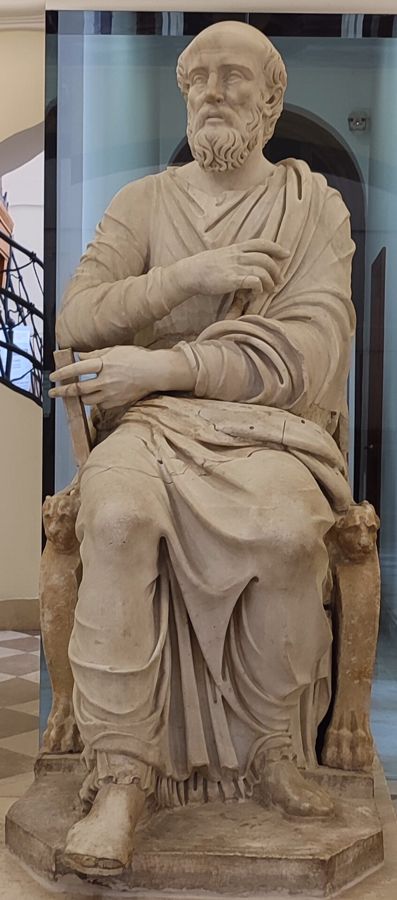
Hippolytus, Saints, Martyrs.—I. St. Hippolytus of Rome, presbyter and antipope; date of birth unknown; d. about 236. Until the publication in 1851 of the recently discovered "Philosophumena", it was impossible to obtain any definite authentic facts concerning Hippolytus of Rome and his life from the conflicting statements about him, as follows:
The discovery of the "Philosophumean" has now made it possible to clear up the most important period of the life of St. Hippolytus through his own evidence, and at the same time to test and correct the conflicting accounts contained in the old authorities. We proceed on the assumption that Hippolytus was really the author of the aforesaid work, an hypothesis almost universally accepted by investigators to-day.
Hippolytus was a presbyter of the Church of Rome at the beginning of the third century. There is no difficulty in admitting that he could have been a disciple of St Irenaeus either in Rome or Lyons. It is equally possible that Origen heard a homily by Hippolytus when he went to Rome about the year 212. In the reigh of Pope Zephyrinus (198-217) he came into conflict with that pontiff and with the majority of the Church of Rome, primarily on account of the christological opinions which for some time had been causing controversies in Rome. Hippolytus had combated the heresy of Theodotion and the Alogi; in like fashion he opposed the false doctrines of Noetus, of Epigonus, of Cleomenes, and of Sabellius, who emphasized the unity of God too one-sidedly (Monarchians) and saw in the concepts of the Father and the Son merely manifestations (modi) of the Divine Nature (Modalism, Sabellianism). Hippolytus, on the contrary, stood uncompromisingly for a real difference between the Son (Logos) and the Father, but so as to represent the Former as a Divine Person almost completely separate from God (Ditheism) and at the same time altogether subordinate to the Father (Subordinationism). As the heresy in the doctrine of the Modalists was not at first clearly apparent, Pope Zephyrinus declined to give a decision. For this Hippolytus gravely censured him, representing him as an incompetent man, unworthy to rule the Church of Rome and as a tool in the hands of the ambitious and intriguing deacon Callistus, whose early life is maliciously depicted (Philosophumena, IX, xi-xii). Consequently when Callistus was elected pope (217-218) on the death of Zephyrinus, Hippolytus immediately left the communion of the Roman Church and had himself elected antipope by his small band of followers. These he calls the Catholic Church and himself successor to the Apostles, terming the great majority of Roman Christians the School of Callistus. He accuses Callistus of having fallen first into the heresy of Theodotus, then into that of Sabellius; also of having through avarice degraded ecclesiastical, and especially the penitential, discipline to a disgraceful laxity. These reproaches were altogether unjustified. Hippolytus himself advocated an excessive rigorism. He continued in opposition as antipope throughout the reigns of the two immediate successors of Callistus, Urban (222 or 223 to 230) and Pontius (230-35), and during this period, probably during the pontificate of Pontianus, he wrote the "Philosophumena". He was banished to the unhealthful island (insula nociva) of Sardinia at the same time as Pontianus; and shortly before this, or soon afterward, he became reconciled with the legitimate bishop and the Church of Rome. For, after both exiles had died on the island of Sardinia, their mortal remains were brought back to Rome on the same day, 13 August (either 236 or one of the following years), and solemnly interred, Pontianus in the papal vault in the catacomb of Callistus and Hippolytus in a spot on the Via Tiburtina. Both were equally revered as martyrs by the Roman Church: certain proof that Hippolytus had made his peace with that Church before his death. With his death the schism must have come to a speedy end, which accounts for its identification with the Novatian schism at the end of the fourth century, as we learn from the inscription by Damasus.
Read the rest of the article
The fact that Hippolytus was a schismatic Bishop of Rome and yet was held in high honour afterwards both as martyr and theologian, explains why as early as the fourth century nothing was known as to his see, for he was not on the list of the Roman bishops. The theory championed by Lightfoot (see below), that he was actually Bishop of Porto but with his official residence in Rome, is untenable.
This statement, made by a few authorities, results from a confusion with a martyr of Porto, due perhaps to a legendary account of his martyrdom. Moreover De Rossi's hypothesis, based on the inscription by Damasus, that Hippolytus returned from exile, and subsequently became an adherent of Novatian, his reconciliation with the Roman Church not being effected until just before his martyrdom under the Emperor Valerian [Roman emperor 253–260, who persecuted bishops and clergy] (253-60), is incompatible with the supposition that he is the author of the "Philosophumena." The feast of St. Hippolytus is kept on 13 August, a date assigned in accordance with the legend of St. Laurence; that of Hippolytus of Porto is celebrated on 22 August.
Hippolytus was the most important theologian and the most prolific religious writer of the Roman Church in the pre-Constantinian era. Nevertheless the fate of his copious literary remains has been unfortunate. Most of his works have been lost or are known only through scattered fragments, while much has survived only in old translations into Oriental and Slavic languages; other writings are freely interpolated. The fact that the author wrote in Greek made it inevitable that later, when that language was no longer understood in Rome, the Romans lost interest in his writings, while in the East they were read long after and made the author famous. His works deal with several branches of theology, as appears from the aforementioned list on the statue, from Eusebius [Eusebius of Caesarea (d. c. 339), the first historian of the Church], St. Jerome, and from Oriental authors. His exegetical treatises were numerous: he wrote commentaries on several books of the Old and New Testaments. Most of these are extant only in fragments. The commentary on the Canticle of Canticles, however, has probably been preserved in its entirety ("Werke des Hippolytus", ed. Bonwetsch, 1897, 343 sqq.); likewise the fullest extant commentary on the Book of Daniel in 4 books (ibid., 2 sqq.). Eight of his works, known by their titles, dealt with dogmatic and apologetic subjects, but only one has come down entire in the original Greek. This is the work on Christ and Antichrist ("De Antichristo", ed. Achelis, op. cit., I, II, 1 sqq.); fragments of a few others have been preserved. Of his polemics against heretics the most important is the "Philosophumena", the original title of which is kata pason aireseon elegchos (A Refutation of All Heresies). The first book had long been known; books IV to X, which had been discovered a short time previously, were published in 1851. But the first chapters of the fourth and the whole of the second and third books are still missing. The first four books treat of the Hellenic philosophers; books V to IX are taken up with the exposition and refutation of Christian heresies, and the last book contains a recapitulation. The work is one of the most important sources for the history of the heresies which disturbed the early Church. Origen is cited in some manuscripts as the author of the first book. Photius attributes it to the Roman author Caius (q.v.), while by others it has been ascribed also to Tertullian and Novatian. But most modern scholars hold for weighty reasons that Hippolytus is undoubtedly its author. A shorter treatise agains heresies (Syntagma), and written by Hippolytus at an earlier date, may be restored in outline from later adaptations (Libellus adversus omnes haereses; Epiphanius, "Panarion"; Philastrius, "De haeresibus"). He wrote a third antiheretical work which was universal in character, called the "Small Labyrinth". Besides these Hippolytus wrote special monographs against Marcion, the Montanists, the Alogi, and Caius. Of these writings only a few fragments are extant. Hippolytus also produced an Easter cycle, as well as a chronicle of the world which was made use of by later chroniclers. And finally St. Jerome mentions a work by him on Church laws. Three treatises on canon law have been preserved under the name of Hippolytus: the "Constitutiones per Hippolytum" (which are parallel with the eighth book of the Apostolic Constitutions), the Egyptian Church Ordinance, in Coptic, and the "Canones Hippolyti". Of these works the first two are spurious beyond doubt, and the last, the authenticity of which was upheld even by Achelis (Die Canones Hippolyti, Leipzig, 1891), belongs in all probability to the fifth or sixth century.
The works of Hippolytus have been edited by Fabricius, "S. Hippolyti episcopi et mart. opera" (2 vols., Hamburg, 1716-18); by Gallandi in "Bibliotheca veterum patrum", II, 1766; in Migne, P.G., X; by Lagarde (Leipzig and London, 1858); and by Bonwetsch and Achelis, "Hippolytus" I, pts. I and II (Leipzig, 1897), in "Die gr. chr. Schriftsteller", a series published by the Berlin Academy. The "Philosophumena" was edited by Miller, as the work of Origen (Oxford, 1851); by Duncker and Schneidewin as the work of Hippolytus (Göttingen, 1859), and in P.G., XVI. The "Canones Hippolyti" were edited by Haneberg (Munich, 1870); by Achelis, "Die altesten Quellen des orientalischen Kirchenrechts:, I, in "Texte und Untersuchungen", VI (Leipzig, 1891), 4.
II. Besides the presbyter, St. Hippolytus of Rome, others of the name are mentioned in the old martyrologies and legends of martyrs as having shed their blood for the Faith. Some of these, however, are to be identified with him. In the Acts of St. Laurence we find an officer Hippolytus who, with his nurse Concordia and nineteen others of his household, was put to death for the Faith. The same statement also appears in the Roman Martyrology under the date of 13 August. But this Hippolytus is without doubt identical with the presbyter and martyr who has been connected by legend with St. Laurence, whose grave is situated near the cemetery of Hippolytus.
Hippolytus was also commemorated at a later date in common with St. Cassian, with whom he had no connection whatsoever. According to the hymn of Prudentius on Cassian (Peristephanon, hymn IX), the latter was a teacher at Imola (Forum Cornelii) and was surrendered to the fury of his pupils, who tortured him to death with their iron styles. He is without doubt an historical martyr, who probably suffered in the persecution of Diocletian [Roman emperor 284–305, who began the ‘Great Persecution’ of Christians in 303].
Another Hippolytus is likewise found among a group of martyrs described as "Greek martyrs" (martyres groeci), whose burial place was venerated in the catacomb of Callistus. This Hippolytus is certainly distinct from the Roman presbyter (De Rossi, "Roma sotterranea", III, 201-208). The feast of these saints is celebrated on 2 December.
Furthermore the bishop and martyr Hippolytus of Porto is commemorated on 22 August in the Roman Martyrology. This statement, which occurs even in ancient martyrologies, is connected with the confusion regarding the Roman presbyter, resulting from the Acts of the Martyrs of Porto. It has not been ascertained whether the memory of the latter was localized at Porto merely in connection with the legend in Prudentius, without further foundation, or whether a person named Hippolytus was really martyred at Porto, and afterwards confounded in legend with Hippolytus of Rome.