Faithfulness to Christ when it cost everything.
Read the essentials →Faithfulness to Christ when it cost everything.
August 8
August 6
Martyr
The rats, pressed by hunger, devoured their flesh, thus occasioning them exquisite torture.” Hormisdas, a noble, of the illustrious race of the Achasmenides, was the son of a satrap.
Stay faithful when it costs you. This account is about holding firm under pressure.
Learn from the kind of life it was. Faithfulness to Christ when it cost everything.
The king then ordered the destruction of all Christian Churches, and a persecution broke out which raged for thirty years. On the death of Isdegerdes it did not cease, but was carried on with redoubled fury by his son Gororanes.
“ It is not easy,” says Theodoret, “ to describe the various tortures to which the faithful were subjected through the ingenuity of their persecutors. Some had the skin torn off the face, from the forehead to the chin. Others had reeds, which had been split, fastened round their bodies, and bound tightly from head to foot; then each of the reeds was plucked out with great force, tearing away with it the adja-: cent skin, causing excruciating agony. The persecutors also dug pits, and filled them with rats; they then threw the pious defenders of the faith into these pits, so bound that they could not drive off the animals. The rats, pressed by hunger, devoured their flesh, thus occasioning them exquisite torture.” Hormisdas, a noble, of the illustrious race of the Achasmenides, was the son of a satrap. When the king heard that he was a Christian, he sent for him, and desired him to deny his Lord and Master. “ Sire !” answered Hormisdas, “ to deny thee, my earthly king, would, be a crime worthy of death; how much rather to deny the King of Kings, the Creator of all things ?"
The king deprived him of his rank and fortune, and ordered him to be camel-driver in the army. One day, as the king was looking from his window, he saw Hormisdas, naked, burnt by the sun, and covered with dust, goading on his camels. Remembering his illustrious parentage, and pitying him, he sent for him, and gave him' a linen tunic. Then he urged him with kindness to change his purpose, and abandon the religion which entailed such discomforts, “ Abandon the carpenter's son !” Hormisdas plucked off the white tunic, and returned it to the king. “Not for the sake of this linen dress,” answered Hormisdas. “ Take back your gift, Sire !” The king, perceiving his fortitude, banished him from the kingdom. Among several bishops in Persia who suffered in this persecution, Sozomen (ii. 13) enumerates Hormisdas. Whether this was the same Hormisdas as the confessor [in old usage, a saint who was not martyred, or who suffered for the faith without being killed] mentioned by Theodoret, does not appear. According to the latter, Hormisdas does not seem to have died for the faith. Bishop Hormisdas suffered martyrdom.
Feast: August 6
Traditional: August 8
One short email a day for nine days. The day's prayer, a line from St. Hormisdas's story, and a nudge to keep going.
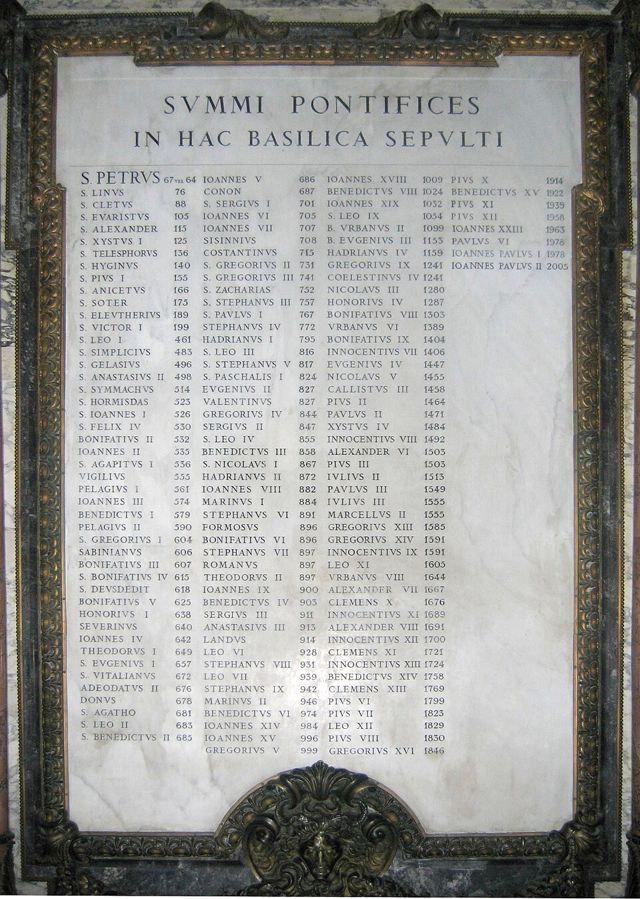
Image: Tafel paepste.jpg · Unknown · CC BY-SA 3.0, via Wikimedia Commons
From Sabine Baring-Gould, The Lives of the Saints, new edition in 16 vols. (London: John C. Nimmo, 1897–98); text from the Internet Archive scan (OCR, lightly cleaned; errors possible). Public domain.
Image: Unknown, Wikimedia Commons (CC BY-SA 3.0)
From Sabine Baring-Gould, The Lives of the Saints, new edition in 16 vols. (London: John C. Nimmo, 1897–98); text from the Internet Archive scan (OCR, lightly cleaned; errors possible). Public domain in the United States. Reproduced unedited, except for short bracketed notes in grey that we added to explain names and terms (“S.” is the old abbreviation for Saint). Some history and judgments reflect 19th-century scholarship.