Baring-Gould’s sources: Ado, Usuardus, Notker, &c. Roman Martyrology. Sarum and York Kalendars as Eustace, but Hubert is meant. Authorities: — A Life by an anonymous contemporary writer in Surius Vit. SS. 3 Novr. vi. p. 5a From c. 21, is an addition by a later hand, Jonas (830). Conversio S. Huberti ap. Duchesne, Hist Franc, sc. i. p. 678.] S. Hubert, the patron of hunters, was the son of Bertrand, Duke of Aquitain, descended from Clothair I.1 His mother, Hugbem, was granddaughter of Blithild, daughter of the 1 Clothair I. had a son named Chramne, Duke of Aquitain, whose son was Bogis, father of Bertram. Blithild, daughter of Clothair I., married her cousin Childeric, and by him had Arnoald and Bogis, and Bogis was the father of Hugbem and S. Oda.
S. Hubert. same Clothair, and sister of S. Oda. He was bom in 656. Bertrand was engaged in contest with Ebroin, mayor of the palace, and Hubert for safety was sent to his aunt, S. Oda, in Austrasia. She placed him with Pepin of Herstal, mayor of the palace in Austrasia, as Ebroin was mayor in Neustria. The last years of the Merovingian line of kings were full of struggles between the rival mayors. Gallo-Roman feeling was more prevalent in Neustria, Germanic in Austrasia. The majority of the Neustrian mayors, especially Ebroin, supported the interests of royalty and a policy of centralization, the Austrasians those of the landholders, and a policy of disintegration. When the Merovingians were indisputably nothing but sluggard kings, and when Ebroin, the last great mayor of the palace of Neustria, had been assassinated (in 681), and the army of the Neustrians destroyed at the battle of Testry, in 687, the ascendency in the heart of the whole of Frankish Gaul [roughly modern France and Belgium] passed to the Franks [the Germanic people who ruled Gaul and gave France its name] of Austrasia. It was in the Court of Pepin, during the time that he was engaged in this long struggle, that Hubert grew up. At the age of six -and -twenty he married Floriban, daughter of Dagobert, Count of Louvain. He was fond of hunting, and followed the wild boar and the stag in the vast forest of the Ardennes.
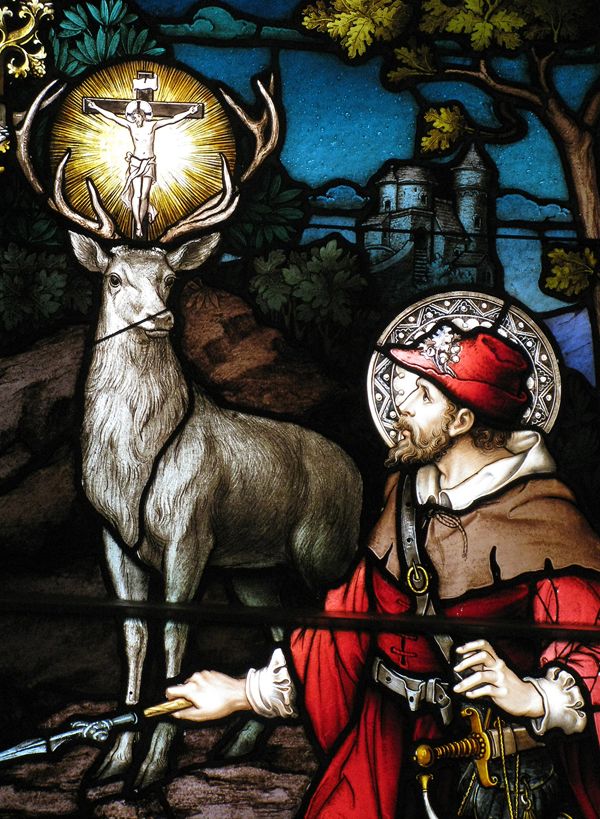
Here follows the curious story of the conversion of S. Hubert, which has been taken from the story of S. Eustace (Sept 20), and appropriated, by what means is not clear, to the northern saint. The story is to this effect: his love of hunting took such possession of his soul, that he even went in pursuit of game on Good Friday, in the Ardennes. On that day he got separated from his companions, and in the midst of a dense wood he came suddenly on a great stag, which bore a crucifix between its horns, and Hubert heard a voice issue from it, saying, “ Turn to the Lord, or thou wilt fall into the abyss of hell !” Hubert jumped off his horse, and fell on his knees before the miraculous cross, and prayed to be told what he should do.
The figure on the cross replied, “ Go to Maestricht to my servant Lambert, and he will tell thee what thou must do.” Then the stag withdrew into the depths of the forest, and was seen no more.
The fact of S. Hubert being buried in the heart of the great forest of the Ardennes caused him to be invoked by the hunters therein, and thence his name came to be generally associated with huntsmen, and he to be regarded as their patron. To account for this patronage, however, the story of the miraculous conversion of S. Eustace was foisted into the history of S. Hubert The story of S. Eustace was probably composed for polemical purposes in the struggles against the Iconoclasts. It was originally written in Greek, and pertains to that period. The trace of the importation remains in the fact that S. Hubert is frequently called S. Eustace; thus in the York and Sarum Kalendar he is entered on November 3 under this name.
The real turning point of his life was the death of his wife Floriban, after only three years of happy married life. She died in her confinement (685), leaving a child, Floribert, the pledge of her love to the disconsolate Hubert. Weary of the world, which was now a blank to him, Hubert resigned to the king his military baldric and collar, and went into Guienne to see his father, who was dying. He was in time to receive his last sigh. Then having abandoned his pretensions to the duchy,1 which was his by right of seniority, to his brother, Eudes, he returned to the neighbourhood of the Meuse, and casting himself at the feet of S. Lambert, bishop of Tongem, placed himself and his son Floribert, at the disposal of the saint He was sent to learn 1 So it is said, but it is most improbable, Eudes was almost certainly the eldest sou of Bertrand.
•S. Hubert. to conquer himself in the solitude of the Ardennes, the forest land he had so loved as the scene of exciting sport. He spent about ten years in these wilds, living as a hermit, tasting the joys and hardships of that wonderful life. Then he went to Rome.
A strange story is told by late writers of his visit there. Whilst Hubert was in the Holy City, S. Lambert was murdered. At the same hour an angel appeared to Pope Sergius I., and gave into his hand the pastoral staff of the martyred bishop, bidding him ordain in the room of Lambert a man whom he would see in the basilica of S. Peter, and whom he described to him. When Sergius awoke he found the pastoral staff in his hand; he went to S. Peter’s, and seeing there a man such as was described, put the staff of Lambert into his hands, and forthwith consecrated him to the vacant see of Tongem [a bishop’s “see” is his diocese, named from his seat (Latin sedes)]. During the ceremony an angel brought from Belgic Gaul the pontifical habits of S. Lambert, and placed them at the disposal of S. Hubert But as there was a stole wanting, the Blessed Virgin sent him one of white silk, embroidered by her in heaven with gold thread. Moreover, S. Peter himself appeared to the saint whilst he was saying his first mass, and gave him a gold key in sign that he communicated to him some of his authority to bind and to loose. This fantastic story rests, as may be supposed, on no evidence worth consideration. It is the growth of legend in the mouths of the people. The key was one of the claves amfessionis S. Petri, which the popes were wont to bestow as marks of special favour.1 The stole was probably embroidered by some lady of the name of Mary, who has been exalted by popular fancy into the Queen of Heaven. It is still preserved religiously in the church of the abbey of S. Hubert, and is used to this day in cases of ‘ One of silver was given to S. Servatus of Tongem; it is now at Maestricht, and a very similar story is told of iL See S. Servatus, May 13, p. 184. [Nor. s.
hydrophobia, which it is supposed to cure. The contemporary biographer of S. Hubert says not a word about all these marvels. He simply states the fact that S. Hubert was elected in a very ordinary and unromantic way by the clergy and people of the diocese to fill the room of Lambert. It only took a century for this nonsense to grow up and be believed, for it is related by Jonas, who dedicated to Walkend, bishop of Ltege, about a.d. 830, his narrative of the translation [the solemn moving of a saint’s relics to a new shrine] of S. Hubert’s relics [the bodily remains of a saint, or objects they used, kept with honor]. As soon as the new bishop had entered into the administration of his diocese, he took care to bury honourably the body of his predecessor on the spot where he had been murdered; and he transferred thither at the same time the seat of the bishopric, thus the cathedra of the bishop which had been planted at Maestricht, and then at Tongem was finally fixed at Li£ge. The translation of the body of S. Lambert from Maestricht to Li£ge took place in 711. S. Hubert built chapels at Nivelle-sur-Meuse, Hernial, and Herstal, where the body had reposed on the occasion of its transport to Li^ge. Pepin of Herstal, at his death, December 16th, 714, did an act of justice, which, however, led to fatal results. He had two wives, Plectrudis and Alpheid; he had repudiated the former to espouse the latter, and the Church, considering the latter marriage unlawful, had constantly urged him to take back Plectrudis. He had by her a son, Grimoald, whom, either from a father’s blind fondness, or through the influence of Plectrudis, he appointed to succeed him to the detriment of his two sons by Alpheid, Charles and Childebrand. Charles, at that time twenty-five years of age, had already a name for capacity and valour. Grimoald, however, was the legitimate son of Pepin, and the Church never regarded Charles in any other light than a bastard. As Grimoald was on his way to see his father, who was dying at Herstal, he was waylaid by the agents 5. Hubert.
of Alpheid and Charles. He took refuge in the church of S. Lambert at Li£ge and was there assassinated. Plectrudis lost no time in arresting and imprisoning at Cologne the son of her rival Alpheid; but some months afterwards, in 715, the Austrasians, having risen against Plectrudis, took Charles out of prison, and set him at their head, proclaiming him Duke of Austrasia. He was destined to become Charles Martel. He first of all took care to extend and secure his own authority over all the Franks. At the death of Pepin of Herstal, the Neustrians, vexed at the long domination of the Austrasians, had taken one of themselves, Ragnfried, as mayor of the palace, and had placed at his side a Merovingian sluggard king, Chilperic II., whom they had dragged from a monastery. Charles, at the head of the Austrasians, twice succeeded in beating, first near Cambrai and then near Soissons, the Neustrian king and mayor of the palace, pursued them to Paris, returned to Cologne, got himself accepted by his old enemy, Queen Plectrudis, and remaining temperate amidst the triumph of his ambition, he, too, took from amongst the surviving Merovingians, a sluggard king, whom he installed under the name of Clothair IV., himself becoming, with the simple title of Duke of Austrasia, master of the Frankish dominions.
In this war against the Neustrians, at the battle of Soissons in 719, Charles had encountered in their ranks Eudes, Duke of Aquitain and Gascony, that beautiful portion of Southern Gaul situated between the Pyrenees, the ocean, the Garonne, and the Rhone, which had been for a long time trying to shake off the dominion of the barbarians, Visigoths and Franks. At the death of Pepin of Herstal the Neustrians had drawn this Duke Eudes, brother of S. Hubert, into alliance with them, for their war against the Austrasians, and gave him, it seems, the title of king. His father Bertrand had been in like manner in revolt against Ebroin, as has been already said. After the defeat of Neustrians and the troops of Eudes, the Aquitanian prince withdrew precipitately to his own country, taking with him the sluggard king of the Neustrians, Chilperic II. Charles pursued him to the Loire, and sent word to him that he would enter into friendship with him if he would deliver up Chilperic and his treasures; otherwise he would invade and ravage Aquitain. Eudes delivered up Chilperic and his treasures; and Charles, satisfied with having in his power this Merovingian phantom, treated him generously, kept up his royal rank, and at his death, which happened soon after, set up another phantom of the same line, Theodoric or Thierry IV., whom he dragged from the abbey of Chelles, and who for seventeen years bore the title of king, whilst Charles Martel was ruling gloriously, and was perhaps the saviour of the Frankish dominions.
Charles Martel was wise and prudent. He had at his back S. Hubert, brother of the powerful duke of Aquitain, and the experience of Ebroin was not forgotten, how powerful and dangerous bishops might become unless conciliated. Charles eased his conscience and pacified the Bishop of Ltege, by giving large estates to his church, under the pretence that he was thereby expiating the murder of Grimoald in the church of S. Lambert — really, no doubt, that he might win the favour of the brother of Eudes of Aquitain. Hubert was invested by him with the territorial jurisdiction of Ltege, and the church he ruled might, from the amount of its possessions, now be considered as one of the most wealthy and powerful in the realm. Hubert surrounded the city with walls, established laws, fixed the weights and measures for the citizens, endowed the church of Our Lady and S. Lambert with twenty canonries, instituted six minor canons, built a monastery which he dedicated to the Prince of the Apostles, and in which he established fifteen monks. He appointed fourteen magistrates and a •S'. Hubert.
superior judge called the grand major, to administer justice in the province of Lidge. In 710 he convoked a provincial council or synod at Li£ge, which passed ten canons, one of which fixes seven as the age at which the Sacrament of Confirmation should be administered, one that parishioners should confess to their parish priests — probably because vagrant priests and monks disturbed the well working of a parish.
In 726, a second synod was held at Lidge, on the subject of images, some conflict of opinion on the reverence due to them having arisen. Details are wanting. The synod is said to have come to the same decision as a Roman synod held by Gregory II., but the existence of which is very doubtful. Two other councils are said to have been held by S. Hubert at Tongem, but all four were certainly nothing more than diocesan synods, for S. Boniface [English missionary to Germany, martyred 754] explicitly declares in a letter to Pope Zacharias (Ep. 50), that no provincial synod had been held for eighty years among the Franks; and this has led Hefele and others to doubt the fact of these synods having been hqld at all S. Hubert followed the steps of his predecessors in carrying the light of the Gospel into the districts of Taxandria and the Campine, where the country people stubbornly clung to their pagan traditions. He laboured diligently among these rude peasants, and succeeded in achieving a real change in their sentiments. Then he turned his face towards the green woodland ridges and vales of his beloved Ardennes, where he had hunted the wild boar in his youth, and had fasted and tamed the flesh in full manhood. He knew that the scattered population there were scarce Christian by name. He therefore returned to these dear forest scenes, and ministered to the souls of the wild wood-dwellers, so that he may fairly bear the name which has been given to him of Apostle of the Ardennes.
His biographer says that a little before his death he was invited to consecrate a church built in Brabant, and that he went there accompanied by some of his domestics. During the consecration he felt ill, but he finished the rite, and then, as his fever increased, he determined to make the utmost haste to a house he possessed at Fure. He accordingly took a boat, and lying down in it fell asleep. He was roused by hearing some of his people engaged in an altercation. He calmed them, and then leaving the boat mounted on horseback, and rode to Fure, which he reached, stayed up by the hands of his servants, late on in the night. He went to bed and lay there four days, but not before, sick and fevered, and weary as he was, he had gone into his chapel, kissed the altar, and said some prayers. He could not sleep, and through the long hours of the night he repeated psalms. Want of sleep and fever made him a prey to delusions, and he fancied he saw strange and hideous forms, and heard them mutter and howl about his bed. On Friday, the 30th of May, 727, at daybreak, as his disciples and his son Floribert surrounded him, he bade them bring a napkin to cover his face, and then recited the Creed. As he began the Lord’s Prayer, he died, without pain, and the angels received his holy spirit.
He was succeeded in the see of Lidge by his son Floribert. There is some uncertainty as to the place where he died. Some think that the place was Freux in the Ardennes, a village belonging to the monastery of S. Hubert, but his biographer says that the church he consecrated was in Brabant. It is believed to have been Hevesle, near Louvain; and that the mansion belonging to him when he died was Tervueren, near Brussels, an estate which had belonged to his wife Floriban. This is far the most probable opinion. His body was transported to Ltege, and was buried before the altar of S. Albinus in the collegiate church of S. Peter; but sixteen years after it was taken up by the clergy of Ltege, in S. Hubert.
the presence of King Caxloman, and was found to be perfectly sound and incorrupt. This exaltation took place on Nov. 3rd, 743, the day on which the festival of S. Hubert is celebrated in the Catholic Church.
His bones were afterwards translated to Andain in the Ardennes, where the monastery and town of S. Hubert have arisen around his precious relics. This translation took place No one knows what has become of the body of S. Hubert. It is, however, believed to have disappeared in the conflagraThe stole, embroidered by the Virgin Mary and woven in the looms of heaven, is still shown. It is of white silk, the extremities, ornamented with a rich lace, ending in fringes of six balls of gilt silk. The design of the silver tissue is varied, and is traversed by gold threads.
When a person bitten by a mad dog comes to be operated on, a gash is made in his forehead, and a minute particle of silk or gold is inserted under the skin. This operation is called “la taille.” The patient who undergoes it is bound likewise to observe several rules. For nine days he has to confess and communicate, sleep alone in a bed between white sheets, or with a white coverlet over it, drink out of one glass during the nine consecutive days, and never stoop to drink of a spring or stream; red wine and water is permitted; only pork and bacon from a boar-pig is to be eaten, and pullets, hard-boiled eggs, fish in the scales — all cold; salt is not forbidden. The hands and face are to be wiped with a clean towel. The idea of ablutions extending further never entered into consideration. The beard must not be clipped for nine days, nor — horrible to think of — the hair combed for forty days.
On the tenth day the bandage over the forehead covering the incision must be removed by a priest, burned, and the ashes placed in the piscina.1 These wonderful regulations, hung up in the church of S. Hubert, and enforced by the clergy on those who seek the cure, have this advantage. The patient, if in a state of hydrophobia, cannot keep the rules, and therefore, necessarily, is not cured. The person who has been bitten by a dog which is not mad is so convinced of his cure by the lengthy operations and ceremonies he has gone through that there is no chance of his allowing his fancy to make him ill.
In 1671, the Sorbonne condemned these ceremonies as superstitious, but the bishop of Lidge and his synodal examiners in 1690 formally approved them. Between the 12th October, 1806, and January 1st, 1835, more than 4,800 persons submitted to the “ taille,” and since that date the clergy of S. Hubert perform the same ceremony on a great number of persons.
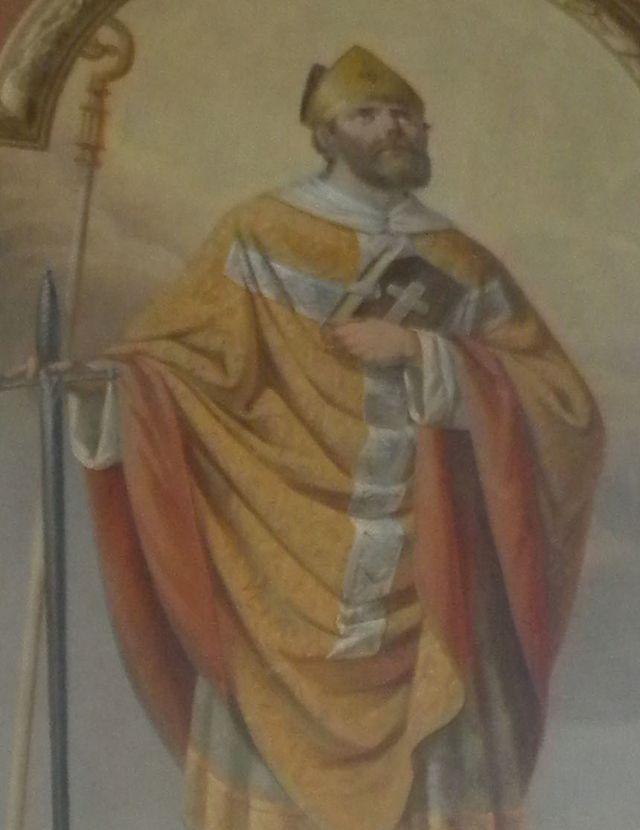
Much fuller information on this superstition will be found in Reinsberg-Dtiringsfeld, “Traditions et L^gendes de la A horn which S. Hubert used when hunting before his conversion is shown in the church of Tervueren. The golden key given him by S. Peter is lost. One of his slippers is at S. Hubert, also a bit of a comb, and an ivory staff! Rambervillers, in the diocese of Saint-Did, possesses a bone of hand or foot of S. Hubert. Limd, near Braine, possesses some other relics. S. Hubert is represented in episcopal vestments with the stag bearing a crucifix between his horns. When represented in lay costume as a hunter, he cannot be distinguished from S. Eustace.
eccldsiastique ne les a pas condanmces."-4jtmra; a Giry, “Via* de« Saiuu,' Kov. * S. Pirminus.