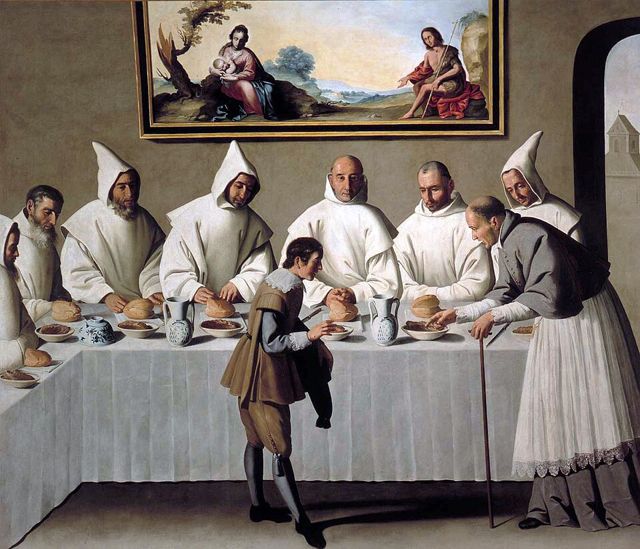
Baring-Gould’s sources: Gallican Martyrology, Wytford, Graven, and Molanus, in their additions to Usuardus, Maurolycus, Wyon, and Roman Martyrology. Authority: — His life written at the command oi Pope Innocent II., by his contemporary, Guigo, Prior of the Grande Chartreuse. S. Hugh was inscribed among the Saints by Innocent II., in 1x34, two years after his death.] Above Chiteauneuf, near Valence, in Dauphin^, on a height, stand the crumbling walls of an old castle, called at the present day the Castle of S. Hugh. Here, in the middle of the eleventh century, lived a nobleman named Odillo de Chiteauneuf, who was twice married, and had several children by his second wife, amongst others Hugh, the subject of this memoir. Both Odillo and his wife were pious and upright people, and the example of these good parents awoke in the heart of the little Hugh his first love and fear of God. Hugh was sent to school at Valence, but not content with the instructions he received there, he left his home and country to seek learning abroad. On his return to Valence he was provided with a prebendal stall in the Cathedral Church, where he conducted himself with such modesty and virtue that Hugh, bishop of S. Die, afterwards archbishop of Lyons, having been nominated papal legate in France, chose Hugh to assist him in the labours of his legation. He followed the legate to Lyons, and thence to Avignon, and during the session of the council there, dignitaries came from Grenoble to inform him of his election by the clergy of that see to the bishopric. Though prebendary of Valence, he was not yet in Holy Orders, and the announcement filled him with terror. But the legate insisted on his accepting the proffered see, conferred on him all orders up to that of priesthood, and persuaded Hugh to accompany him to Rome, that he might receive episcopal consecration from the hands of the Pope, as Varmond, archbishop of Vienne, his metropolitan, had obtained his promotion by bribery, and Hugh was unwilling to receive orders and mission from a simoniacal prelate.
Whilst at Rome, on the very day of his consecration, Hugh was terribly beset with a temptation to blasphemy, the first cutting of a sharp spiritual cross which weighed on him through the rest of his life, causing him indescribable anguish of soul. It seems to have been a horrible doubt wherewith Satan sought to cut at the root of the abundant charity and faith of the holy man. In his agony of soul, Hugh threw himself into the arms of the legate [an official representative sent by the pope], his dear friend and director, and implored him to deliver him from the burden of the obligation about to be laid upon him. The bishop of S. Die consoled and encouraged his suffering son, and bade him go and tell all his trouble to the Pope. He did so, and the Holy Father received him with such tenderness, and gave him such excellent advice, that he went away calmed and cheered. He was then consecrated, the Countess Mathilda, the liberal benefactress of the Holy See, furnishing all that was necessary for the ceremony, and presenting the young bishop with his pastoral staff, and two books, the commentary on the Psalms by S. Augustine, and the Book of Offices of S. Ambrose [bishop of Milan (d. 397)]. After his ordination S. Hugh at once left Rome, and betook himself to his diocese, which he found in the most deplorable condition. “ He found the clergy and the people very rude and undisciplined in divine things, so that, not only the lower orders of clergy, but even the priests married wives, celebrating their nuptials publicly, the laity buying and selling sacred things, churches, oblations, tithes, and cemeteries, and the priests subject to their dominations.” With infinite labour, with zeal and tenderness, and more by his own example than by any other April i.] ■S'. Hugh.
means, Hugh succeeded in raising the moral and religious tone of the clergy and laity of his diocese. The revenues of the see had all been dissipated, its land sold to the nobles by his predecessors, and he was left almost without means of subsistence, because he would not receive fees for the administration of sacraments and collation to livings. Sick at heart and despairing of effecting a reformation, knowing also his faults and need of self-discipline, for he was only twenty-seven years old, he retired after two years* labour into the monastery of Chaise- Dieu, of the Order of Cluny, and assumed the Benedictine [monks following the Rule of St. Benedict] habit But Gregory VII., hearing of his flight, sent him peremptory orders to return to his duties, and with a sigh and many tears he bade farewell to the peaceful cloister, and returned to that which weighed on him daily, the care of all his Churches. He had spent but a year in Chaise-Dieu, but his soul was refreshed thereby.
Three years after his return to Grenoble, S. Bruno, accompanied by six friends, visited him, to ask for some retired spot in which he might lay the foundations of his Order. S. Hugh received him with joy. Up among the mountains was a desert basin he had once visited, only reached by a toilsome scramble through one of the wildest and narrowest of gorges in the Dauphin^ Alps. In dream, Hugh had once seen seven stars shining over the white peaks that enclosed this valley. Surely these seven men were signified by the stars in his vision ! He conducted S. Bruno to this solitude, and there the seven laid the foundations of the world-famous monastery of the Grande Chartreuse. Often did the bishop come to this mountain retreat, from the noise and strife of tongues of the outer world, to slake the thirst of his parched soul there. So poorly lodged were these first hermits, that two occupied the same cell. The monk with whom S. Hugh was placed complained that the bishop treated him as his superior. So great was Hugh’s zeal for holy poverty, that he would have sold his horses, and gone on foot through his diocese, preaching, catechising, and conferring sacraments, had not S. Bruno dissuaded him, because such an action would have had an air of singularity, and because it would have been impossible for him properly to visit his mountainous diocese without riding.
S. Hugh set his face against a practice, then not uncommon, of hearing women’s confessions in private rooms and vestries, but insisted, so as to avoid scandal, on their being heard in Church, where priest and penitent were visible to the whole congregation.
In vain did S. Hugh, after many years of bearing all the people on his shoulders, implore Popes Gelasius II., Calixtus II., and Honorius II., to relieve him of his charge. The latter told him that he preferred to see him, old and bowed down with sickness, shepherding his flock, rather than any young and active man.
At length the Great Shepherd Himself released him from his labours on April ist, 1132, at the age of eighty, fifty-two of which had been spent in charge of his see. He was buried in the Church of Notre Dame at Grenoble, and was canonised on April 22nd, 1134, two years after his death. His relics [the bodily remains of a saint, or objects they used, kept with honor] were burnt in the 16th century, when the Baron des Adrets took Grenoble, and all the churches were given up to be pillaged by the Huguenots.