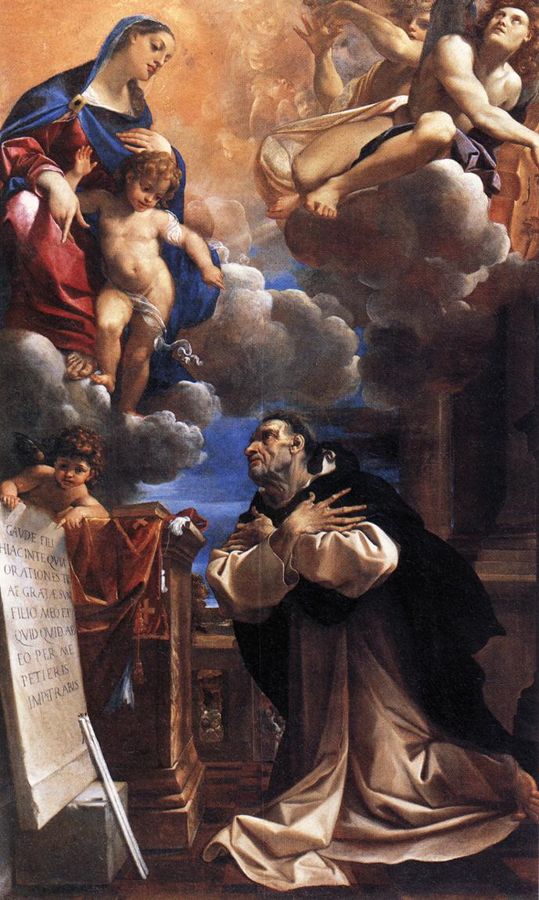
Baring-Gould’s sources: Roman Martyrology. Canonized by Pope Clement VIII. Authority: — A life by Leander Albertus given in the Acta Sanctorum.] S. Hyacinth, called in Poland S. Jacko or Jaczko, belonged to the noble family of Oddrovag, was born at Camin in Poland in 1185, and studied at Cracow, Prague, and Bologna, at the last of which universities he took the degree of Doctor of Laws and Divinity. On his return to Poland he was at once given a prebendal stall in the cathedral. On the resignation of the bishop, S. Vincent Kadlubek, in 1218, Ivo Konski, uncle of Hyacinth, became Bishop of Cracow, and went to Rome accompanied by his nephews Hyacinth and Ceslas. S. Dominic was then at Rome. Ivo and the Bishop of Prag, charmed with his sanctity and.fervour, urged him to send some of his preachers into their dioceses. S. Dominic was unable to do so, as he had not sufficient friars for the purpose, but four of the attendants on the Bishop of Cracow, among them Hyacinth and Ceslas, volunteered to enter the Society of S. Dominic, and to be trained by him for the work in Poland. In the same year (r2i8), after a brief novitiate of six months, Hyacinth was appointed Superior of the mission; and started for Poland. On the arrival of the Dominicans in Cracow they were received with great favour, and the sermons of S. Hyacinth were productive of much good. He founded convents of his Order at Sandomir, in Cracow, and at Ploksko on the Vistula.
He passed throughout the country preaching and carrying the light of the gospel into Prussia and Pomerania. He even went into Denmark, Gothland, Sweden, and Norway, founding convents of his Order wherever he went. Then he visited Red Russia, where he combated the Eastern Church, and persuaded the prince to desert it for the Roman communion. He built convents at Lemburg, and Haletz on the Mester, and then invaded Muscovy. The Duke Vladimir IV., son of Ruric II., with noble tolerance allowed Hyacinth to establish a convent at Kiefif, but was deaf to his entreaties that he should join the Roman Church. But the preaching of Hyacinth in Muscovy left no permanent or appreciable results.
Whilst Hyacinth was at Kiefif, a terrible Mongol invasion occurred. The princes of Russia, distracted with rivalry, their strength broken by civil war, could not oppose an effectual resistance. A bloody battle was fought on the river Kalka. Three princes of the name of Mistislaff sustained it with desperate valour; but two, the Great Prince, Mistislaff III., and the Prince of Chemigoff, fell in the action (a.d. 1224), whilst a third, the Prince of Galich, was compelled to fly. The barbarians retired; but innumerable hosts gathered under Bathi, grandson of Genghis Khan, and twelve years after (a.d. 1236) burst on Russia again. The town of Riazan was the first to suffer; her princes, Oleg and Theodore, died the death of martyrs. When Vladimir was besieged, the bishop Metrophanes, with the consort of Vladimir IV., her daughter-in-law, and the boyars, shut themselves up in the cathedral; there they all received the holy mysteries from the hand of the bishop, and from the Lord the crown of martyrdom, amidst the flames and smoke of the burning temple. George, son of Vladimir IV., fell in battle on the banks of the Siti, and his nephew, Prince Basiliko, died a martyr’s death for the name of Christ. Next year (a.d. 1137) came the turn of Southern Russia. Pereyaslavla perished with its bishop, Simeon. The Mongols surrounded Kieff, and struck with its antique beauty, its green and scarlet and gold and blue cupolas, and spires August 1 6.] Hyacinth.
hung with shining chains, clanging forth their bells all day long,’ offered to spare it, if it would open its gates. But in the absence of all the Russian princes, it was heroically defended by Demetrius, a boyar of Galich. As became the mother and head of Russian cities, Kiefif gave a lesson to all Russia in preferring a glorious end to the disgrace of slavery. After a bloody siege, its towers and every stately church and monastery were converted into separate fortresses by the despair of the citizens, when the ring of walls had yielded to the barbarians’ onslaught. The cathedral of S. Sophia, the church of the Tithes, founded by S. Vladimir two hundred years before, the monastery of S. Michael, and the Pecherskoi monastery, were taken by storm one after another, and became a prey to the flames. John, the Metropolitan, it is believed, perished in the general massacre amidst his flock. Hyacinth, with the ciborium in one hand and an alabaster image of the Virgin in the other, was more fortunate.1 He managed to escape across the river, and made the best of his way back to Cracow, where the image became afterwards an object of great veneration.
S. Hyacinth next preached to the Jazyges on the Danube. He is said to have been so successful as to have converted and baptized several thousands. It is pretended that he went into Great Tartary and Thibet, preaching, but this is probably an invention of the lively imaginations of authors of after ages. Nothing is said of it in the earlier historians. After a while he again entered Red Russia, thinking that the sufferings of the country might have induced the people to turn for assistance to the West, a 1 According to the account of Severinus of Cracow, in the Acta Sanctorum [the Bollandists’ huge collection of saints’ lives], when the friars came crying to Hyacinth that Kieff was taken, he made ready to run out of the church, when the alabaster image screamed after him,,fO Hyacinth ! are you running from the Tartars and leaving me behind?” “ You are too heavy to carry,” * answered Hyacinth. “Try me,” answered the image. necessary condition for receiving which was renunciation of the Eastern Church. Seeing the distressed condition of the Russian Christians, Pope Innocent IV. sent to Prince David of Galich a crown, and a promise of help, of sending a crusade of Western Christians against the Mongols, if he would abandon his schism. The papal legates visited the court of S. Alexander Nevski, Prince of Novgorod, but he refused to receive the letter or listen to the proposal. Daniel, however, acted more cautiously, owing to his proxi mity to Vengria and Poland. He accepted the crown and the title of King of Galich, but put off the proposition for a union of the Churches till there should be an oecumenical council. A Prince Caloman on the frontiers proved more accessible. Fearing lest the steadfast adhesion of the Russians to the orthodox faith should furnish an excuse to the Teutonic Order to invade and possess themselves of his territory, he listened to the solicitations of S. Hyacinth, and abandoned communion with the Eastern Church. Hyacinth died on Aug. 14, a.d. 1257, at the age of seventy-two. His relics [the bodily remains of a saint, or objects they used, kept with honor] are preserved in a chapel dedicated to him at Cracow.