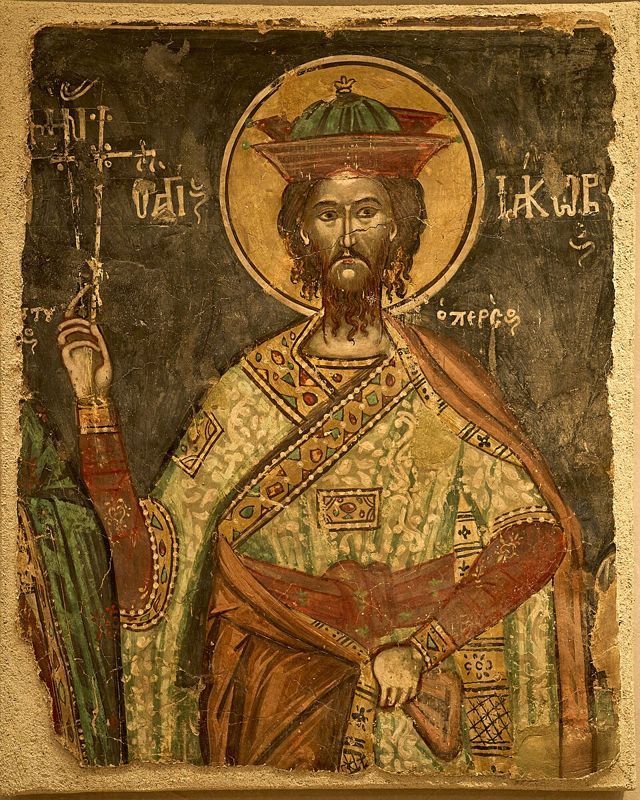
Baring-Gould’s sources: Roman Martyrology. By Greeks, Copts, Maronites, &c. on same day. Authority: — The genuine Chaldee Acts in Assemani, Acta Mart. Orient, i. p. 237. A Greek version in Metaphrastes, simplified.] S. James was a native of Beth-Lapetha, a royal city in Persia, of high rank, and much in favour with the king, Isdegerdes. When Abdias, the bishop, had burned down a fine temple in a fit of intemperate zeal, the king persecuted the Christians, and James shrank from disgrace and death, giving up outward conformity to Christianity. His wife and mother were grieved at his fall, and withdrew from his society. Upon the death of King Isdegerdes they wrote to him the following letter: “We were informed long ago, that, for the sake of the king’s favour and for worldly riches, you forfeited the love of the immortal God. Think where that king now lies, on whose favour you set such store. Unhappy man ! behold he is crumbled to dust — the fate of all mortals: nor can you any longer hope to receive honour or gifts from him, much less be protected by him from eternal torments. And know that if you persevere in your estrangement from God, you yourself, by Divine justice, will suffer damnation along with the king your friend. We, for our parts, will have no more commerce with you.” James was strongly affected on reading this letter, and began to reflect what just reproaches his apostacy would deserve at the last day from the mouth of the Judge of quick and dead. He appeared no more at court, shunned the company of those who would have endeavoured to seduce him, and renounced honours, pomp, and pleasure. He bitterly bewailed his fall, and his words of self-condemnation were speedily carried to Yararanes, the new king.
5. James Intercisus. He was sent for, and boldly confessed he was a Christian. The king asked him where was his gratitude for the favours which had been showered on him by Isdegerdes. “And where is that prince now? What has become of him?” asked James. Vararanes threatened him with a lingering death. “ Let me die the death of the righteous,” said the saint. “ Death is but sleep.”
“Death,” said the king, “ is not sleep; it is a terror to kings.” “The hope of the wicked shall perish,” said James. “ Do you call us wicked, you who worship not sun, moon, fire nor water?”
“Sire,” answered James, “I give not the incommunicable name to creatures.” The king, greatly incensed, after discussing the case with some of his counsellors, came to the decision that if James would not renounce Christianity and conform to the established religion, he should be hung on the rack, and his limbs be cut off one after another, joint by joint. The sentence was no sooner made public than the whole city flocked together to see this uncommon execution, and the Christians, falling prostrate on the ground, poured forth their prayers to God for the martyr, who had been carried from the court without delay to the place of execution. When he arrived there, he begged a moment’s respite, and, turning his face towards the east, he fell on his knees, and, lifting up his eyes to heaven, prayed with great fervour. After having allowed him time for his devotions, the executioners approached, and displayed their weapons; then they took hold of his hand, and violently stretched out his arm; and in that posture explained to him the cruel death he was to suffer, and pressed him to avert so terrible a punishment by obeying the king. His birth, and the high rank which he had held in the empire, the flower of his age, and the comeliness and majesty of his person, moved the whole multitude of spectators to tears. The heathens conjured him to dissemble his religion only for the present, saying he might return to it again after the wrath of the king was overpassed. The martyr answered them: “This death, which appears to you so dreadful, is very little for the purchase of eternal life.” Then, turning to the executioners, he said: “Why stand ye idly looking on? Why begin ye not your work?” They therefore cut off his right thumb. Upon which he prayed thus aloud: “ O Saviour of Christians, receive a branch of the tree. It will decay, but will bud again, and will be clothed with glory.” The judge who had been appointed by the king to oversee the execution, burst into tears, and many cried out to the martyr: “ It is enough that you have lost thus much for the sake of religion. Suffer not your body to be cut up piecemeal, and destroyed. You have riches: bestow part of them on the poor for the good of your soul, but die not in this manner.” S. James answered: “ The vine dies in winter, yet revives in spring: and shall not the body when cut down sprout up again ? ” When his first finger was cut off, he cried out: “ My heart was glad, my glory rejoiced: my flesh also shall rest in hope. Receive, O Lord, another branch.” The joy of his heart seemed visible in his countenance. At the lopping off each finger he thanked God afresh. After the loss of the fingers of his right hand, and again after those of his left, he was conjured by the judges to conform and save himself. To whom he meekly answered: “ He is not worthy of God, who, after putting his hand to the plough, shall look back.” The great toe of his right foot was next cut off, and followed by the rest; then the little toe of the left foot, and all the others after it. At the loss of each part, the martyr repeated the praises of God, exulting as at a triumph. When his fingers and toes were gone, he cheerfully said to the executioner: “Now the boughs are smitten off, cut down the trunk. Do not pity me; for my heart hath rejoiced in the Lord, and my soul is lifted up to Him who loveth the humble and the feeble.” Then his right foot, after that his left foot: next the right, then the left hand were cut off. The right arm, and next the left: then the right leg, and after that the left felt the knife. While he lay weltering in his blood, his thighs were tom from the hips. Lying a naked trunk, and having already lost half his body, he still continued to mutter prayers, till a guard, by severing his head from his body, completed his martyrdom. This took place on the 27th of November, in the year of our Lord 421, the second of King Vararanes. The Christians offered a considerable sum of money for the martyr’s relics [the bodily remains of a saint, or objects they used, kept with honor], but were not allowed to redeem them. They afterwards seized an opportunity that presented itself, and carried off the body. It was sunset, and the last rays falling on the mangled body and its fragments, bathed them in a ruddy glory.