St. John Francis Regis

Witnessing to Christ by the way of life, not by death.

Read the essentials →
June 16 · Confessor

St. John Francis Regis

St. John Francis Regis

Witnessing to Christ by the way of life, not by death.

Traditional feast

June 16
1914 / pre-1969 calendar, per Baring-Gould (1897)

Current feast

June 16
Secondary source · Wikipedia

Represents

Confessor

Their story

Adapted in modern English from the Catholic Encyclopedia (1913) · original text below

John Francis Regis was born on 31 January 1597 at Fontcouverte in Languedoc, the son of a rich, recently ennobled merchant. As a child he was so sensitive that a harsh word left him inconsolable. At fourteen he was sent to the Jesuit (member of the Society of Jesus, founded by St. Ignatius of Loyola) college, and he later joined the Society of Jesus.

Burning to work for souls, he begged to shorten his theology course and said his first Mass on 15 June 1631. Because of this he was never admitted to solemn profession of the four vows. He nursed plague victims at Toulouse, then spent his last ten years on missions: at Montpellier among Huguenots, the sick, the poor and fallen women, and from 1633 in more than fifty districts of the Vivarais, Forez and Velay. Some called him impetuous and meddlesome, and priests who felt rebuked by him denounced him to the Bishop of Viviers, who for a time believed them. His patience and humility outlasted the slander. He died at La Louvesc on 30 December 1640.

Struggles & surrender

What they wrestled with, and how they gave it to God

  • Slandered by fellow priests ·
    Critics called him impetuous and meddlesome, and priests who felt rebuked by his life denounced him to the Bishop of Viviers, who believed them for a time; his patience and humility outlasted the calumny.

Early life

The book says little or nothing about early life. This is how the account begins.

VOL. vi. [June x6 Regis was ordained priest in 1630. Shortly after, the plague broke out in Toulouse, and he devoted himself to the sick with absolute self-forgetfulness. The affairs of his family having required his presence at Font-couverte, he obtained leave of absence, and went to Eis native place.

What they represent

How they teach us to live

Drawn from themes in the original account

Share your faith, in words and by example. Preaching and conversion are central here.

Give to people in need. The account records care for the poor.

Learn from the kind of life it was. Witnessing to Christ by the way of life, not by death.

From the Catholic Encyclopedia

1913 · 1772 words

Born 31 January, 1597, in the village of Fontcouverte (department of Aude); died at la Louvesc, 30 Dec., 1640. His father Jean, a rich merchant, had been recently ennobled in recognition of the prominent part he had taken in the Wars of the League; his mother, Marguerite de Cugunhan, belonged by birth to the landed nobility of that part of Languedoc. They watched with Christian solicitude over the early education of their son, whose sole fear was lest he should displease his parents or his tutors. The slightest harsh word rendered him inconsolable, and quite paralyzed his youthful faculties. When he reached the age of fourteen, he was sent to continue his studies in the Jesuit college at Béziers. His conduct was exemplary and he was much given to practices of devotion, while his good humour, frankness, and eagerness to oblige everybody soon won for him the good-will of his comrades. But Francis did not love the world, and even during the vacations lived in retirement, occupied in study and prayer. On one occasion only he allowed himself the diversions of the chase. At the end of his five years' study of the humanities, grace and his ascetic inclinations led him to embrace the religious life under the standard of St. Ignatius Loyola. He entered the Jesuit novitiate of Toulouse on 8 December, 1616, the Feast of the Immaculate Conception of Mary. Here he was distinguished for an extreme fervour, which never afterwards flagged, neither at Cahors, where he studied rhetoric for a year (Oct., 1618-Oct., 1619), nor during the six years in which he taught grammar at the colleges of Billom (1619-22), of Puy-en-Velay (1625-27), and of Auch (1627-28), nor during the three years in which he studied philosophy in the scholasticate at Tournon (Oct., 1622-Oct., 1625). During this time, although he was filling the laborious office of regent, he made his first attempts as a preacher. On feast-days he loved to visit the towns and villages of the neighbourhood, and there give an informal instruction, which never failed—as attested by those who heard him—to produce a profound impression on those present.

As he burned with the desire to devote himself entirely to the salvation of his neighbour, he aspired with all his heart to the priesthood. In this spirit he began in October, 1628, his theological studies. The four years he was supposed to devote to them seemed to him so very long that he finally begged his superiors to shorten the term. This request was granted, and in consequence Francis said his first Mass on Trinity Sunday, 15 June, 1631; but on the other hand, in conformity with the statutes of his order, which require the full course of study, he was not admitted to the solemn profession of the four vows. The plague was at that time raging in Toulouse. The new priest hastened to lavish on the unfortunate victims the first-fruits of his apostolate. In the beginning of 1632, after having reconciled family differences at Fontcouverte, his birthplace, and having resumed for some weeks a class in grammar at Pamiers, he was definitively set to work by his superiors at the hard labour of the missions. This became the work of the last ten years of his life. It is impossible to enumerate the cities and localities which were the scene of his zeal. On this subject the reader must consult his modern biographer, Father de Curley, who has succeeded best in reconstructing the itinerary of the holy man. We need only mention that from May, 1632, to Sept., 1634, his head-quarters were at the Jesuit college of Montpellier, and here he laboured for the conversion of the Huguenots, visiting the hospitals, assisting the needy, withdrawing from vice wayward girls and women, and preaching Catholic doctrine with tireless zeal to children and the poor. Later (1633-40) he evangelized more than fifty districts in le Vivarais, le Forez, and le Velay. He displayed everywhere the same spirit, the same intrepidity, which were rewarded by the most striking conversions. "Everybody", wrote the rector of Montpellier to the general of the Jesuits, "agrees that Father Regis has a marvellous talent for the Missions" (Daubenton, "La vie du B. Jean-François Régis", ed. 1716, p. 73). But not everyone appreciated the transports of his zeal. He was reproached in certain quarters with being impetuous and meddlesome, with troubling the peace of families by an indiscreet charity, with preaching not evangelical sermons, but satires and invectives which converted no one. Some priests, who felt their own manner of life rebuked, determined to ruin him, and therefore denounced him to the Bishop of Viviers. They had laid their plot with such perfidy and cunning that the bishop permitted himself to be prejudiced for a time. But it was only a passing cloud. The influence of the best people on the one hand, and on the other the patience and humility of the saint, soon succeeded in confounding the calumny and caused the discreet and enlightened ardour of Regis to shine forth with renewed splendour (Daubenton, loc. dit., 67- 73). Less moderate indeed was his love of mortification, which he practiced with extreme rigour on all occasions, without ruffling in the least his evenness of temper. As he returned to the house one evening after a hard day's toil, one of his confrères laughingly asked: "Well, Father Regis, speaking candidly, are you not very tired?" "No", he replied, "I am as fresh as a rose." He then took only a bowl of milk and a little fruit, which usually constituted both his dinner and supper, and finally, after long hours of prayer, lay down on the floor of his room, the only bed he knew. He desired ardently to go to Canada, which at that time was one of the missions of the Society of Jesus where one ran the greatest risks. Having been refused, he finally sought and obtained from the general permission to spend six months of the year, and those the terrible months of winter, on the missions of the society. The remainder of the time he devoted to the most thankless labour in the cities, especially to the rescue of public women, whom he helped to persevere after their conversion by opening refuges for them, where they found honest means of livelihood. This most delicate of tasks absorbed a great part of his time and caused him many annoyances, but his strength of soul was above the dangers which he ran. Dissolute men often presented a pistol at him or held a dagger to his throat. He did not even change colour, and the brightness of his countenance, his fearlessness, and the power of his words caused them to drop the weapons from their hands. He was more sensitive to that opposition which occasionally proceeded from those who should have seconded his courage. His work among penitents urged his zeal to enormous undertakings. His superiors, as his first biographers candidly state, did not always share his optimism, or rather his unshaken faith in Providence, and it sometimes happened that they were alarmed at his charitable projects and manifested to him their disapproval. This was the cross which caused the saint the greatest suffering, but it was sufficient for him that obedience spoke: he silenced all the murmurs of human nature, and abandoned his most cherished designs. Seventy-two years after his death a French ecclesiastic, who believed he had a grievance against the Jesuits, circulated the legend that towards the end of his life St. John Francis Regis had been expelled from the Society of Jesus. Many different accounts were given, but finally the enemies of the Jesuits settled on the version that the letter of the general announcing to John his dismissal was sent from Rome, but that it was late in reaching its destination, only arriving some days after the death of the saint. This calumny will not stand the slightest examination. (For its refutation see de Curley, "St. Jean-François Régis", 336-51; more briefly and completely in "Analecta Bollandiana", XIII, 78-9.) It was in the depth of winter, at la Louvesc, a poor hamlet of the mountains of Ardèche, after having spent with heroic courage the little strength that he had left, and while he was contemplating the conversion of the Cévennes, that the saint's death occurred, on 30 December, 1640. There was no delay in ordering canonical investigations. On 18 May, 1716, the decree of beatification was issued by Clement XI. On 5 April, 1737, Clement XII promulgated the decree of canonization. Benedict XIV established the feast-day for 16 June. But immediately after his death Regis was venerated as a saint. Pilgrims came in crowds to his tomb, and since then the concourse has only grown. Mention must be made of the fact that a visit made in 1804 to the blessed remains of the Apostle of Vivarais was the beginning of the vocation of the Blessed Curé of Ars, Jean-Baptiste Vianney, whom the Church has raised in his turn to her altars. "Everything good that I have done", he said when dying, "I owe to him" (de Curley, op. cit., 371). The place where Regis died has been transformed into a mortuary chapel. Near by is a spring of fresh water to which those who are devoted to St. John Francis Regis attribute miraculous cures through his intercession. The old church of la Louvesc has received (1888) the title and privileges of a basilica. On this sacred site was founded in the beginning of the nineteenth century the Institute of the Sisters of St. Regis, or Sisters of Retreat, better known under the name of the Religious of the Cenacle; and it was the memory of his merciful zeal in behalf of so many unfortunate fallen women that gave rise to the now flourishing work of St. Francis Regis, which is to provide for the poor and working people who wish to marry, and which is chiefly concerned with bringing illegitimate unions into conformity with Divine and human laws.

Besides the biographies mentioned in CARAYON, Bibliographic historique de la Compagnie de Jésus, nn. 2442-84, must be mentioned the more recent lives: DE CURLEY, St. Jean-François Régis (Lyons, 1893), which, together with DAUBENTON'S work—often reprinted—is the most complete history of Regis; CROS, Saint Jean-François Régis (Toulouse, 1894), in which the new portion consists of unedited papers regarding the saint's family. Among the early biographers LABRONE, a pupil of the saint, occupies an unparalleled place for the charm, the sincerity, and the documentary value of the relation. His book appeared in 1690, ten years after the death of the saint.
Read more

The full original · 1388 words

Read Baring-Gould’s full account

Baring-Gould’s sources: Roman Martyrology. Beatified by Clement XI. in 1716, and canonised by Clement XII. in 1737. Authority A life by the Pfcre Daubenton.] John Francis Regis was born on the 31st of January, in the year 1597, at Font-couverte, in the diocese of Narbonne. He was a grave pious child, with the fear of God ever before his eyes. In 1616, when he was aged nineteen, he entered on his noviciate in the Jesuit College at Toulouse, and his saintliness was manifest to all his fellow students. In 1618 he was sent to Cahors, and in the following year to Toumon, where he was commissioned to preach a mission in the adjacent village of Audance. His success was remarkable, and a general amelioration of morals was the result. There he established for the first time a confraternity of the Blessed Sacrament, and drew up the rules for it himself. In 1625 he was sent to teach literature in the city of Le Puy. In 1628 he was sent to Toulouse to study theology. Every night he was wont to steal softly to the chapel, and fling himself before the Blessed Sacrament in long prayer and rapture of devotion. The superior was told of the conduct of Regis. “Trouble not the communion of that angelic soul with God,” was his answer.

VOL. vi. [June x6 Regis was ordained priest in 1630. Shortly after, the plague broke out in Toulouse, and he devoted himself to the sick with absolute self-forgetfulness. The affairs of his family having required his presence at Font-couverte, he obtained leave of absence, and went to Eis native place. There he occupied himself with instructing the children, preaching, and hearing confessions. His brothers were much offended at the manner in which he placed himself at the service of the poor, begging for them, carrying food or fuel on his back to the hovels of the necessitous, and on one occasion he was hooted at by the soldiers. His success at Fontcouverte in converting the impenitent, and arousing the careless, determined his superiors to destine him entirely to the work of missions. In the summer he evangelized the towns, in the winter the villages. His style was extremely simple. An eloquent and renowned preacher having heard him, said, “ All our oratorical efforts are thrown away ! The simple words of that man convert souls, our eloquence tickles ears.”

Though persons of all ranks crowded to hear him, and to make their confessions to him, he always preferred an audience of poor people, and to become the director of the simple and unlettered. His confessional was so thronged, that sometimes he had not time to leave it for his meals. “ I cannot remember my dinner when I am ministering to these poor wounded souls,” he said once when remonstrated with. He established at Toulouse some houses of refuge for sinful women, under the supervision of nuns; and afterwards another at Le Puy. His apostolic career lasted ten years, during which he had made religion flourish again in Montpellier, the Lavonaye, the Vivarais, and in Le Puy and all Velay. Irreligion and dissolution of morals was very great at S. John Francis Regis.

Sommifcres, the capital of Lavonaye. A mission of S. John Francis there was crowned with fruit so surpassing his expectations that he wrote to his superior a letter expressing his thankfulness to God for the transformation which had taken place. He founded there also a confraternity of the Blessed Sacrament. In the Vivarais, a province devastated by Calvinism, he laboured for three years, and reaped an abundant harvest of souls. The churches were re-built, converts were made, and the Catholics were stimulated to become models of virtue. Amongst his conversions one of the most remarkable was a wealthy lady of rank at Usez, who had been a prominent and active fomentor of heresy. When she saw the saint and heard him speak, her rebellious will yielded, the Holy Spirit broke down the hard crust which Calvinism had formed over all her better and holier feelings, and she placed herself in his hands, meek and zealous, to be taught the truth as it is in Jesus. Another of his conversions was the Count of La Mothe, who was so filled with zeal that he called the saint to Cheylard, which was for the most part Calvinist, to labour for the restoration of the lost sheep to the fold of Christ. There Regis preached and taught with his usual success. He did not confine his efforts to the town, but traversed the mountains to seek out and convert the peasants who had been ensnared by heresy. Often he lost his way, and was obliged to sleep in the forests. His indefatigable energy his devotion, kindled the fire of faith throughout the district. One day he was leaving the church exhausted with his labours, when he found a group of travel- worn peasants at the gate. 44 Oh, father ! we have walked all night, we have come twelve leagues to hear you, and now we are too late ! ” I “No, my children,” said Regis, his eyes filling with tears; “come with me.” He returned to the church, preached to them a moving sermon, heard their confessions, gave each advice, and sent them away rejoicing One day he was giving a mission at S. Agreve. A crowd of peasants surrounded him begging him to give them further instructions. “ I cannot, my children. I have promised to hold a mission to-morrow at S. An dr 6. I must go there at once.” “Then, father, we will follow you.”

Father Clement, a Jesuit of Tournon, was on his journey through the mountains. Suddenly he saw from a height, in the distance, a black swarm of people coming along the road. He halted, and heard a burst of hymnody rise from the crowd. The father, much surprised, asked what all this meant. “ It is the saint followed by the inhabitants of whole villages who cannot leave him,” was the reply. Father Clement pushed on his road so as not to be involved in the crowd, but found himself entangled in another crowd pressing along the road from another direction. “ What is the meaning of this?” “We are going out to meet the saint.” He hastened on to S. Andrd, where he was to sleep the night. The little town was in excitement, there was a crowd about the doors of the church. “We are waiting to hear the saint,” said they. Then Father Clement thought how of old the people followed Jesus from every quarter, and he wondered and rejoiced that such zeal to hear the word of God should be revived in his days. “ Regis, in explaining the Christian verities,” said the Count de la Mothe, “spoke with a lucidity and simplicity which carried his meaning into the understanding of the most stupid, and with a logical clearness which convinced the most obstinate, and withal with a divine •SI John Francis Regis.

unction which made everyone love him. His holy life gave efficacy to his discourses. The mere sight of him touched hearts.” The last three years of his life were spent in missions through the Velay. In the summer he preached in Le Puy, the capital; in the winter, when the peasants were not engaged abroad on their farms, he visited the villages. Such multitudes thronged to hear him at Le Puy, that seats were secured three hours before the sermon. His catechizings were attended by five thousand persons.

The Pere Mangeon relates: “The catechizings of Regis were touching and eloquent, and delivered with an inspired rather than a natural or acquired eloquence. The Pere Jean Filleau, provincial, although he had to leave on the morrow, required to be conducted by me to the church where Regis was giving his catechizings. It was half-past twelve, and I told him that I doubted if we should find room. 4 Never mind that,’ he answered, 1 1 must once more look on that dense throng of people which so gladdened my eyes yesterday.’ We got into the church, and I found a place for him where he could stand, but not without great difficulty. He listened standing for an hour. He cried, and was so touched that he said to me as we came away, 4 If that father were preaching forty leagues from here, I would walk to hear him. That man is full of God and the love of Jesus Christ; I do not know his equal.’ ”

Regis died on a mission, like a soldier at his post. He was to hold a mission at Louvesc, a little mountain village. He left Le Puy to reach it on the 22nd of December, 1640, in fiercely cold, snowy weather, by miserable roads. On his way he had to sleep a night in a barn, and was attacked with pleurisy. He pushed on next day, in great pain, and forgetful of himself, as usual, began his mission. Christmas Eve and Christmas Day he did not leave the confessional except to say mass and preach. On the morrow he preached thrice, and on his way back to the confessional fainted on the church floor. On the 30th of December he received the last sacraments, and raising his eyes and hands to heaven, said, “ Jesus Christ, my Saviour, I recommend my soul to Thee,” and died. Throughout the mountains a wail arose, “ The saint is dead I ” His body was laid at Louvesc; it was saved during the Revolution, and is there still.

Feast days

Feast: June 16

Nine days · Free

Pray the novena
with us.

One short email a day for nine days. The day's prayer, a line from St. John Francis Regis's story, and a nudge to keep going.

Also on June 16
N

Sts. Nicander and Marcian

June 17 · Martyrs
M

Sts. Manuel

June 17 · Martyrs
P

St. Pior

June 17 · Hermit
← All 1727 saints in the library
Sources & notes

Feast-day sources

Story sources

Sources

Credits

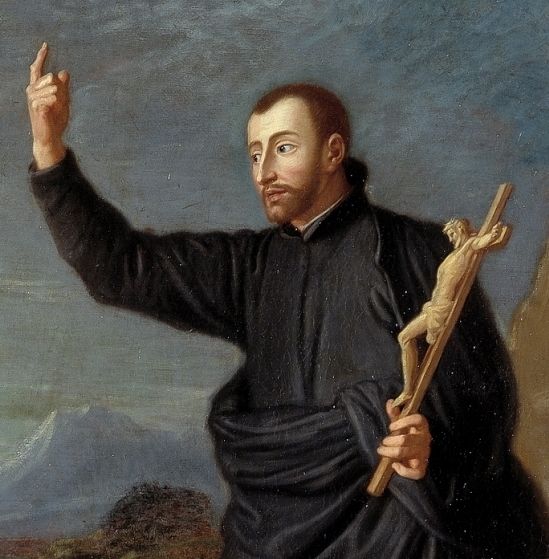
Image: San Juan Francisco de Regis.jpg · Michel Ange Houasse · Public domain, via Wikimedia Commons

From Sabine Baring-Gould, The Lives of the Saints, new edition in 16 vols. (London: John C. Nimmo, 1897–98); text from the Internet Archive scan (OCR, lightly cleaned; errors possible). Public domain.

Image: Michel Ange Houasse, Wikimedia Commons (Public domain)

From “Catholic Encyclopedia (1913)/St. John Francis Regis,” The Catholic Encyclopedia (New York: Robert Appleton Company, 1907–1914), via Wikisource. Public domain. Matched by name and feast date; text unedited except for our bracketed notes in grey.

From Sabine Baring-Gould, The Lives of the Saints, new edition in 16 vols. (London: John C. Nimmo, 1897–98); text from the Internet Archive scan (OCR, lightly cleaned; errors possible). Public domain in the United States. Reproduced unedited, except for short bracketed notes in grey that we added to explain names and terms (“S.” is the old abbreviation for Saint). Some history and judgments reflect 19th-century scholarship.