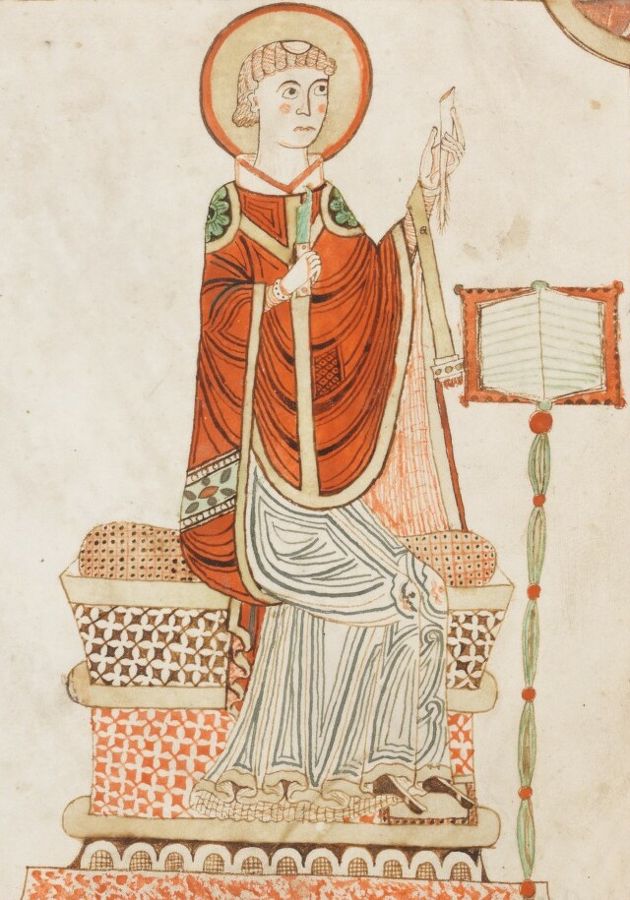
St. John I., Pope

Faithfulness to Christ when it cost everything.

Read the essentials →
May 27 · Martyr

St. John I.

St. John I., Pope

Faithfulness to Christ when it cost everything.

Traditional feast

May 27
1914 / pre-1969 calendar, per Baring-Gould (1897)

Current feast

May 18
Verified · General Roman Calendar

Represents

Martyr

Their story

Adapted in modern English from the Catholic Encyclopedia (1913) · original text below

John I, a Tuscan, was elected pope on 13 August 523. Of his administration nothing is known except his journey to Constantinople, which cost him his life.

Emperor Justin had issued a harsh edict against the Arians (followers of Arius's teaching that the Son is a created being, not fully God). Theodoric, the Arian Ostrogoth king of Italy, forced the pope in 525 to lead an embassy of senators to have it withdrawn. As head of the Church, John could only urge gentleness. Constantinople received him with honour: the emperor prostrated himself before him and was crowned by him.

Theodoric, who had just put Boethius and Symmachus to death, was enraged by an outcome so different from what he wanted. When John landed in Italy he had him arrested and imprisoned at Ravenna. Worn out by the journey and harsh treatment, John died there in May 526. He was buried in St Peter's and is honoured as a martyr.

Early life

The book says little or nothing about early life. This is how the account begins.

But towards the close of his reign a change of policy was forced on by the imprudence of the Eastern Emperor Justin. In 523 Justin in a terrible edict commanded all Manichseans to leave the empire on pain of death 3 other heretics were incapacitated for holding all civil and military office. The Arians, deprived of their churches and their rights as citizens, appealed to the Gothic king of Italy.

What they represent

How they teach us to live

Drawn from themes in the original account

Learn from the kind of life it was. Faithfulness to Christ when it cost everything.

Keep their day. Remember them on May 27 with a short prayer, and ask for their help.

From the Catholic Encyclopedia

1913 · 765 words

Died at Ravenna on 18 or 19 May (according to the most popular calculation), 526. A Tuscan by birth and the son of Constantius, he was, after an interregnum of seven days, elected on 13 August, 523, and occupied the Apostolic see for two years, nine months, and seven days.

We know nothing of the matter of his administration, for his Bullarium contains only the two letters addressed to an Archbishop Zacharias and to the bishops of Italy respectively, and it is very certain that both are apocryphal.

We possess information — though unfortunately very vague — only about his journey to Constantinople, a journey which appears to have had results of great importance, and which was the cause of his death. The Emperor Justin, in his zeal for orthodoxy, had issued in 523 a severe decree against the Arians [followers of Arius, who taught that the Son is a created being, not fully God], compelling them, among other things, to surrender to the Catholics the churches which they occupied. Theodoric, King of the Ostrogoths and of Italy, the ardent defender of Arianism, keenly resented these measures directed against his coreligionists in the Orient, and was moreover highly displeased at seeing the progress of a mutual understanding between the Latin and Greek Churches, such as might favour certain secret dealings between the Roman senators and the Byzantine Court, aiming at the re-establishment of the imperial authority in Italy. To bring pressure to bear upon the emperor, and force him to moderate his policy of repression in regard to the heretics, Theodoric sent to him early in 525 an embassy composed of Roman senators, of which he obliged the pope to assume the direction, and imposed on the latter the task of securing a withdrawal of the Edict of 523 and — if we are to believe "Anonymous Valesianus" — of even urging the emperor to facilitate the return to Arianism of the Arians who had been converted.

Read the rest of the article

There has been much discussion as to the part played by John I in this affair. The sources which enable us to study the subject are far from explicit and may be reduced to four in number: "Anonymous Valesianus", already cited; the "Liber Pontificalis"; Gregory of Tours [bishop and historian of the Franks (d. 594)]'s "Liber in gloria martyrum"; and the "Liber Pontificalis Ecclesiæ Ravennatis". But it is beyond question that the pope could only counsel Justin to use gentleness and discretion towards the Arians; his position as head of the Church prevented his inviting the emperor to favour heresy. That this analysis of the situation is correct is evident from the reception which the pope was accorded in the East — a reception which certainly would not have been kindly, had the Roman ambassadors opposed the emperor and this Catholic subjects in their struggle waged against the Arian sect. The inhabitants of Constantinople went out in throngs to meet John. The Emperor Justin on meeting him prostrated himself, and, some time afterwards, he had himself crowned by the pope. All the patriarchs of the East made haste to manifest their communion in the Faith with the supreme pontiff; only Timothy of Alexandria, who had shown himself hostile to the Council of Chalcedon, held aloof. Finally, the pope, exercising his right of precedence over Epiphanius, Patriarch of Constantinople, solemnly officiated at St. Sophia in the Latin Rite on Easter Day, 19 April, 526. Immediately afterwards he made his way back to the West.

If this brilliant reception of John I by the emperor, the clergy, and the faithful of the Orient proves that he had not been wanting in his task as supreme pastor of the Church, the strongly contrasting behaviour of Theodoric towards him on his return is no less evident proof. This monarch, enraged at seeing the national party reviving in Italy, had just stained his hands with the murder of Boethius, the great philosopher, and of Symmachus his father-in-law. He was exasperated against the pope, whose embassy had obtained a success very different from that which he, Theodoric, desired and whom, moreover, he suspected of favouring the defenders of the ancient liberty of Rome. As soon as John, returning from the East, had landed in Italy, Theodoric caused him to be arrested and incarcerated at Ravenna. Worn out by the fatigues of the journey, and subjected to severe privations, John soon died in prison.

His body was transported to Rome and buried in the Basilica of St. Peter. In his epitaph there is no allusion to his historical role. The Latin Church has placed him among its martyrs, and commemorates him on 27 May, the ninth lesson in the Roman Breviary for that date being consecrated to him.

Read more

The full original · 724 words

Read Baring-Gould’s full account

Baring-Gould’s sources: Roman Martyrology. Ado, Notker, Hrabanus, &c. Authorities: — The anonymous historian of the Csesars from Constantius Chlorus to Theodoric, published by Valesius, Anastatius Bibliothecarius, &c.] Theodoric the Goth, in all the earlier part of his reign, showed a spirit of remarkable toleration. Though inheriting the Arian tenets of his Ostrogoth forefathers, he behaved to the Catholics with rigid impartiality. Towards the close of the Gothic monarchy the royal ambassadors to Belisarius defied their enemies to prove a case in which the Goths had persecuted the Catholics.1 Theodoric treated the pope, the bishops, and clergy, with grave respect, in the more distinguished he ever placed the highest confidence. He showed as much reverence, and even bounty, to the church of S. Peter, as though he had been a Catholic. Theodoric himself adhered firmly but calmly to his native Arianism; but, all the conversions seem to have been from the religion of the king 3 even his mother became a Catholic, and some other distinguished persons of the Court embraced a different creed from their sovereign without forfeiting his favour. Theodoric was the protector of Church property, which he himself increased by large grants.

But towards the close of his reign a change of policy was forced on by the imprudence of the Eastern Emperor Justin. In 523 Justin in a terrible edict commanded all Manichseans to leave the empire on pain of death 3 other heretics were incapacitated for holding all civil and military office. The Arians [followers of Arius, who taught that the Son is a created being, not fully God], deprived of their churches and their rights as citizens, appealed to the Gothic king of Italy. It was precisely at this juncture that rumours of conspiracy 1 Procop. de Bell, Gothic ii., c. 6.

reached his ear. Vague intelligence of a correspondence carried on by the heads of the Roman senate with the emperor of the East, arrived at Ravenna. Indignation, not without apprehension, at this sudden, and as it seemed simultaneous, movement of hostility, seized the soul of Theodoric. The whole circumstances of his position demanded careful consideration. Nothing could be more unprovoked than the religious measures of Constantinople, as far as they menaced the West, and assailed those in the East who held the same faith as Theodoric. His equity to his Catholic and Arian subjects was unimpeachable; to the pope he had always shown respectful deference, he had taken no advantage of the contention for the pontificate by Symmachus and Laurentius to promote his own tenets. Even as late as this very year, he had bestowed on the church of S. Peter two magnificent chandeliers of solid silver. He at once arrested Albinus, the chief of the Roman senate, on the charge of holding treasonable correspondence with Constantinople. Severianus Boethius, the senator, was involved in the charge. This consummate master of all the arts and sciences known at that period had been raised to the consulate, and had received high marks of his sovereign’s esteem. His signature, forged as he declared, was shown at the foot of an address, inviting the emperor of the East to re-conquer Italy. He was condemned to imprisonment, and was incarcerated at Calvenzano, a castle between Milan and Pavia.

In the meantime the religious affairs of the East became more threatening to those who held the same religious creed with Theodoric. The correspondence between the monarchs had produced no effect, and Theodoric adopted the strange expedient of sending the pope to Constantinople to remonstrate with the Eastern emperor, and obtain toleration for the Arians. To the pope’s remonS- John /.

strances and attempts to limit his mediatorial office to points less unsuited to his character, Theodoric angrily replied, by commanding the envoys instantly to embark in the vessels which were ready for the voyage.

John I., a Tuscan by birth, was then pope, he had succeeded Hormisdas in 523. Of his acts little is known before he was sent on this expedition, except that he repaired the catacombs of SS. Nereus and Achilles, of SS. Felix and Adauctus. and of S. Priscilla.

S. Gregory the Great, in his dialogues, relates of his journey, how on the way he healed a blind man, and how he rode a horse which after it had borne the pope would never suffer a woman to mount his back. John was received in Constantinople with the most flattering honours. The whole city, with the emperor at its head, came forth to meet him with tapers, as far as the tenth milestone from the gates. The emperor knelt at his feet to receive his apostolic benediction. On Easter Day he said mass in the 'great church, Epiphanius the bishop ceding the first place to the more holy stranger. But of the course and success of his negotiations all is utterly confused and contradictory. By one account, now abandoned as a later forgery, he boldly confirmed the emperor in the rejection of all concessions. By another, he was so far faithful to his mission, as to obtain liberty of worship, and the restitution of their churches to the Arians. All that is certainly known is, that John the pope, on his return, was received as a traitor by Theodoric, thrown into prison, and there the highest ecclesiastic of the West languished for nearly a year and died. Even before his return, Boethius had been sacrificed to the suspicions and fears of Theodoric.

In prison Boethius wrote his great book, “ The Consolation of Philosophy,” which appears as the last work of Roman letters, rather than as eminent among Christian
Feast days

Feast: May 18
Traditional: May 27

Nine days · Free

Pray the novena
with us.

One short email a day for nine days. The day's prayer, a line from St. John I.'s story, and a nudge to keep going.

Also on May 27
St. Julius

St. Julius

May 27 · Martyr
St. Bede the Venerable, Ml

St. Bede the Venerable

May 27 · Deacon
F

St. Frederick of Liege

May 27 · Bishop
← All 1726 saints in the library
Sources & notes

Feast-day sources

Story sources

Sources

Credits

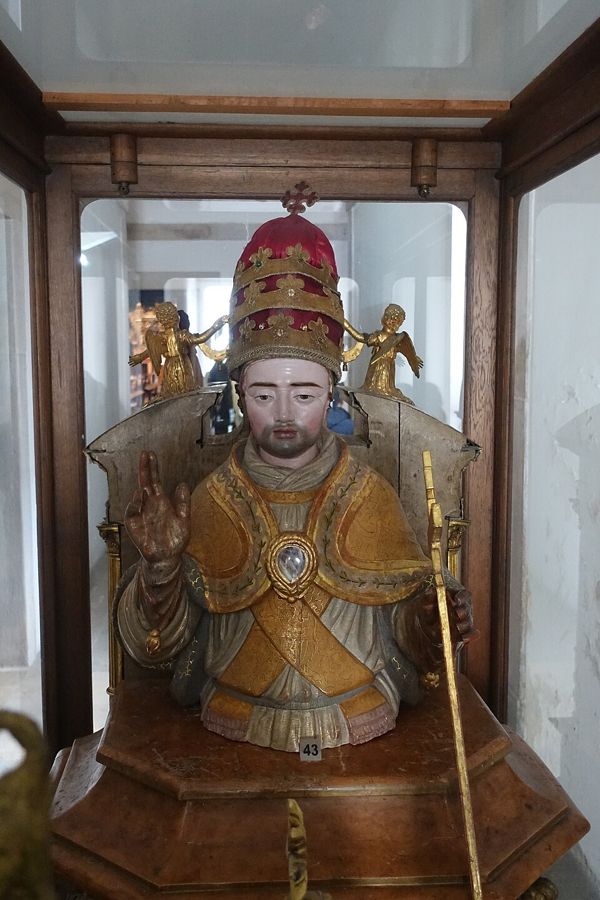
Image: Busto relicário do Papa São João I.jpg · Joseolgon · CC BY-SA 4.0, via Wikimedia Commons

From Sabine Baring-Gould, The Lives of the Saints, new edition in 16 vols. (London: John C. Nimmo, 1897–98); text from the Internet Archive scan (OCR, lightly cleaned; errors possible). Public domain.

Image: Joseolgon, Wikimedia Commons (CC BY-SA 4.0)

From “Catholic Encyclopedia (1913)/Pope St. John I,” The Catholic Encyclopedia (New York: Robert Appleton Company, 1907–1914), via Wikisource. Public domain. Matched by name and feast date; text unedited except for our bracketed notes in grey.

From Sabine Baring-Gould, The Lives of the Saints, new edition in 16 vols. (London: John C. Nimmo, 1897–98); text from the Internet Archive scan (OCR, lightly cleaned; errors possible). Public domain in the United States. Reproduced unedited, except for short bracketed notes in grey that we added to explain names and terms (“S.” is the old abbreviation for Saint). Some history and judgments reflect 19th-century scholarship.