Baring-Gould’s sources: Roman Martyrology. Authority:—the Bull of his Canonization by Innocent III.
S. John was born of pious and noble parents, at Faucon, on the borders of Provence, June 24th, 1169, and was baptized John, in honour of S. John the Baptist. His mother dedicated him to God by a vow from his infancy. His father Ephemius sent him to Aix, where he learned grammar, fencing, riding, and other exercises fit for a young nobleman. But his chief desire was to advance in virtue. He gave the poor a considerable part of the money his parents sent him for his own use; he visited the hospital every Friday, assisting the sick poor, dressing and cleansing their sores, and affording them all the comfort in his power.
On his return home he begged his father's leave to continue the pious exercises he had begun, and retired to a little hermitage not far from Faucon, with a view of living at a distance from the world, united to God alone. But finding his solitude interrupted by the frequent visits of his friends, he desired his father's consent to go to Paris to study divinity, and this he easily obtained. He accomplished his studies with extraordinary success, and received the degree of doctor of divinity with uncommon applause. He was soon after ordained priest, and said his first mass in the chapel of the bishop of Paris, at which the bishop himself, Maurice de Sully, the abbots of S. Victor and of S. Geneviève, and the rector of the university, assisted; admiring the graces of heaven in him, which appeared in his extraordinary devotion on this occasion, as well as at his ordination.
On the day he said his first mass, by a special inspiration from God, he resolved to devote himself to the ransoming of Christian slaves from captivity. But before he entered upon so important a work, he thought it needful to spend some time in retirement, prayer, and mortification. And having heard of a holy hermit, S. Felix of Valois, living in a great wood near Grandlieu, in the diocese of Meaux, he repaired to him, and begged he would admit him into his solitude. Felix soon discovered him to be no novice, and would not treat him as a disciple, but as a companion.
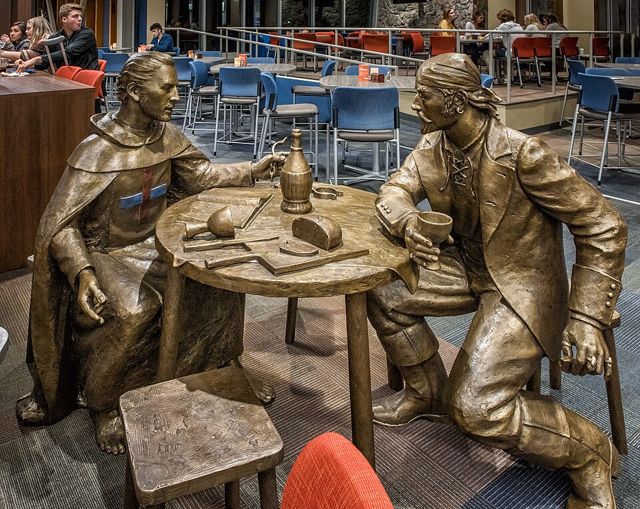
One day, as they were sitting together on the bank of a spring, John disclosed to Felix the design he had formed on the day on which he said his first Mass, of succouring the Christians under Mahomedan slavery, and spoke so movingly upon the subject, that Felix was convinced the design was from God, and offered to assist him in carrying it into execution. They took some time to recommend it to God by prayer and fasting, and then set out for Rome in the midst of a severe winter, towards the end of the year 1197, to obtain the Pope's benediction. They found Innocent III. promoted to the chair of St. Peter, and he being already informed of their sanctity and charitable design by letters of recommendation from the Bishop of Paris, received them as two angels from heaven; lodged them in his own palace, and gave them many long private audiences. After which he assembled the cardinals and some bishops in the palace of S. John Lateran [St. John Lateran, the pope’s cathedral in Rome], and asked their advice. After their deliberations he ordered a fast and special prayers, to ascertain the will of heaven. At length, being convinced that these two holy men were led by the Spirit of God, and that great advantage would accrue to the Church from such an institute, he consented to their erecting a new religious order, and declared S. John the first general minister. The Bishop of Paris, and the abbot of S. Victor, were ordered to draw up the rules, which the Pope approved by a bull, in 1198. He ordered the religious to wear a white habit, with a red and blue cross on the breast, and to take the name of the Order of the Holy Trinity. He confirmed it some time after, adding new privileges by a second bull, in 1209.
The two founders having obtained the Pope's blessing and certain indulgences, returned to France, presented themselves to the king, Philip Augustus, who authorized the establishment of their Order in his kingdom, and favoured it with his liberalities. Gauthier III., lord of Châtillon, gave them land whereon to build a convent. Their number increasing, the same lord, seconded by the king, gave them Cerfroid, near Grandlieu, the place in which S. John and S. Felix concerted the first plan of their institute. It is situated in Brie, on the confines of Valois. This house of Cerfroid, or De Cervo frigido, was the chief of the order. The two saints founded many other convents in France, and sent several of their religious to accompany the counts of Flanders and Blois, and other lords, to the Crusade. Pope Innocent III. wrote to recommend these religious to the Emir of Morocco; and S. John sent thither two of his religious in 1201, who, on the first voyage, redeemed one hundred and eighty-six Christian slaves. The year following, S. John went himself to Tunis, where he purchased the liberty of one hundred and ten more. He returned into Provence, and there received great charities, which he carried into Spain, and redeemed many in captivity under the Moors [the Muslims of North Africa and Spain]. On his return he collected large alms among the Christians towards this charitable undertaking. His example produced a second order of Mercy, instituted by S. Peter Nolasco, in 1235.
S. John made a second voyage to Tunis, in 1210, in which he suffered much from the infidels, enraged at his zeal and success in exhorting the poor slaves to patience and constancy in their faith. As he was returning with one hundred and twenty slaves he had ransomed, the barbarians took away the helm from his vessel, and tore all its sails, that they might perish in the sea. The saint, full of confidence in God, begged Him to be their pilot, and hung up his companions' cloaks for sails, and, with a crucifix in his hands, kneeling on the deck, singing psalms, after a prosperous voyage they all landed safe at Ostia, in Italy. Felix, by this time, had greatly propagated his order in France, and obtained for it a convent in Paris, in a place where stood before a chapel of S. Mathurin, whence these religious in France were called Mathurins.
S. John lived two years more in Rome, which he employed in exhorting all to penance with great energy and fruit. He died on the 21st of December, in 1213, aged sixty-one. He was buried in his church of S. Thomas, where his monument yet remains, though his body has been translated into Spain.