Baring-Gould’s sources: Canonized in 1729. Roman Martyrology. Authorities quoted in the article,] This saint is especially venerated as the martyr of the confessional.
He was the son of Wayland Wolflein of Pomuk, or Nepomuk,1 a village in Bohemia, was born in the year 1330, and was a sickly child, whose life was despaired of, but the prayers of his mother prevailed, and he grew to maturity. The piety of the child drew attention to him, and he was sent to study Latin at Staab, that he might follow the bent of his vocation, and enter holy orders [ordination; “orders” means the sacrament by which deacons, priests and bishops are ordained]. In the year 1378 he was appointed first notary to the archbishop, as is proved by a deed executed under his hand, now extant. The last time his signature occurs in this capacity is in 1380. In i38r he was made incumbent of the church of S. Gall [Irish companion of Columbanus, founder of the Swiss monastery that bears his name] at Prague, and in the same year took his degree as licentiate of canon law.2 His sermons are said to have produced a great effect. Everyone crowded to hear him, with the rest came the students of the university, and many whose lives had been irregular were melted by his appeals, and renounced their dissolute lives, to tread in future in the ways of sobriety and righteousness. His influence determined the archbishop to advance him to higher honours. In 1387, he was made canon of S. iEgidius in Old Prague, and the same year he took the degree of doctor of canon law. ItJ^eems probable, however, that before receiving this canonry, he was advanced temporally to the deanery of Prague, in 1382, for we find 1 In the Libri Erectionum, or Registers of Foundations, See., belonging to the see of Prague [a bishop’s “see” is his diocese, named from his seat (Latin sedes)], S. John signs himself in 1372, as “ John, son of Wayland Wolflein of Pomuk,” as also in two other documents bearing the dates 1374 and 1378. 2 This is proved by the lists of candidates preserved in the university archives, “John the Licentiate ” appointed in 1382, the year after he had passed as licentiate; but this office he held only provisionally, for in 1383 he vacated it, and was recompensed with the canonry, and the offer of the bishopric of Leitomischl, which became vacant in 1387, by the elevation of John III. to the bishopric of Olmutz, and the patriarchate of Aquileia.
In 1389 he was made canon of Wischehrad, in Prague, and in the same year was appointed vicar-general of the arch-diocese. As such his signature recurs over and over again in the diocesan registers. His colleague in the administration of the affairs of the see was Nicolas Puchnik, afterwards archbishop.
In 1390, he resigned the cure of S. Gallus to be invested with the archdeaconry of Saatz, which was vacated for him by one Leonhardt, who received in exchange the incumbency ofS. Gallus, and thus John of Nepomuk became a member of the cathedral chapter.
Wenceslas IV., king of Bohemia and emperor,1 succeeded his father, the Emperor Charles IV., in 1378, at the age of sixteen. Wenceslas had been brought up in pomp and luxury, at an early age initiated into the affairs of the empire, and, during his father's life-time, declared his successor to the imperial throne by the bribed electors. Wenceslas, called at too early an age to participate in the governmeut of the empire, treated affairs of state with ridicule, or entirely neglected them, to devote himself to idleness and drunkenness. At one moment he jested, at another burst into the most brutal fits of rage. The Germans, with whom he never interfered, beyond occasionally holding a useless diet at Niirnberg, deemed him a fool, whilst the Bohemians, who, on account of his residence at Prague, were continually exposed to his savage 1 He was crowned emperor at Aix-la-Chapelle. May i6j.S'. John of N 'epomuk. 229 caprices, regarded him as a ferocious tyrant. The possessions with which the Bohemian nobility had formerly been invested by the crown exciting his cupidity, he invited the whole of the aristocracy to meet him at Williamow, where he received them under a black tent that opened into two other tents, or wings, one white, the other red. The nobles were summoned into the imperial presence one by one, and were forced to declare that they received their land as fiefs of the crown. Those who voluntarily submitted were feasted in the white tent, those who refused were executed in the red tent. The massacre of three thousand Jews in Prague, on account of one of that nation having ridiculed the Holy Sacrament, gave Wenceslas the idea of declaring all debts owed by Christians to Jews to be null and void. He married Joanna, daughter of Albert of Bavaria. She died a shocking death in 1387. King Wenceslas had many large hunting-dogs, purchased for ■ him in all countries; of these the two largest and greatest favourites shared his bed room; and it is related that Queen Joanna was throttled by one of them, as she chanced to raise herself in bed, on the night of December Wenceslas married again in 1389, his second wife being Sophia of Bavaria. He behaved to her with great brutality, publicly exhibiting his preference for his mistress, Susanna, the Bathwoman.
The unfortunate Joanna chose John of Nepomuk as her confessor [in old usage, a saint who was not martyred, or who suffered for the faith without being killed], and after her death he became the confessor of Sophia. This queen was very beautiful,1 and the king became suspicious of her fidelity to him. He is said to have endeavoured to induce John of Nepomuk to break the seal of confession, and tell him what she had confided 1 “Mulier forma insigni ac corpore valde eleganti.’* Cuspinianus, p. 390. “Commendant ejus formam et vermstatem oris plurimi scriptores.” Balbinus, to his ear. The saint steadfastly refused. He incurred the king's anger in another way. It happened one day that a fowl was sent to his table insufficiently roasted. In a fury, he ordered the cook to be spitted and roasted alive at the same fire at which the fowl had been dressed. The poor servant was already placed before the fire, and the officers were preparing to execute the barbarous sentence, when S. John heard of it, and rushed into the dining-hall, flung himself before the king, and implored him to spare the unfortunate wretch. Wenceslas spurned him away, and ordered him to be cast into a dungeon. Whilst he lay in chains, the king again attempted to extort from him the secret of his -wife’s confession, but S. John remained inflexible. Wencenlas then ordered his release, and attempted to gain his object by favour and flattery. About the same time, a quarrel broke out between the archbishop and the king. Wenceslas was contemplating the erection of a new episcopal see in the south-west of his kingdom for the benefit of a creature of his own, and he was waiting for the death of the old abbot of Kladrau, to confiscate the revenues of the abbey for the establishment of the bishopric. But the abbot was scarcely dead, when the monks proceeded to the election of a successor, and the archbishop confirmed their choice by his two vicar s-general, so rapidly, and contrary to the express orders of the king, that the latter received intelligence of both events at one and the same time. Another cause of offence was the excommunication of the royal chamberlain for having executed two priests convicted of a dreadful crime. This the archbishop regarded as an encroachment on the prerogative of the Church, and resented it accordingly. An attempt at reconciliation was made by the king's councillors, and on March 20th, 1393, a meeting between the king and the archbishop was arranged at Prague. But Wenceslas sent the May x6.] 61 John of Nepomuk.
prelate, John of Genzenstein, an insulting letter, written in German: — “You archbishop, give me up my castle of Rudnicz, and my other castles, and be off out of my lands of Bohemia; and if you do anything against me or my men, I will drown you, and so make an end of the strife.” But the king himself burst into the chapter-house where the archbishop and the chapter were assembled, maltreated the old dean, by striking him over the head with his swordhandle, and having bound the two vicars-general, the provost of Meissen, and the marshal Niepro, carried them off to the castle. During the evening he tortured them on the rack, or at least one of them, John of Nepomuk, stretching him out on the rack, and applying lighted torches to his sides with his own hands. The others were allowed to depart with a reprimand, but John of Nepomuk was taken down half dead, a piece of wood was placed in his mouth to prevent him from speaking, and he was, by the king’s orders, taken to the bridge over the Moldau and cast into the river, with his hands tied behind his back.1 This took place at nine o’clock in the evening of March 30th, 1393. That night lights appeared on the water, above where the saint had been cast in, and towards morning the body floated ashore, the lights twinkling on the water above it, till it was cast up on the bank. It was then taken to the church of the Holy Cross, and a few days afterwards was buried in the cathedral.
The last deed bearing the signature of John of Nepomuk in the Registers of Foundations, bears date March 3rd, 1 Alban Butler, following Balbinus, tells the story differently. His account is certainly erroneous, as it cannot be reconciled with the facts as stated above, which are derived from the statement drawn up by the archbishop and sent to the pope in his appeal against Wenceslas next year. Balbinus says that after racking and torture, S. John went a pilgrimage to the miraculous image of S. Mary at Bnntzel, and that Wenceslas saw him on his return, as he was looking out of a window in his palace, and ordered him to immediate execution. S John may have made the pilgrimage after the first imprisonment, or shortly before this second one.
1393; the last in the Register of Confirmations of the See is March 14th, 1393, six days before his death. In the list of memorial masses, belonging to the cathedral, is the following entry: — “In the year 1396, Janeczko gives a charge of seven groschen per annum to be levied on his house at Aujezd, to be paid to Nicolas Puchnik (the coadjutor [an assistant bishop who will succeed the current one] of S. John) for a yearly memorial of the dean and archdeacon of Saatz, John of Pomuk, who was drowned in 1393/' The contemporary chronicler Hagen, in his addition to the “ Chronica des Landes Oesterreich,” says: — “ King Wenceslas, in the year 1393, in May, shockingly drowned a venerable priest and professor of canon law, named Master John.”
Andrew of Ratisbon [Regensburg in Bavaria], who was also a contemporary (he wrote in 1422), gives the same account under the same date. The chronicler who continued Pulkawa to 1450, says under the date 1393, “In this year John, the honourable doctor and vicar-general of the archbishop was drowned.” An anonymous Chronicle of Prague, ending T4r9, and therefore by a contemporary, places the drowning of John of Nepomuk between 1389 and 1394, without giving the exact date; but the Chronicon Palatinum, written in 1438, says, “ In the year 1393, Doctor John was drowned.” The Chronicon Bohemie or Lipsense, also by a contemporary, written in T4ii, says, “In the year 1393, on the day of S. Benedict [father of Western monks (d. c. 547), author of the Rule], John of Nepomuk was drowned.”1 1 It is curious that one of the charges brought against Buss at the Council of Constance had reference to the murder of John of Nepomuk. “Item. Ponitur quod in domo Wenceslai Piscaritoris post prandium immediate, coram magistro quodam et presbytero et aliquibus laicis, dicere non erubuit atque dixit quando facta fuit mentio de stibmersione D. Joannis pi® memori® et Puchniack et decani Pragensis detentione, quod interdictum poni debuisset, pr®dictus M. Joann Huss scandalose dixit: — Magnum quid quod illi propones detinetur ! Dicatis ratio nem, quare a laude Dei cessare deberet.” Pit. et Documenta, p. 165. S. John of Nepomuk.
Immediately after this outrage, the bishop, John of Genzenstein, escaped from Bohemia, where he deemed his ' life was endangered, and in the same year appealed formally to the pope against the king, and in that appeal he complained of the tortures and murder of his vicargeneral, John of Nepomuk.1 He afterwards resigned his see, and was not long after succeeded by Nicholas von Puchnik,2 the coadjutor of the saint, a man who speedily made himself odious in Bohemia for his avarice. There can be no manner of doubt therefore, that John of Nepomuk was drowned by order of the king in 1393. But the bull of canonization of S. John places his death in 1383, mislead by Balbinus, who wrote his “Bohemia Sancta” in 1670. Balbinus gave 1383 instead of 1393, as the date of the martyrdom of the saint, and made him the confessor of Joanna only, and not of Sophia. Balbinus was misled by Hajec i. Liboczan, who wrote the Annals of Bohemia in 1540. Hajec died in 1553. He was not an accurate historian, and he was probably misled by John having resigned the deanery of Prague in 1383, if the supposition be admitted that “John the Licentiate/' who occupied the deanery for a twelvemonth, was the same as John of Nepomuk, who was licentiate in that year, and who may have been put in as a stop-gap. Or Hajec may not have liked to represent the saintly John as the prede.— cessor of John Huss the heretic in the direction of the conscience of Queen Sophia, and therefore may have antedated his martyrdom to free him from all suspicion of having sowed the seeds of error in the queen's mind. Or what is more probable still, the mistake of ten years was a mere piece of carelessness.
1 Acta in curia Romana Johan, a Genzenstein; inPelzePs Geschichte Wenzels, 2 He resigned in 1396, and was immediately succeeded by Wolfram von Skworek, hut Wolfram died in 1402; and was succeeded by Nicolas Puchnik. The error was pointed out by the Jesuit Andreas Freiberger, in 1680. but his correction was overlooked at the canonization of S. John.
Another objection has been raised against the received story of the martyrdom of S. John. In all the contemporary notices of the murder, there is no mention of the execution having taken place because he refused to divulge the queen’s confession, but only because he had acted against the king’s wishes in the matter of the abbey of Kladrau. It is, therefore, asserted that the story of his being a martyr because he refused to break the seal of confession is fabulous. But it may be remarked that the king could not have proceeded against the priest for his refusal to divulge the secrets of the confessional, without raising such a storm against him as would have driven him from his throne, and the matter of the abbey was just such an one as he could allege as an excuse for his barbarous treatment of the vicar-general. That the matter of Kladrau was only an ostensible reason for the murder appears from the fact of the king letting the real offender, the archbishop, depart unmolested, and also from his having dismissed Nicolas Puchnik, the other vicar-general, and the provost of Meissen. On John alone did he vent his fiendish rage, and repay what must have been a personal grudge, by torturing him with his own hands, till the priest was almost dead. That there was some covert reason for this murder hidden under the reason openly alleged, is rendered also very probable from the following testimonies. The Prague Chronicle says that Wenceslas killed the canon “ because John had remonstrated with the king for his crimes,” and Andrew of Ratisbon, in 1422, and therefore a contemporary, says that one reason of the drowning of John was that he had rebuked the king for his misgovernment, as rendering him unworthy of his crown.
May i6.{J S. John of Nepomuk, But there is other evidence. Thomas Ebendorfer of Haselbach (d. 1460), who wrote the “Chronicon Austriacum,” and the Acts of the Council of Basle, the first session of which was in 1431, says in his “ Liber Augustalis ” tha* John of Nepomuk — “ Confessor to the wife of Wenceslas — was drowned in the Moldau, as it is reported, because he refused to break the seal of confession.” Paul Zidek, dean of All Saints, at Prague (in 1470), says that “the king having a bad opinion of his wife... came to John of Nepomuk, and asked him to tell him with whom she had held forbidden relations... and as John would not tell him, the king drowned him.”
A passage was extracted by Berghauer, “ Protomartyr Poenitentise,” 1736, from the Zittau Chronicle, tells the same tale, but gives the wrong date. But this passage is suspicious. The Zittau Chronicle does not now exist. The style in which the event is related precludes the possibility of its having been written by a contemporary.1 At any rate Ebendorfer shows that some thirty or forty years after the death of John of Nepomuk the belief existed that he had died because he would not break the seal of confession, and this opinion could hardly have arisen without some good cause. And this, moreover, has been the constant tradition in Bohemia. It has been objected that the bishop in his appeal to the pope referred only to the reason for the murder alleged by the king, and that, therefore, there was no ulterior reason. But this is not self-evident The object of the archbishop was to show that the plea put forward by the king to justify his act did not do so; and the archbishop could not in a formal appeal make the accusation that the king suspected his wife’s fidelity, and had endeavoured to force her confessor to her confess or,” &c.
[May i6. betray her secret confession, without causing public scandal. The tomb of the saint was opened in 1719, on April 14th, and though the rest of the body was reduced to bone and dust, the tongue was found to be incorrupt. Pope Innocent XIII. confirmed the veneration in which the saint was regarded in Bohemia, by a decree equivalent to a beatification, and the bull of his solemn canonization was published by Benedict XIII. in 1729. The saint now reposes in a silver shrine in the cathedral of Prague. March 20th, the day on which S. John suffered, being the double feast of S. Benedict, the feast of S. John Nepomucen has been transferred to May 16th.
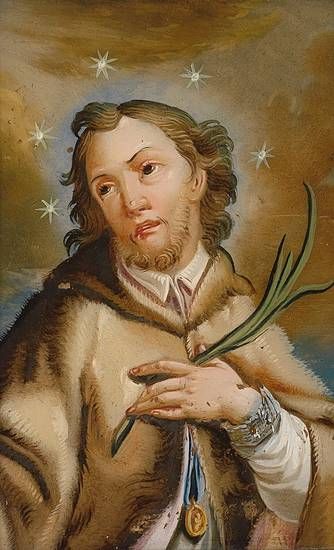
In art S. John is represented with surplice and purple stole, his finger to his lip, a canon's fur liripipit over his shoulders, and a doctor's four-horned biretta on his head. Seven stars, to represent the flames that were seen above his body, surround his head. On the bridge over the Moldau is a metal plate marked with the seven stars, to indicate the place where the body of the saint was thrown into the river.