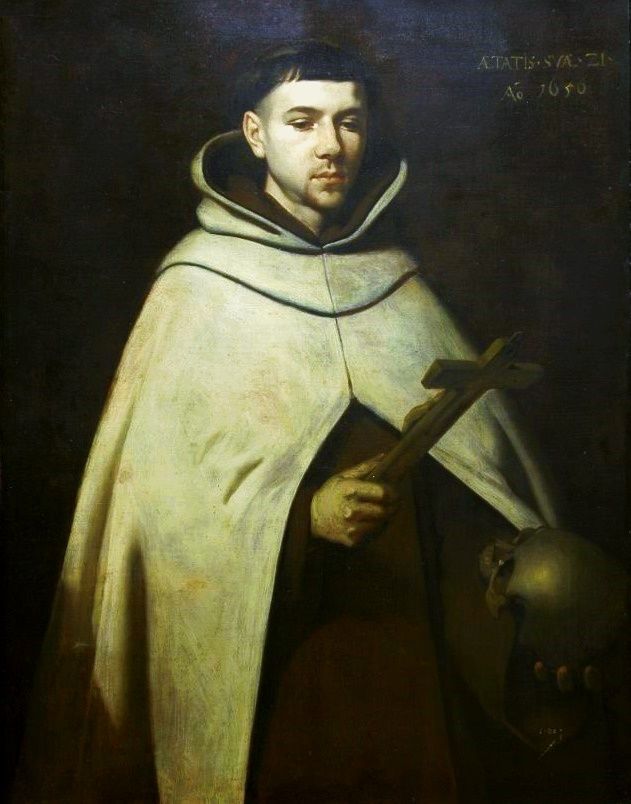
Baring-Gould’s sources: Roman Martyrology. Canonized by Benedict XIII. in 1726, when his office was appointed for Nov. 24, though he died on Dec. 14. Authorities: — A Life by F. Honoratus a Santa Maria; another by F. Dositheus a S. Alexis, Paris, 1727.] S. John of the Cross was born at Fontibere, near Avila, in Old Castile, in the year 1542. His family name was Yepez, and he was the son of Gonzales di Yepez and of Catharine Alvarez. His father died whilst he was still young, and he was left to the care of a mother, who instructed him from earliest infancy to turn to Mary as the fountain of solace and salvation. Consequently throughout life he manifested the most tender, unquestioning devotion to the Blessed Virgin, and was constantly in the humour to believe himself the object of her special favour.
His mother lived with him at Medina, and sent him to the Jesuit College, there to be instructed in letters, probably intending him for the Church. The administrator of the hospital associated the young man with him in the care of the sick, and John spent all his leisure in nursing the patients in the hospital with the utmost zeal, patience, and gentleness.
When he had attained the age of twenty-one, he assumed S. John of the Cross. the Carmelite habit at Medina, fully believing the Blessed Virgin to be the special patroness of this Order. The Carmelite Order was founded by B. Albert, Latin patriarch [the title of the bishops of the great ancient sees: Rome, Constantinople, Alexandria, Antioch, Jerusalem] of Jerusalem, in 1209, who founded a community of hermits on Mount Carmel, and pretended that he had seen Elijah in vision, who urged him to continue and develop his old school of the prophets formerly established there. The Carmelites endeavoured to convince themselves and the world that their Order had never ceased since the time of Elijah, and adopted a mantle striped black and white, asserting that this was fashioned after the cloak of Elijah which he cast from him as he ascended into heaven, and gave to Elisha as the habit of his Order, and that the mantle, originally white, had been scorched by the flaming chariot wheels, and thus originated these bars. Either the Order was laughed out of this pretence, or had come to the conclusion that the whole mantle was scorched, but certain it is, that it abandoned its striped habit for one entirely dark. John Yepez having entered this Order, was sent to Salamanca to go through a course of theology. He gave himself up to singular and distressing mortifications. He made for himself a trough of boards like a coffin, and slept in it in a cell at the end of the dormitory. He fasted, and wore a rough sackcloth next his skin, which rubbed sores in it. He affected unworthiness to become a regular member ot the society, and entreated to be allowed to be only a lay brother; but his superiors would not listen to his appeal, and he was ordained priest when he had attained the age of twenty-five. He prepared himself for his first Mass by subjecting himself to fresh mortifications, regarding every torture to which he subjected his body as a savoury oblation in the nostrils of the God of love and compassion. The Carmelite rule no longer satisfied the hunger after excessive self-immolation in this advanced ascetic of fiveand-twenty. and after a brief sojourn in the Order, he meditated transferring his valuable allegiance to another, that of the Carthusians [a strict order of hermit-monks founded by St. Bruno in 1084].
But at that time he met S. Theresa, who Avas engaged on a reform of the Carmelite Order. The meeting took place at Medina del Campo. She set herself to work to dissuade him from entering the Carthusian Order, and to persuade him to Avork Avith her at the reform of the Order of Our Lady of Mount Cannel. She told him that she Avas authorized by the general to found two houses for men, and that he Avas undoubtedly chosen by God to assist her in this holy work. Not long after, in 1568, Avhen he Avas aged twenty-six, he took up his residence in the little house S. Theresa had obtained at Durvello. But before taking this decided step, S. Theresa carried off S. John of the Cross with her, from his monastery to Valladolid, that he might see the foundation of one of her convents there; and Avhile engaged with the Avorkmen directing the alterations and additions that had to be made before the house could be adapted to the purposes of a nunnery, she described to John of the Cross the life led by the nuns, their mortifications, amusements, and their style of conversation.1 Immediately after the convent was completed and taken possession of, “ Ave arranged,” says S. Theresa, “ that Father John de la Cruz should go to the house (at Durvello), and prepare it in such a Avay that he might be able to enter it as he desired, for I made all haste to have a beginning, because I Avas greatly afraid some obstacle might come in the Avay, and so the business was done. Father Antonio (of Jesus, late Prior of S. Anne’s, Medina), had already collected a feAV things that Avere necessary, and Ave helped as Avell as Ave could, which Avas but little. He came to speak to me at Valladolid, and Avas full of joy, telling me AA’hat he had prc1 S. Theresa, “ Book of the Foundations,” c. 12. vided, which was scanty, but how he had got together five hour-glasses, which made me laugh heartily. He told me that as he wished to keep the exact hours, he did not wish to go unprovided. I think they had, as yet, no place to sleep in. There was little delay in fitting up the house, for though they wished to make several alterations, they had no money. After this, Father Antonio renounced his priorship with great willingness, and took the vows of the First Rule; and though I told him to try it at first, yet he would not, but went to the little house with the greatest content in the world. Father John (of the Cross) was there already. To neither of them did the house appear inconvenient, but rather they imagined that they lived amidst great delights. O my God ! how little do such buildings and exterior delights contribute to interior joy ! On the first or second Sunday in Advent (I do not remember which), in the year 1568, the first mass was said in that little portal of Bethlehem, for no better name did it appear to me to merit. The following Lent [the forty days of fasting before Easter], as I was going to the foundation of a convent at Toledo, I passed by it, and came there one morning while Father Antonio de Jesus was sweeping the door of the church, with a cheerful countenance, such as he always has. I said to him, 4 What is this, father ? what has become of your dignity ? ’ He replied, ‘ I consider that time badly spent when I was in the enjoyment ot honour/ When I went into the church I was astonished to see the spirit our Lord had produced there; and not only I myself but two merchants also, friends of mine, who had come with me from Medina, did nothing but weep, so many crosses and skulls were there. Never shall I forget one little wooden cross, which was placed over the holy-water stoup, to which was fastened a paper Christ, and which produced more devotion than if it had been a crucifix very elaborately carved. The garret formed the choir, which was high towards the middle, so that they could recite the Hours; but to enter it in order to hear mass, they were obliged to stoop very low. They made two little hermitages on each side of the church, where they could only sit or lie down, and filled inside with hay, because the place was cold; their heads almost touched the roof. Towards the altar were two little windows, and two stones served for pillows: here also were crosses and skulls. I understood that after the singing of Matins [the night prayer of the Divine Office], they returned to their cells, not to sleep, but to continue in prayer, an exercise which they enjoy to a high degree. It happened many times that when they went to say Prime, they found their habits covered with snow, and they had not perceived it falling on them, so absorbed were they in prayer. They recited the Hours with another father of the relaxed rule, who came to live with them, though he did not change his habit, being of a weak constitution. Another religious young man lived with them also, not in holy orders [ordination; “orders” means the sacrament by which deacons, priests and bishops are ordained]. They went about preaching in many neighbouring places, where the people were very ignorant, so that I am glad in this respect that the house was erected in a spot so far from any monastery, whence the people could get instruction. In a short time the two fathers gained so great a reputation, that, when I heard of it, it gave me the greatest consolation. They went to preach six or eight miles off, bare foot, for they wore no sandals then, though afterwards they were commanded to wear them. They went in the midst of cold and snow, and when they had finished preaching and confessing, they returned very late to their meal, but with such joy, that all their sufferings seemed but little to them. As for food, they had sufficient, for the people in all the neighbourhood provided them with a superfluity. Some gentlemen who came to the church to confession, offered them better houses and better situations. Among them was one Don Luis, lord of five villas; this gentleman had built a church for a picture of Our Lady, worthy indeed of veneration. His father had sent it from Flanders to his grandmother or mother (I forget which), in the care of a merchant, who became so fond of it that he kept it for many years, but on his deathbed commanded it to be restored to the rightful owner. It is a large picture, and in my whole life I have not seen a better; and others say the same. Father Antonio de Jesus having gone there at the gentleman’s request, was so taken with the picture that he consented to found a monastery there. The place is called Mancera. The gentleman built a small house for them, suitable to their profession, and gave them furniture and many other things. When I saw this little house, which a short time before could not be inhabited, endowed with such a spirit that wherever I turned I found something to edify me; and when I understood the manner of living of the fathers, and the good example they set, I could not sufficiently thank the Lord, so excessive was my interior joy, for I thought I already saw a foundation laid for the great increase of our Order and the service of the Lord. The merchants who passed along with me told me that they would not for all the world have neglected going there. What power there is in virtue ! they were more pleased with that poverty than with all the riches they possessed, and. their minds were thereby greatly edified.
“After these fathers and myself had spoken about certain matters, I earnestly requested them not to mortify themselves with such excessive rigour, for since it had cost me so much prayer and desire to obtain such persons to begin the work, I was afraid lest the devil should find means of bringing them to their graves before the work was fully completed; and being so imperfect, I did not consider their proceedings to be the work of God, and that His Majesty could strengthen them to go through with them. But they being endowed with those virtues which I lacked, took no notice oi my words, and continued their self-mortifications.” 1 Father Antonio, and Father John of the Cross, remained 1 S. Theresa, “ Book or the Foundations,” c. 13. VOL. XIV.
together at Durvello the following year, 1569, when the Princess of Eboli, mistress of Philip II., and her husband Ruy Gomez, founded a nunnery and a monastery of Discalced Carmelites at Pastrana, and Father Antonio was removed from Durvello to become the head of the friars there. Father John of the Cross remained at Durvello. He met with much external and internal trouble. The reform was assailed by enemies, and its members regarded as runaways from their Order, and perhaps as infected with heresy. His soul was also troubled with fits of deep depression, in which he thought the face of God was withdrawn from him, a state of spiritual misery to which he has given touching expression in his book entitled “ Noche obscura del Alma 99 (the dark night of the Soul).
The inconvenience of Durvello, and the offer of the house and Flemish picture at Mancera, led to the transfer of the monastery thither in 1570. Since then there has existed considerable rivalry between the houses of Pastrana and Mancera, as to which should be regarded as the mother house; Pastrana was founded before Mancera, but Mancera was the community of the monastery of Durvello moving to a more congenial spot. Durvello, having been deserted, returned to the estates of the donor; but in 1612, the Discalced Carmelites, having regretted their abandonment of the house in which their reform took its rise, bought it back again.
In 1570 John of the Cross was sent to Pastrana to take charge of the new house. He found there fourteen members collected by S. Theresa and Father Antonio, of these ten were novices, and four professed friars.
In 1571 he was moved from Pastrana to take charge of a new house founded at Alcala. But his successor at Pastrana, by his over-strictness, brought the novices to insubordination, and S. John was speedily recalled, to bring back order to the disturbed community.
— tP Nov. 34.3 S- John of the Cross. 533 In the same year, however, or the beginning of the next, he was hastily called by S. Theresa to assist her at Avila, where the Apostolic Visitor of the Carmelites in Castile had appointed her prioress of her old Convent of the Incarnation, from which she had escaped nine years before with a party of nuns to found her reform.
This appointment met with great opposition from the nuns, from the people of Avila, and from the magistrates of the town. The Convent of the Incarnation had been a great resort of ladies and gentlemen disposed for an afternoon gossip, and the nuns had been always ready to visit and stay with friends and relatives, when they were tired of the routine of cloister life; and, as the memoirs of S. Theresa reveal to us, were not altogether repugnant to a little flirtation, if carried on quietly. “ All this must be altered,” was the decision of the Visitor, and S. Theresa was the right person to reform the relaxed house. No wonder that she met with opposition. She was obliged to send for S. John of the Cross to assist her in her struggle against overt and covert hostility.
The wrath and envy of the Carmelite Order against the innovators, or rather reformers, could find no vent so long as S. Theresa and her disciples were supported by a papal nuncio and by the king, the latter of whom, if a man of unbounded licentiousness in morals, was a man also of unbounded devotion to the professors of asceticism. But in 1575 the Grand Chapter of the Order in Spain passed decrees against the Discalced Carmelites, and the General of the Order sent Father Geronimo Tostado into Spain as his Visitor, to press on the king the necessity for suppressing the reform, or schism as he, not unreasonably, regarded it. At this time also the papal nuncio who had favoured S. Theresa, most inopportunely died, and was succeeded by another who disapproved of her work. In 1577 the Carmelite Visitor, F. Tostado, obtained a band of soldiers, and bursting open the doors of the house where S. John of the Cross lived, seized and carried him off to Toledo, where he was brutally cudgelled, and thrown into a dark dungeon, into which light only penetrated through a little hole of three fingers' breadth, and where he was kept in filth, rags, and starvation by the Carmelite superior, for nine months, till his health was so shattered that the religious were in very shame obliged to release him, lest he should die under their ill-treatment. He was sent to a wretched convent of Calvary, in the country. But though the Discalced were under a cloud, they were not exterminated. Philip II. took them under his favour, and in 1579 John was able to found a monastery at Baeza, and in 1581 he became prior of a reformed Carmelite house at Granada. In 1585 he was made Vicar-provincial of Andalusia, and in 1588 first definitor of the Order.
His austerities exceeded the bounds of moderation and reason. He slept for only two or three hours in the night, and spent the rest of the night in prayer or dozing; and in the semi-devotional, semi-somnolent condition in which he knelt, he — as might have been expected — was visited by all sorts of visions, waking dreams, conjured up by a brain deprived of its natural rest. These were generally of an edifying nature — or at least those which he communicated to his brethren were such. In one of these dreams he thought he heard Christ say to him, “ John, what recompense dost thou ask for thy labours?" He answered, “None, Lord, save that I may suffer and be condemned for Thy love." He was wont to say, “To suffer for the sake of God is the true characteristic of His love, as we see in Christ, and in the martyrs. And persecutions are the means whereby we may enter into the depth, or attain to the knowledge, of the mystery of the cross, a necessary condition for comprehending the depth of the wisdom of God and of His love." His great ambition was to be miserable. He often prayed that three things might happen to him. 1st. That he might not pass one day of his life without suffering something. 2ndly. That he might not die Superior. 3rdiy. That he might end his life in humiliations, disgrace, and contempt. He was frequently found by those who came to consult him in a dazed, halfconscious condition, consequent on want of sleep, but believed to be the bewilderment of a soul recovering itself from ecstasy. Many persons with lively imaginations asserted that they had seen his face shine with a supernatural light. One lady, it is pretended, was so struck with this illumination as she came to him for confession, that she laid aside her jewels, and dedicated herself to the religious life. The whole furniture of his cell consisted of a rush cross with a paper Christ attached to it.
His acquaintance with his own condition when praying when he ought to have been asleep, enabled him to judge ot the value of visions appearing to other persons in the same condition, and he was able to assure them that what they regarded as Divine manifestations were very often only waking dreams. His unhesitating judgment on visions is, that they are to be rejected. “ These imaginary visions and other supernatural impressions to which the senses are subject without the assent of the will, I maintain should be avoided and not dwelt on by the soul, upon all occasions and at all times, whether in the perfect or in beginners.”1 Directors, he says, have done great mischief by encouraging their penitents in a visionary habit. “ There are some spiritual directors who fall into error because their instructions to those who are liable to visions are such as to lead them astray or perplex them. They suffer their penitents to make much of their visions, and attaching so much importance to these visions they fail to build them up and stablish them in faith. This sort of direction shows that they themselves consider visions 1 “Ascent of Mount Carmel," b. ii. c. 17. to be matters of importance, and their penitents, observing this, follow their example and dwell on these dreams, instead of bracing up their faith. This is the necessary result of the language and conduct of spiritual directors \ for, somehow, a certain sense of satisfaction springs up at these things, and that draws away the eye from the depth of faith into which it should gaze. The penitent, finding the confessor [in old usage, a saint who was not martyred, or who suffered for the faith without being killed] very appreciative of them, is induced also to magnify them, indulge in them, give way to them, and hold them in mighty esteem. This sort of direction is the source of many imperfections, to say the least, to the soul. It makes the soul lose humility and get self-satisfied; and the devil is not slow to foster this.”1 With strong good sense he argues that visions, even though presumably coming from God, are very likely to deceive, and that, therefore, the less attention paid to them the better.
S. John of the Cross was a vernacular poet of no low order. The poem which he composed as the text to his “Dark Night,” formed on the model of the Aubades of the Troubadours, is not undeserving of ranking with the amatory compositions of Bertrand de Born and Giraud de Borneil. It has its counterpart in the aubade “ En un vergier” by an unknown troubadour. It does not fall behind the graceful little piece in its poetic power, or in the sensuality of the picture it paints. The religious who reads the “ Dark Night ” is likely to be distracted from the cold regions of ascetic theology to the ardour of sensual imaginings conjured up by this unseemly though very beautiful poem. S. John takes the first two verses and explains them mystically, line by line. They represent a maiden eloping at night down a ladder from her house, when all within are asleep, to ' meet her lover, who is hiding in a grove for her. The six last verses, descriptive of the meeting, S. John abstained 1 “Ascent of Mount Carmel,” b. ii. c. x8. S. John of the Cross.
from explaining; he would have done better to have abstained from writing them. The poem entitled the “ Spiritual Canticle between the Soul and Christ,” is based on the Song of Solomon. The “ Living Flame of Love ” is descriptive of the human passion of a mistress for her lover, whom she has admitted to her chamber, which may be compared with one of Herrick’s warmest compositions. It has, however, quite another signification in the mouth of a mystic to whom earthly passion is unknown.
It is to be regretted that S. John of the Cross, who was possessed of such good sense in his estimate of visions, should have encouraged instead of checking that sentimental love of Christ in the breast of nuns, which has run in hysterical persons to such dangerous lengths.1 S. John held in dislike the dressing up of images of the saints with artificial hair and jewels, and with laces and velvet and satin gowns. “ There are people,” he says, “ who squander that inward devotion which ought to be spiritually directed to the invisible saint, in demonstrations of endearment and curiosity towards the image, and all love and joy end there. This is an effectual hindrance to real spirituality. And this is clearly visible in that hateful custom observed 1 As the following, from the Diary of the B. Marie de T Incarnation: — “ Allant b l’oraison, je tressaillois en moi-meme, et disois: Allons dans la solitude, mon cher amour, afin que je vous embrasse a mon aise, et que, respirant mon ame en vous, elle ne soit plus que vous-meme par union d’amour Puis, mon corps etant brise de fatigues, j’etois contrainte de dire: Mon divin amour, je vous prie de me laisser prendre un peu de repos, enfin que je puisse mieux vous servir, puisque vous voulez que je vive Je le priois de me laisser agir: lui promettant de me laisser apres cela consumer dans ses chastes et divins embrassements O amour ! quand vous embrasserai-je ? N’avez-vous point pitie de moi dans le tourment que je souffre ? helas F helas ! mon amour, ma beaute, ma vie ! au lieu de me guerir, vous vous plaisez b mes maux. Venez done que je vous embrasse, et que je meure entre vos bras sacrez ! M Some pupils of Marie de I'lncamation also had mystical marriages with Christ; and the impassioned rhapsodies of one of them being overheard, she nearly lost her character, as it was thought that she was apostrophizing an earthly lover. Is it to be wondered at that S. Christina and S. Rose of Lima, in these unwholesome conditions of combined sexual and religious exaltation, should have supposed that they had received favours which no longer left them virgins ?
now-a-days by certain persons who, instead of holding in abhorrence the vanities of the world, adorn the sacred images with the garments fashionable at the time, invented for the satisfaction of wanton recreation. They dress up the images in those garments which are objectionable when worn by themselves, and which the saints would certainly have held in detestation. The result is, that all modest and sound devotion in such people disappears, to make way for a superfluous decoration of images, and to them they cling, and on them base all their joys. You see people who are never tired of adding image to image; and they hold to their images as Micah did to his idols, who when he lost them ran out of his house crying because they had been taken away.”
“ When many people go on a pilgrimage,” he says elsewhere, “ I should advise staying at home, for in general, men return from pilgrimages more dissipated than they were before. And many become pilgrims for recreation more than for devotion.”
In 1591 the Reformed Carmelite Order broke into factions. John of the Cross was dismissed his offices, and sent to the lonely monastery of Penguela, on the mountains of the Sierra Morena. Some members of the society whom he had forbidden to preach, when he was provincial of Andalusia, now became his principal accusers and enemies. One of them, F. Diego Evangelista, spread everywhere ugly reports of his conduct, which he probably regarded as insane, and he was accused of heresy. He found himself forsaken of all. Those who received his letters burned them, lest they should be involved in his disgrace. John of the Cross was ordered to leave Penguela and go to Baeza or Ubeda. He chose the latter. He had been for some time suffering from ulcers. The fatigue of his journey caused these ulcers to burst, and discharge. The prior behaved towards him with great inhumanity, forbade any one visiting him, locked him up in a tiny cell, denied him necessary food, and dismissed the infirmarer for treating him with compassion. Sectarian envy and spite seemed to have extinguished the common instincts of humanity in the breast of the holy prior Francis Chrysostom of Ubeda.
Fortunately the provincial came that way, and when he found how barbarously the sick and dying man had been treated by his religious brethren, he rated the prior soundly. Two hours before S. John died he repeated the Miserere ?nei with his brethren; then he desired one to read to him part of the book of Canticles, and during the lection appeared in transports of joy. He at length cried out, “ Glory be to God!” pressed the crucifix to his breast, and after some time said, “ Lord, into Thy hands I commend my spirit,” with which words he calmly breathed forth his soul on the 14th of December, in 1591, at the age of forty-nine years, of which he had spent twenty-eight in a religious profession. S. Theresa in her epistles styles him a saint even before he had embraced her reformed Order, and says that he was one of the most pure souls in the Church, to whom God had communicated great treasures of light, and whose understanding He had filled with the science of the saints.