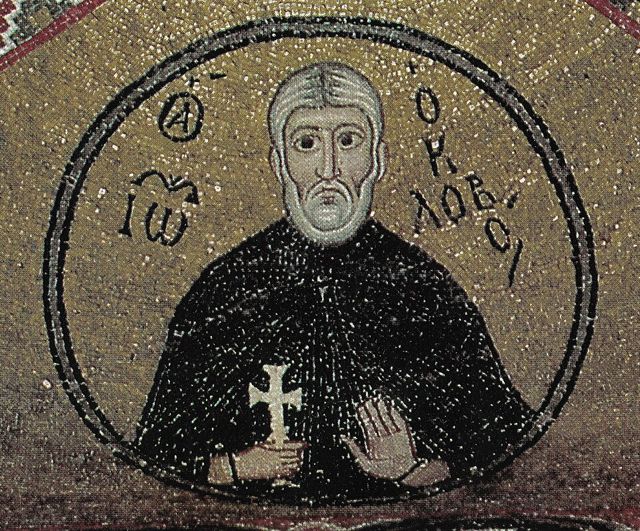
Baring-Gould’s sources: By the Copts on Oct. 17, but by the Greeks and Russians on Nov. 9. Authorities: — Mention by Sulpicius Severus, S. Nilus, in the “Life of S. Arsenius,” and the “ Lives of the Fathers of the Desert.”] When the great S. Arsenius presented himself before the solitaries of Scete, asking to be received among them, none was thought more suitable to be his master than the venerable John the Dwarf. Arsenius was brought to his cell. John sat down to eat with his disciples and the other monks, leaving Arsenius standing unnoticed. After a while he pretended to observe the tutor of the emperors, and he flung a loaf of bread on the floor, and said contemptuously, “ There, take and eat that” Arsenius knelt down and ate the bread on the ground. “That will do,” said John, “the man is humble. I will receive him as my disciple.” Nothing of the early life of John is known. He was a very little man, and like most little men, was peppery. Indeed, his temper was his great trial. Whenever he felt angry with anyone, he took to his heels and ran off to a distance till his temper had cooled down. If two monks were quarrelling he would do the same, fearing lest his natural impetuosity would involve him in the dispute.
When young in the religious life, he said to his elder brother who lived in the cell with him, “ I long to be as an angel ! I will go and lead the angelic life in the desert.” So he went away into the wastes of rock and sand, and got very tired of it in a few days, so he came back. It was night when he reached his brother’s cell and knocked at the door. His brother did not open, but called out to know who was there. “ It is I, John,” replied the little man. “ That cannot be,” answered the brother; “ he is not a man like us any more; he has become an angel” And he left him outside all night. When morning dawned he went out, and saw John crouching at his door. “Why, how is this? Why did you not come in ? Angels can pass through closed doors.”
So John was humbled. After some time he became a complete master of his temper, and was a model of gentleness. One day he sat at the door of the church at Scete, and a number of hermits crowded round him to talk to him, and listen to his advice. An old hermit passing by was jealous; and looking scornfully on the little man, said, “Bah! courting the eyes and attention like a painted harlot” “ Yes, yes,” said John, humbly, “lam too fond of attracting attention.”
“A little pitcher full of spite, that is what you are !” said the hermit “ Ah ! friend, there are worse things in the little pitcher than spite, if you could peep inside,” answered John, gently. S. John the Dwarf.
He thought much of obedience. A disciple placed himself under his instruction, and asked what he must do. “ Do !” said the dwarf, “ take my walking stick, plant and water it” The young man did so, and though he had to fetch water from a great distance, he watered it daily for more than two years. The thorn stick took root, put forth leaves and flowers, and finally was covered with scarlet berries. John plucked a handful of them, took them to the church, and said, “See the fruit of holy obedience.” “ How do you resist temptations?” he was asked. “ I fight against them.”
“ But sometimes they are more than one can resist ? ” “ If I am sitting under a palm tree, and scorpions and wasps assail me, I beat them off with a stick and with my hands. But when they are too numerous for me I escape up the tree. It is so with my temptations. When I have no more power myself I take refuge in God.” A young lady of some fortune showed great hospitality to the hermits when they went to town to sell their baskets and mats. But after a while she fell into grave moral faults, and gave up receiving the solitaries. John the Dwarf went to the town, and knocked at her door. The servants wanted to drive him away, but he persisted in demanding admission, and he made his way at last to her room. He seated himself beside her, and said, “Thou complainest that Jesus Christ has abandoned thee. Or hast thou abandoned Him ?” Then he kept silence. She looked at him and saw that he was weeping. “ My father,” said she, starting up, “ is there any place of penitence for such as I am?” “ There is,” he answered. “ Lead me thither.” And they went forth at once together into the wilderness, and she gave no thought to anything in her home. She neither gave directions to her servants what to do with her goods, nor communicated with her relations about her wealth, giving no thought to anything, save how she might obtain pardon for her sin. When night fell on the desert John made a little mound of sand, and said to her, “ Paesia, lie down here, this is thy pillow. Rest in the Lord.” And he went off some little way and made another heap of sand, and laid his head thereon, and fell asleep. And in his dream he saw a golden beam of light fall out of heaven to where the girl lay, and glorify the sleeping form, and light with celestial splendour the face and hair. And up the ray of light he saw flickering golden wings and a feeble quivering soul ascending and brightening as it went up, till it blazed as a star of intense brilliancy, and then passed into the uncreated light. And he heard a voice say, “ The great fervour of the penitence of Paesia has perfected her penitence in a little while.”
And when he woke and went and looked next morning, the girl lay dead on the desert sand, with the morning sun falling on her, and the dews sparkling on her hair and eyelashes.
We do not know the date of the death of John the Dwarf. It was some time before S. Poeraen and S. Arsenius.