J

S. John the Silentiary was born at Nicopolis of Armenia, on Jan. 8th, 454, of an honourable and wealthy family.

Read the essentials →
May 13 · —

St. John the Silentiary

St. John the Silentiary, Mil

S. John the Silentiary was born at Nicopolis of Armenia, on Jan. 8th, 454, of an honourable and wealthy family.

Traditional feast

May 13
1914 / pre-1969 calendar, per Baring-Gould (1897)

Current feast

Not verified yet

Represents

Feast

Their story

Adapted in modern English from the Catholic Encyclopedia (1913) · original text below

John was born at Nicopolis in Armenia on 8 January 452, to a wealthy family of generals and governors who were also devout Christians. When his parents died in 471 he gave his inheritance to relatives, keeping only enough to build a church and monastery, where he lived austerely with ten companions.

In 481 the Bishop of Sebaste made him Bishop of Colonia, against his will. He kept his monastic way of life. When his brother-in-law oppressed the Church, he had to call on Emperor Zeno for help. Once matters were settled he left his see secretly and went to the laura of St Sabas near Jerusalem, hiding who he was and doing the lowliest work.

Sabas eventually sent him to be ordained priest. John then told the Patriarch of Jerusalem the truth, and the patriarch told Sabas that John could not be ordained. With his superior's leave John lived in a hut against a rock in the desert, in seclusion and constant silence, which gave him his name. He died in 558. His contemporary Cyril of Scythopolis wrote his life.

Early life

Selected sentences from the original account, unaltered.

S. John the Silentiary was born at Nicopolis of Armenia, on Jan. 8th, 454, of an honourable and wealthy family. Upon the death of his parents he divided the 1 Lib. ix.

What they represent

How they teach us to live

Drawn from themes in the original account

Make time for silence. Solitude and withdrawal to pray shape this life.

Keep their day. Remember them on May 13 with a short prayer, and ask for their help.

From the Catholic Encyclopedia

1913 · 357 words

Bishop of Colonia, in Armenia, b. at Nicopolis, Armenia, 8 Jan., 452; d. 558. His parents, Encratius and Euphemia, wealthy and honoured, belonged to families that had done great service in the State and had given to it renowned generals and governors, but they were also good Christians, and gave their son a holy education. After their death in 471, John distributed his inheritance among his relatives, retaining only a small share, with which he built a church and a monastery. Here, with ten congenial companions, he began a life of mortification and self-denial, wonderful traits of which are recorded by his biographer. The Bishop of Sebaste drew him out of his solitude and made him Bishop of Colonia (Taxara) in 481, against which promotion John vainly struggled. In his new dignity he preserved the monastic spirit entire, and the austerities and exercises as far as was compatible with duty. His brother-in-law Pasinius oppressed the Church to such an extent that John had to call upon the Emperor Zeno for assistance. As soon as matters had been properly arranged, John left his see, went to the Laura, near Jerusalem, and placed himself under the obedience of St. Sabas, without revealing his identity. In course of time Sabas, who had subjected John to all kinds of trials and had found him ready to perform even the most common and menial labours, thought him worthy of receiving priesthood, and for this purpose sent him to Elias, the Patriarch of Jerusalem. John now revealed all, and Elias informed Sabas that John had confided to him things which forbade his ordination. Sabas at first felt very sad, but was comforted by a vision in which the true state of affairs was made known to him. John with the permission of his superior entered a hut built against the face of a rock in the desert, and here passed the remainder of his days in seclusion and perpetual silence, whence his surname. A contemporary, Cyril of Scythopolis, wrote his life. His feast is on 13 May.

Butler, Lives of the Saints; Acta SS., May, III, 230; Streber in Kirchenlex, s.v. Johannes Hesychastes.

Read more

The full original · 525 words

Read Baring-Gould’s full account

Baring-Gould’s sources: Roman Martyrology. In the Menology of the Emperor Basil on Dec. 8th; but in the Synaxarinm of the Church of Constantinople on Dec. 7th. Authority: — His life by Cyril the Monk, who wrote the lives of S. Sabas and S. Euthymius; he was a contemporary and an eye-witness of most that he describes.!

S. John the Silentiary was born at Nicopolis of Armenia, on Jan. 8th, 454, of an honourable and wealthy family. Upon the death of his parents he divided the 1 Lib. ix. Ep. 122. 2 S. Greg. Turon. aDe Gloria Martyrum,” lib. i. c. 28. *The remark of tbe Pere Giry is too sublime in its superiority to common sense and critical acumen to be passed over. “There are authors who think this key was given to S. Servais by the pope, and that it was one of those keys in which were inserted a filing of the chains of S. Peter. This is a. conjecture which has some plausibility, but as it is supported by no proof, it is not to be compared to the tradition of the churches of Maestricht and Liege, which declares that this key was given by S. Peter himself.”

[May i3, inheritance among his brothers, and shortly after retired into a cell with ten companions. He was then aged eighteen, and he spent ten years in solitude till he was drawn from it by the Bishop of Sebaste, who ordained him Bishop of Colonia. His sister was married to Pasinicus, governor of the province, a man who exercised tyrannical rule, and interfered with the bishops and other ecclesiastics in the discharge of their duties, so that after having been subjected to intolerable vexations, S. John was forced to appeal to the emperor against his brother-in-law. As soon as he had obtained redress, he suddenly disappeared from his see, having wearied of its cares and responsibilities, and secreted himself in the laura of S. Sabas, in Pales- i tine, where he was employed first in carrying stones for the labourers engaged in building, and afterwards as cook. Many years after, S. Sabas, admiring his virtue, brought him to Jerusalem to be ordained priest by the Patriarch Elias, but John asked to speak privately to the patriarch [the title of the bishops of the great ancient sees: Rome, Constantinople, Alexandria, Antioch, Jerusalem], and he told him that he was already a bishop. Elias then spoke to S. Sabas, saying, “John has revealed to me something which makes it impossible for me to ordain him.” The venerable abbot burst into tears, thinking that the monk had fallen into some sin, and he spent many nights in prayer for him, till it was revealed to him that his conjecture was erroneous, and then going to John he was told all. John afterwards retired into a hovel built against the face of a rock in the desert, and there he planted a fig, and it grew in the face of the crag and overshadowed liis hut, and this caused much astonishment, for no figs grew in the garden of the laura. Now when an incursion of the Saracens [medieval Christian name for Arab and Muslim peoples] filled all the land with fear, the monks sent to him to take refuge in their fortified monastery; but he refused, saying, “ If God will not protect me, why should I care?” And all the while the Saracens were devastating the land a lion paced in the glen, or couched on the rock before his cell, and none dared approach. He died at the age of one hundred and four.
Feast days

Feast: May 13

Nine days · Free

Pray the novena
with us.

One short email a day for nine days. The day's prayer, a line from St. John the Silentiary's story, and a nudge to keep going.

Also on May 13
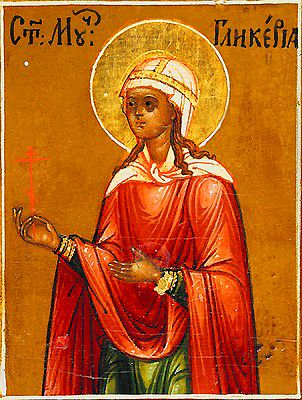
St. Glyceria, Y

St. Glyceria

May 13 · Martyr
M

Sts. Martyrs of…

May 13 · Feast
S

St. Servatus of Tongres

May 13 · Bishop
← All 1726 saints in the library
Sources & notes

Feast-day sources

Story sources

Sources

Credits

From Sabine Baring-Gould, The Lives of the Saints, new edition in 16 vols. (London: John C. Nimmo, 1897–98); text from the Internet Archive scan (OCR, lightly cleaned; errors possible). Public domain.

From “Catholic Encyclopedia (1913)/St. John the Silent,” The Catholic Encyclopedia (New York: Robert Appleton Company, 1907–1914), via Wikisource. Public domain. Matched by name and feast date; text unedited except for our bracketed notes in grey.

From Sabine Baring-Gould, The Lives of the Saints, new edition in 16 vols. (London: John C. Nimmo, 1897–98); text from the Internet Archive scan (OCR, lightly cleaned; errors possible). Public domain in the United States. Reproduced unedited, except for short bracketed notes in grey that we added to explain names and terms (“S.” is the old abbreviation for Saint). Some history and judgments reflect 19th-century scholarship.