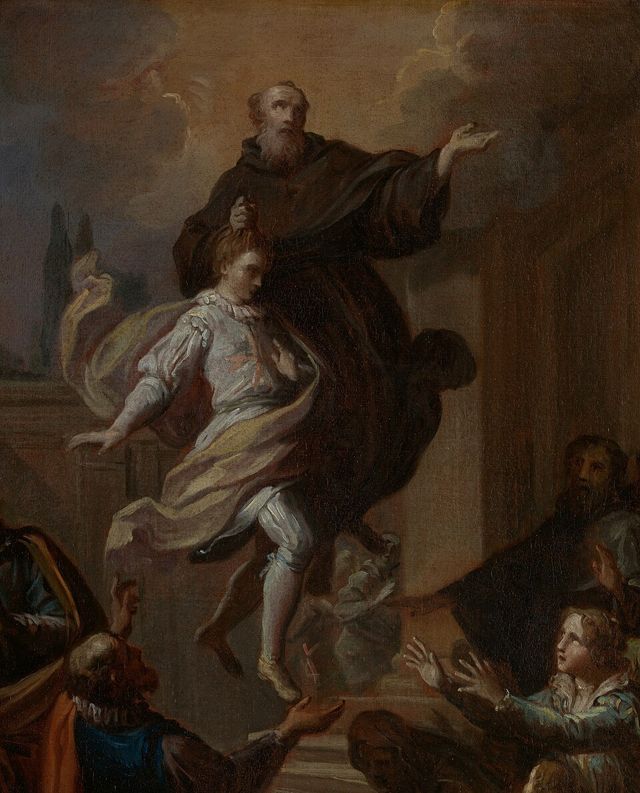
Baring-Gould’s sources: Roman and Franciscan Martyrologies. Beatified by Benedict XIV. in 1753, and canonized by Clement XIII. in 1767. His office inserted in the Breviary by Clement XIV. Authorities: — A Life by Angelo Pastrovicchio from the process of Beatification. Also an Italian Life by Bernini.] Joseph Desa was the son of Felix Desa, a carpenter, and his wife Francesca, poor people living at Cupertino, in the kingdom of Naples. He was born on June 17th, 1603, in a stable, whither his mother had retired when officers came to arrest her husband for debt.
He was troubled as a child with abscesses; and when they were healed, he was left with feet turned inward, so as to walk ungracefully. His appearance was altogether uncouth • and the boys of the village called him “ Gaping Mouth.” His ways also were not those of healthy ordinary children. He would go for a day or two without his meals, and when his attention was called to it, he would say, “ I forgot them J”
■S’. Joseph of Cupertino. His mother treated him with some severity, punishing him for the least fault, and often for his stupidity. At seventeen, the boy went to a neighbouring Franciscan convent, in which was his uncle, Fra Franceschi Desa, and begged to be admitted as novice \ but he was refused admission. In no way deterred, he went to the provincial of the Capuchins, Fra Antonio Francavilla, and obtained his consent that he should enter a convent of the Order. He was accordingly drafted into one at Martino, near Tarento, a.d. 1620. But the friars soon had enough of him; if he was given pots or plates to carry, he let them fall; if he had to put sticks on the fire, he upset the cauldron simmering over it,1 and was altogether so clumsy, that at the end of eight months he was dismissed; the monastic habit was taken off him, and his old tattered clothes were restored to him. Ashamed to return to his native place, he wandered on, with puzzled head- and sad heart, to Vetrara, attacked by shepherd dogs on the road, and only liberated by their masters after he had been nearly frightened out of his few wits. At Vetrara he found his uncle, who was delivering a course of Lent [the forty days of fasting before Easter] sermons. He flung himself at his feet, sobbing, “ The Capuchins have turned me out, as I am good for nothing/7 His uncle pitied his forlorn condition, kept him with him till Easter, and then brought him back to his mother at Cupertino, whom he found in dire straits to meet the demands of her husband’s creditors, he being now dead; and her temper not being sweetened by distress, she beat Joseph soundly for being such a stupid fool as to come back on her hands.
The unfortunate lad’s scrofulous ulcers had opened on his knees, and he had cut them with a knife, in hopes of removing the swellings, and had thereby incapacitated him1 “ Evenit ut vasaque et testas, e manibus lapsas frequenter rumperet, diunquo ligna super focum reponebat, lebetes everteret/' &c. self for work. Francesca was quite unable to maintain him, and as soon as he was better, with tears in her eyes, she implored the Minorites of Grottella, near Cupertino, to take him in. He was made a third order brother, and set to look after the stable. His obedience, humility, and love of mortification, so gained on the brethren that in a provincial chapter held at Altamura in 1625, it was resolved that he should be elevated to the upper order, so that he might qualify himself for holy orders [ordination; “orders” means the sacrament by which deacons, priests and bishops are ordained].
Joseph begged to be allowed to go through a second novitiate, after which he spent his time by himself, not associating with the others, but devoting his hours to prayer. He received minor orders [the lower ranks below deacon, such as reader and acolyte, abolished in 1972] in 1627, and was ordained priest on March 28th, 1628, “ without examination,” the bishop having previously heard him discourse on the text, t( Blessed is the womb that bore thee."
He now kept himself more aloof than before from the rest of the friars, haunting the top of the dome of the church, or a little cell in the rocks at a distance. His habits were so eccentric, he was so absent, and gave way to such extravagant freaks, that for thirty-five years he was not allowed by his superiors to assist with the rest of the friars in choir at the recitation of the offices, or in the processions, not even might he be their companion at meals. He at the same time took off all his underclothing, and sent it to his mother; then, when covered only with the habit, he rejoiced that he was stripped of everything in the world except what was absolutely necessary. This habit he wore for two years, and then it became so torn that he could not possibly go about the country in it. He therefore flung himself on his bed in a condition of deepest despondency, with door and windows shut, and waited. A new habit was sent him by a religious, whom he did not know, and when he put it on all his despondency vanished S. Joseph of Cupertino.
For five years he did not eat bread, and for ten abstained from wine. He lived only on herbs and dry fruits, and on Fridays ate such roots and herbs as no other stomach could have digested. His fast in Lent was so rigorous that for seven years he took nourishment only on Sundays and Thursdays. He now began to go throughout the province of Bari, followed by trains of people, listening to his words, wondering at his ecstasies, and the extraordinary bounds into the air in which he indulged, and saluting him as “ the Apostle of the Kingdom.” Thereupon he was denounced by a certain priest to the Inquisition at Naples as “a man aged thirty-three who ran through those provinces, and as a new Messiah drew crowds after him by the prodigies wrought on some few of the ignorant populace, who are ready to believe anything.” He was ordered to Naples, and examined before the Inquisition, but as no positive grounds for his condemnation appeared, he was released, but ordered to go to Rome to the General of his Order, who was privately notified to place him under restraint. Joseph obeyed with the utmost joy; a piece of money given him for his necessary expenses he placed on the top of a stone outside the gates of Naples, and made his way to the Eternal City without money. At Rome he was received very roughly by the general, who, knowing that he had been suspected of heresy, and that the Holy Office required him to confine the saint in a solitary cell, was ill pleased to sec him. He therefore sent him to Assisi, where he was treated with great harshness, the superior regarding him either as a maniac or as an impostor. Under this treatment, Joseph fell into the deepest melancholy, and was tormented with hideous dreams and distressing thoughts. The General of the Order, hearing of the deplorable mental and spiritual condition into which he had sunk, and fearing permanent derangement, ordered him back to Rome for Lent. There the change of scene and treatment restored him to serenity, and when he went back to Assisi it was in an altogether calmer and more cheerful condition of mind. S. Joseph of Cupertino was extremely sensitive to music; when hymns were being sung he cried out aloud, or fell into trances.
One Christmas eve, as he was in the church, the pifferari began to play their charming carols to the new-born Jesus. Joseph, carried away by excitement, began to dance in the midst of the choir, and then with a howl,1 taking a flying leap, jumped upon the high altar, on which a crowd of candles were blazing, and hugged the tabernacle for a quarter of an hour. The leap was one of many feet, and yet he did not shake down one of the candles nor set anything on fire. Joseph was vested at the time in cope for Benediction. The carolers were amazed, not less so the friars. And their amazement was increased when they saw him, still in his cope,2 jump from the high altar on to the pulpit, fifteen feet above the floor, and there fall into an ecstasy.
He did something similar one Good Friday evening, when a sepulchre had been erected on the high altar with illumined clouds and lamps about it. He again bounded on to the altar, and clasped the tabernacle, without setting fire to anything, and clung to it till recalled by the Superior, when he leaped back to the place where he had stood before. There was a large Calvary cross at Grottella which had previously excited similar exhibitions. The saint would jump to the arms, stand on them, and sometimes balance himself on the top of the cross above the title. It will be understood, therefore, that the friars of his convent acted with prudence in not allowing him to assist at the offices in their church, or in any public ceremony. 1 “ Cum magno ejulatu, velut avis per sera, volavit a medio ecclesia: usque supra altare majus, plus quam quinque perticis inde dissitum.” 8 “ riuviali indutum.”
S. Joseph of Ctipertiiio. One day he was out walking with a friar, who said to him, “Brother Joseph, how lovely heaven is !” The words struck a chord in his breast, he jumped, and, at a bound, reached a bough of an olive tree, and knelt on it.1 One day he went into the convent choir of the Sisters of S. Clara at Cupertino. When the nuns began to sing “Veni sponsa Christi,” Joseph, unable to restrain himself, ran across the choir, caught the confessor [in old usage, a saint who was not martyred, or who suffered for the faith without being killed] of the convent in the arms, danced with him into die middle of the church, and spun him round and round in the air. One day, in the presence of the legate [an official representative sent by the pope] to Spain, uttering a shrill cry, he jumped over the heads of those kneeling before the altar, twelve paces, to the feet of an image of the Blessed Virgin which stood on the high altar, and jumped back over their heads “ with the same noise.’' On another occasion he bounded backwards over the heads of some persons gathered to venerate the habit of S. Francis, and fell in worship before it. Once he asked the sacristan of one of the chapels at Assisi to say with him “ Beautiful Mary !” He did so. Instantly Joseph caught him by the waist, and jumped with him into the air, repeating at every bound “ Beautiful Mary ! ” 1 At Protestant Dissenting Revivals similar extraordinary leaps and dances are not infrequent. The Jumpers and Shakers take their name from these nervous hysterical capers. In the American Revival of 1801, the “Jerks” hecame epidemical. Such phenomena are common not merely in the Christian Church to ecstatics, but also in all religions in which the imagination is greatly excited. Some of the pagan philosophers of the Neoplutonic school were similarly raised; so also were heretical enthusiasts. Among saints who were lifted up, according to their biographers, may be mentioned S. Peter of Alcantara, S. Philip Neri, S. Paul of the Cross, and the ecstatics Marie d’Agreda, and Dominic of Jesus-Mary. So also the Blessed Philipin who rose above the tops of oaks. Anne-Catherine Emmerich was able to skip about like a grasshopper, according to her own account, in a miraculous manner. Margaret of the S. Sacrament had similar powers. Christine the Wonderful leaped to the cross rafters of the church, jumped into a font, and rolled about the floor like a ball. In all seriousness the bull of canonization of S. Thomas of Villanova related that he remained suspended for twelve hours in mid-air. S. Agnes of Bohemia went up like a shuttlecock out of sight, and did not drop till an hour had elapsed. Marie d'Agreda was made a public exhibition, suspended in the air, in her convent at Burgos. I have seen the thing done at a show at a fair. It is an optical delusion, contrived by means of looking-glasses. Margaret Agullona was carried up and floated in rapture in a church at Vanencia, and was blown about by the draught from the door like a feather. All this sort of stuff is discussed in a silly hook, “ La Stigmatisation,” by Dr. A. lmbert-Gourbeyre, Clermont, 1895; also by M. J. Ribet, “La Mistique Divine,” Paris, 1895.
A maniac was brought to Joseph, and was made to kneel before the saint. Joseph ordered his chains to be knocked off; then clutching his hair, and bursting into his wonted shout of “ Hah !” he jumped high into the air, dragging the lunatic after him. The madman never gave way to his peculiar fancies again.
John Frederick, Duke of Brunswick, in 1649, came to Assisi to see the saint, whose fame was widely spread. The duke was the son of George, Duke of Brunswick and Hanover, and Wilhelmina Amelia, daughter of the Emperor Joseph. He had with him, when he came to Assisi, two counts, one a Catholic, the other a Protestant. He himself was a Lutheran, but inclined towards Catholicism. When he arrived, S. Joseph Cupertino was saying mass. The saint found the Host so hard that he could not break it, though he used great force. Then, replacing it on the paten, he uttered a loud cry, and bounded back, with folded knees, five paces, and after another loud cry returned in the same manner to the altar, and succeeded in the fracture of the Host. When asked why he uttered such loud cries, he replied, “ Because those who entered the church at that moment are hard of heart, and believe not the truth.” After dinner, the Duke of Brunswick asked to see the saint, who exhorted him to abandon heresy, and entreated him to attend mass when he celebrated on the following morning. The duke did so, when Joseph was lifted into the air, so that his feet were a hand’s breadth above the top of the altar table, and thus he remained for the space of six or seven minutes. The duke was so convinced that this was a miracle, that he exclaimed, “ Here I am torn with scruples; at home I was at ease of mind.” Joseph took his girdle, bound it about the duke, and said, “ So I bind you for Paradise.” The duke returned to Brunswick, but next year saw him again at Assisi; unable to shake off the impression v9. Joseph of Cupertino.
produced on his mind by this remarkable man, he had come to make his abjuration of heresy before him, and to be received into the Catholic Church. S. Joseph is said to have possessed a supernatural insight into minds. He once pounced on a woman at Cupertino, and told her she had been preparing poison; she trembled and turned pale. He ordered her to produce the mixture, and when she obeyed he flung it into the fire. “ Go, go,” he said to a nobleman approaching him; “wash your face!” meaning that he should cleanse himself from a sin which had stained his soul. He used to say to people with nice scruples of conscience who came to consult him, “ I like not scruples or melancholy \ let your intention be right, and fear not.” His prudence, which was remarkable m the conduct of souls, drew to him a great concourse of people, and even cardinals and princes. He foretold to John Casimir, son of Sigismund III., King of Poland, that he would one day reign for the good of the people, and advised him not to enter any religious Order. But this prince afterwards joined the Jesuits, took the vows of the scholars of the society, and was made Cardinal by Pope Innocent X. in 1646. Joseph dissuaded him from the resolution he had taken of receiving holy Orders. What the saint foretold came to pass; for Vladislas, eldest son of Sigismund, dying in 1648, John Casimir was elected King of Poland; and being given a dispensation from the Pope, married his brother's widow. After some time he resigned his crown, and retired into France, where he died in 1672. This prince himself afterwards disclosed the circumstances here related. The miracles wrought by S. Joseph were not less remarkable than the other extraordinary favours he received from God. Many sick owed their recovery to his prayers. The saint fell sick of a fever at Osima, the 10th of August, 1663, and foretold that his last hour was near at hand. The day before his death he received the last sacraments. He was heard often to utter the aspirations of a heart inflamed with the love of God: “Oh! that my soul were freed from the shackles of my body, to be united to Jesus Christ ! Praise and thanksgiving be to God ! The will of God be done. Jesus Crucified, receive my heart, and kindle in it the fire of Thy holy love.” He died the 18th of September, 1663, at the age of sixty years and three months. His body was exposed in the church, and the whole town came to visit it with respect; he was afterwards buried in the chapel of the Conception of Our Lady.