St. Judas or Quiriacus

A shepherd who stayed with his people through hard times.

Read the essentials →
May 4 · Bishop

St. Judas or Quiriacus

St. Judas or Quiriacus

A shepherd who stayed with his people through hard times.

Traditional feast

May 4
1914 / pre-1969 calendar, per Baring-Gould (1897)

Current feast

May 4 (also listed: October 28)
Secondary source · Wikipedia

Represents

Bishop

Their story

Adapted in modern English from Baring-Gould (1897–98) · original text below

The apocryphal (outside the Bible and not accepted as Scripture) Acts say Judas was a Jew, nephew of St. Stephen, who showed St. Helena where the Cross was hidden, was baptized as Quiriacus, and became bishop of Jerusalem. Baring-Gould calls the story absurd: there was no patriarch of that name, and Judas died in 133, long before Helena came in 326.

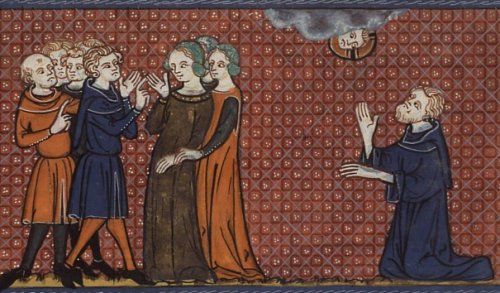
Ancona nevertheless claims his relics and has him as patron. Baring-Gould thinks the saint there is a different martyr of the same name; Baronius says, on unknown authority, he was a bishop of Ancona martyred by Julian. Part of his skull is shown at Provins.

Pope Gelasius condemned the romance as apocryphal. Henry I, count of Champagne, brought part of the relics from the East to Provins and built a church there. Baring-Gould says it is hopeless to untangle the confusion caused by so many saints of the same name and by the popular Acts.
Early life

The book says little or nothing about early life. This is how the account begins.

Judas or Quiriacus. phal “ Acts of Judas or Quiriacus" already alluded to in the article on the Invention of the Cross. He is said to have been a Jew who was the nephew of S. Stephen the first martyr, and grandson of Zacharias. He revealed to S. Helena the place where the cross of Christ was hidden, and was converted by the miracles wrought on its discovery, and was baptized under the name of Quiriacus or Cyriacus, and became bishop of Jerusalem.

What they represent

How they teach us to live

Drawn from themes in the original account

Share your faith, in words and by example. Preaching and conversion are central here.

Learn from the kind of life it was. A shepherd who stayed with his people through hard times.

Read more

The full original · 328 words

Read Baring-Gould’s full account

Baring-Gould’s sources: The Ancient Roman Martyrology attributed to S. Jerome in Aiay i, Also other Maityrologies which have on this day “ the Elevation cf s' Quirinus (Quiriacus) ion the Appian way." Hrabanus and Notker say, “The passion of S. Jude or Quiriacus the bishop, to whom was revealed the wood of the Lord’s cross,” on April 30th.] UDAS was, according to Eusebius, the fifteenth bishop of Jerusalem. This Jude is venerated on the roth April, but is supposed to be the same Jude also called Quiriacus by the Martyrologists, commemorated on this day. That he was the true discoverer of the wood of the true cross is hardly possible; there is no evidence to support the assertion of Usuardus; and that he was a martyr in the reign of Julian, another statement in some martyrologies, is also wholly unsupported. “All the history of his passion we may set down as pure and unmixed fiction,” says Le Quien,1 “nevertheless it is not impossible that he who is set down May ist, in the Martyrology of Jerome (or that which passes under his name) was the last bishop of the circumcision, and that he died a martyr.” The history of his passion is that apociy1 Oriens Christiana, HI., p. l4g.

Judas or Quiriacus. phal “ Acts of Judas or Quiriacus" already alluded to in the article on the Invention of the Cross. He is said to have been a Jew who was the nephew of S. Stephen the first martyr, and grandson of Zacharias. He revealed to S. Helena the place where the cross of Christ was hidden, and was converted by the miracles wrought on its discovery, and was baptized under the name of Quiriacus or Cyriacus, and became bishop of Jerusalem. The story is too absurd to need refutation. There was no Patriarch of the name of Cyriacus, and Judas died in 133; S. Helena did not visit Jerusalem till 326. However, his relics [the bodily remains of a saint, or objects they used, kept with honor] are to be found at Ancona, of which city he is patron, and on the old coins of the city he is represented in Greek pontifical habits, with his full title of Patriarch. The feast of the translation [the solemn moving of a saint’s relics to a new shrine] of these relics is celebrated at Ancona on August 8th. There can be little doubt that the Cyriacus or Quiriacus there venerated is some utterly different martyr of the same name, and that mediaeval ignorance and local pride have combined to regard him as the famous Jew of the romance condemned as apocryphal by Pope Gelasius. According to Baronius [Cardinal Baronius (d. 1607), church historian who edited the Roman Martyrology], on what authority we do not know, he was a bishop of Ancona, who was martyred by Julian when visiting Jerusalem. A portion of his relics were translated by Henry L, count of Champagne, from the East to the town of Provins, where he built a church under his invocation. This translation is commemorated in the diocese of Meaux, on July 29th. A portion of his skull is still shown at Provins. It is hopeless to attempt to unravel the confusion that has arisen from there being so many saints and martyrs of the same name, and from the popularity of the apocryphal Acts having affected the traditions of churches preserving such relics. VOL. V.

Feast days

Feast: May 4

Nine days · Free

Pray the novena
with us.

One short email a day for nine days. The day's prayer, a line from St. Judas or Quiriacus's story, and a nudge to keep going.

Also on May 4
St. Pelagia

St. Pelagia

May 4 · Virgin, Martyr
S

St. Sylvanus of Gaza

May 4 · Bishop, Martyr
M

St. Monica

May 4 · Widow
← All 1726 saints in the library
Sources & notes

Feast-day sources

Story sources

Sources

Credits

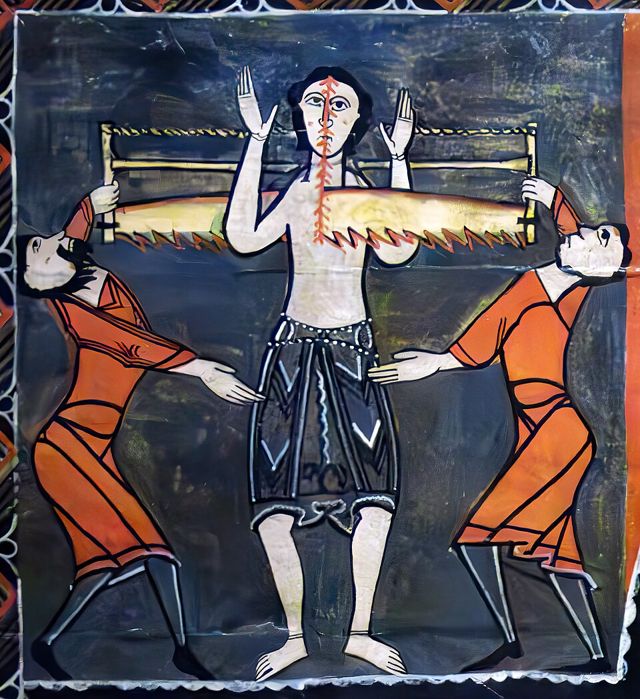
Image: (Barcelona) Martyrdom of St. Quiricuso - Museu Nacional d'Art de Catalunya.jpg · Didier Descouens · Public domain, via Wikimedia Commons

From Sabine Baring-Gould, The Lives of the Saints, new edition in 16 vols. (London: John C. Nimmo, 1897–98); text from the Internet Archive scan (OCR, lightly cleaned; errors possible). Public domain.

Image: Didier Descouens, Wikimedia Commons (Public domain)

From Sabine Baring-Gould, The Lives of the Saints, new edition in 16 vols. (London: John C. Nimmo, 1897–98); text from the Internet Archive scan (OCR, lightly cleaned; errors possible). Public domain in the United States. Reproduced unedited, except for short bracketed notes in grey that we added to explain names and terms (“S.” is the old abbreviation for Saint). Some history and judgments reflect 19th-century scholarship.