St. Justus, Boy

Faithfulness to Christ when it cost everything.

Read the essentials →
October 17 · Martyr

St. Justus

St. Justus, Boy

Faithfulness to Christ when it cost everything.

Traditional feast

October 17
1914 / pre-1969 calendar, per Baring-Gould (1897)

Current feast

October 18
Secondary source · Wikipedia

Represents

Martyr

Their story

Adapted in modern English from Baring-Gould (1897–98) · original text below

(The surviving account on this page begins partway through the story.)

Justin had paid Lupus to redeem a slave and set off home with his brother Justinian and his son, the boy Justus. But the persecutor Rictiovarus, at Amiens, heard Christians had been there and sent soldiers after them. At Sinomovicus, now Saint-Justin-Chaussée, the two men hid in a cave while the boy kept watch outside, not very carefully. Caught, he would not reveal where they were, and was beheaded.

The legend says his body rose, picked up the head, and placed it at the cave's entrance, while his soul prayed to God to receive his innocent spirit; the frightened soldiers galloped back to tell Rictiovarus. When the men came out, the head asked them to bury the body there and take the head to his mother. At Auxerre his mother Felicissima kissed it, wrapped it in a towel and hung it from her ceiling, where it shone at night like a lamp, until Bishop Amator had it buried and built a church over it.

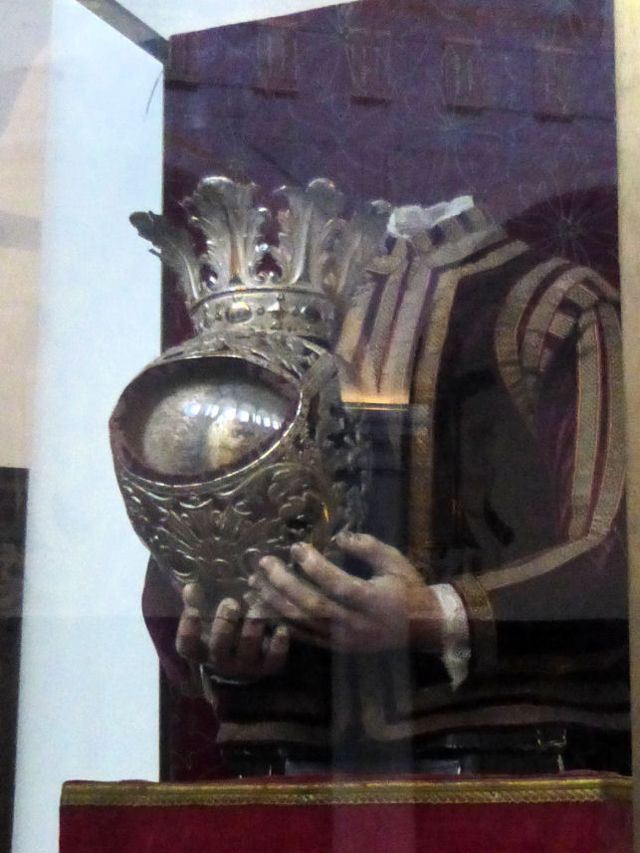
In 946 the body was moved to New Corbei in Germany, and part of the head followed in 949; his house is still shown at Auxerre in the Rue du Temple. Baring-Gould lists other claimed bodies and heads at Beauvais, Poictiers, Malmédy, Einsiedeln, Flums, Zutphen and Antwerp.

Early life

The book says little or nothing about early life. This is how the account begins.

So Justin paid Lupus the money, and departed with his brother and son. But Rictiovarus, the persecutor, was in Amiens, and some one told him that Christians had been there redeeming a slave, and he bade soldiers pursue them. Now*when the fugitives came to the place, then called Sinomovicus, but now Saint-Justin-Chauss^e, the two elder hid in a cave, but the boy remained outside watching.

What they represent

How they teach us to live

Drawn from themes in the original account

Learn from the kind of life it was. Faithfulness to Christ when it cost everything.

Keep their day. Remember them on October 17 with a short prayer, and ask for their help.

Read more

The full original · 437 words

Read Baring-Gould’s full account

Baring-Gould’s sources: Roman and Gallican Martyrologies; Sarum, York, and Hereford Kalendars. Authority:— The late Acts, which have been also appropriated, with slight change of name, to S. Justin of Louvre, in Paris. The untrustworthy character of the Acts is shown by their making S. Amator a contemporary with Rictiovarus, whereas a century intervened between them.] Justus, a boy of nine, lived at Auxerre, with his father Justin and his mother Felicissiraa. His father’s brother, Justinian, had been made captive, and was at Amiens, in the house of a certain man, named Lupus. J ustin and his son, [Oct. A Justus, set off for Amiens with money to redeem Justinian. They travelled till they reached Paris, where they met a man named Hippolytus, and told him their story. Hippolytus said, “ Come home with me, and I will give you wine and pulse.” And when he had regaled them he dismissed them, and they came to the river Oise, and boated across, and came to the house of Lupus, and offered to purchase his slave. Then Lupus ordered his twelve servants before them, but Justinian was not among them. But suddenly Justus noticed his uncle holding a lamp in his hand, kindling the lights in the house, for it was evening, and he cried out, “ This is the man we seek.”

So Justin paid Lupus the money, and departed with his brother and son. But Rictiovarus, the persecutor, was in Amiens, and some one told him that Christians had been there redeeming a slave, and he bade soldiers pursue them. Now*when the fugitives came to the place, then called Sinomovicus, but now Saint-Justin-Chauss^e, the two elder hid in a cave, but the boy remained outside watching. His watch cannot have been very careful, for he was caught by the pursuers, who asked him where his companions were, and when he refused to tell they cut off his head. “And when his head was cut off, the body rose, and stood motionless, and took up the head between its hands, and put it at the entrance of the cave, and his soul prayed to God, saying, ‘Lord of heaven and earth, receive my spirit, for I am. innocent and clean of heart.’ And when the servants saw the marvel wrought by his body they were frightened with a great fear, and were scared thoroughly; so galloping away, they told Rictiovarus what had taken place.”

When Justin and Justinian [Byzantine emperor 527–565] came out of the cave, they were startled and distressed to find the boy holding his head in his hands, instead of on his shoulders. “What are we to do with him?” asked the father of the uncle. “Bury my body here,” Oct x&] •S'. Julian Sabas.

said the amputated head; “ but take my head home to my mother, that she may kiss it" They did so. And when they reached Auxerre, Felicissima kissed her son's head, and then wrapped it in a towel, and hung it up to a crook in the ceiling of her room, where at night it shone like a lamp; and, indeed, so brilliant was the light it emitted that it excited the wonder of the as yet unborn Bishop Amator, who insisted on burying it and building a church over it In 949, a portion of the head was removed to New Corbei, in Germany, whither his body had been translated in 946. The house of S. Justus is still pointed out at Auxerre, in the Rue du Temple.

In 900, the body, or another body, was translated from Sinomovicus to Beauvais; another body, in 940, was in the abbey of S. Cyprian at Poictiers. Another body at Malmddy, which is entire with head. A head, carried away from Auxerre, at Einsiedeln in Switzerland. Another head at Flums, in the diocese of Chur, on the lake of Wallenstadt Another body, formerly at Zutphen, and another head at Antwerp, in the church of S. Charles.
Feast days

Feast: October 18
Traditional: October 17

Nine days · Free

Pray the novena
with us.

One short email a day for nine days. The day's prayer, a line from St. Justus's story, and a nudge to keep going.

Also on October 17
H

St. Hero

October 17 · Bishop, Martyr
S

St. Solina

October 17 · Virgin, Martyr
L

St. Louthiern

October 17 · Feast
← All 1726 saints in the library
Sources & notes

Feast-day sources

Story sources

Sources

Credits

Image: AD 2024 - Reliekhouder Sint-Justus - Antwerpen.jpg · Carolus · CC BY-SA 4.0, via Wikimedia Commons

From Sabine Baring-Gould, The Lives of the Saints, new edition in 16 vols. (London: John C. Nimmo, 1897–98); text from the Internet Archive scan (OCR, lightly cleaned; errors possible). Public domain.

Image: Carolus, Wikimedia Commons (CC BY-SA 4.0)

From Sabine Baring-Gould, The Lives of the Saints, new edition in 16 vols. (London: John C. Nimmo, 1897–98); text from the Internet Archive scan (OCR, lightly cleaned; errors possible). Public domain in the United States. Reproduced unedited, except for short bracketed notes in grey that we added to explain names and terms (“S.” is the old abbreviation for Saint). Some history and judgments reflect 19th-century scholarship.