Read Baring-Gould’s full account
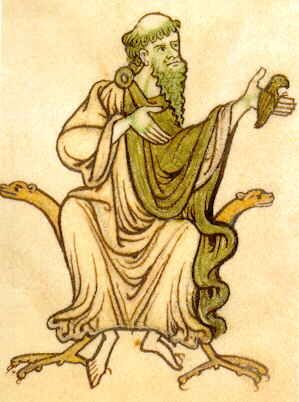
Baring-Gould’s sources: Irish Martyrologies. Authority: — A life abounding in marvels, sometimes of grotesque absurdity,1 written very late, as is the case with all the lives of Irish saints. However, the main outlines of his story may be unravelled from the tangle of traditions which compose his life.J S. Kevin or Coemgen (the Fairbegotten) was of an illustrious family, in the country of the O’Tooles. His 1 Once a man ran away from twelve men who sought his life, to seek the protection of S. Kevin. The cell*door was shut, so he cast himself down outside. The pursuers came up. and seeing the door shut said, “ Here is a log of wood, we will sit on it and wait till our man comes out.*' Now by the virtue of S. Kevin to their eyes the man they were pursuing appeared to be a log. So they sat in solemn row on him, waiting. When the saint opened their eyes, they were so moved with compunction that they all became monks. He is said to have put his shirt outside his door for a cow to lick clean. The cow was unparalleled for the abnndance of milk she gave after having cleansed the garment. father's name was Coemlog, and his mother was of the princely house of Dal-Messincorbh, and was called Coemella. They were Christians, and Coemgen was bap' tized as a child by the priest Cronan. At the age of seven he was placed under the care of S. Petroc, a Briton, then in Ireland. When twelve years old his parents consigned him to the care of the three holy fathers — Eogan, Lechan, and Enna — to be educated by them in their school, and he remained with them diligently studying for three years. After this he is said to have become the disciple of Beran, a hermit, and then of a bishop, Lugid, who ordained him priest By the advice of this bishop he is said to have founded a monastery for himself at a place called Cluainduach. Then, leaving some monks there, he repaired to his own country, and formed his chief establishment at Glendalough. At what time this monastery was founded is not recorded, but it must have been before a.d. 549, if it be true that he was abbot there when he went to pay a visit to S. Kieran of Clonmacnois, where he did not arrive till three days after the death of that saint. Into his charge was committed the care of Foelan, the infant son of Colman, a Leinster noble, or petty prince, to protect it from the fury of the divorced wife of Colman, who contrived the death of all his children. Coemgen fed the child on the milk of a doe which came from the forest to the door of his cell. A raven was wont, after the doe had been milked, to perch on the bowl, and sometimes upset it. 44 Bad luck to thee,” exclaimed the saint; 44 when I am dead, there will be a famous wake, but no scraps for thee and thy clan. Whilst all the mourners are making merry below, thou wilt be croaking round the mountaintop supperless, for not a bite shalt thou have.” When very old, the saint moved further up the valley among the woods to be more alone, and lived in complete solitude, save for the birds which fluttered singing around him, and perched on his shoulders.
When far advanced in years he meditated a long pilgrimage, but was dissuaded by Carbhan, a hermit, who said drily, “Birds do not hatch eggs whilst on the wing.” Coemgen took the hint, and remained at Glendalough perfecting his institutions, and extending them into different places. When he felt his end approach, he received the holy Viaticum from S. Mochnorog, a Briton, who had a cell to the east of Glendalough, and died June 3rd, 618.