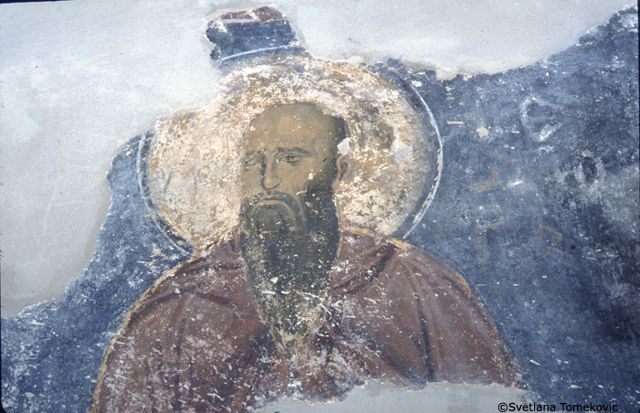
Building a community where people could actually live the Gospel.
Read the essentials →Building a community where people could actually live the Gospel.
September 9
Not verified yet
Abbot
At the expiration of these seven years our saint removed, according to one account, to Inniscathig, where he was charged by S. Senan with the care of providing for strangers. But his liberality to the poor was so profuse that he incurred the displeasure of some of the monks, and accordingly thought it advisable to quit the monastery. He then proceeded to an island of Lough Rie, called Aingin, where, having erected a monastery, he was soon surrounded by a vast number of excellent monks.
Build up the community you belong to. This life was lived with and for a community.
Learn from the kind of life it was. Building a community where people could actually live the Gospel.
At the expiration of these seven years our saint removed, according to one account, to Inniscathig, where he was charged by S. Senan with the care of providing for strangers. But his liberality to the poor was so profuse that he incurred the displeasure of some of the monks, and accordingly thought it advisable to quit the monastery. He then proceeded to an island of Lough Rie, called Aingin, where, having erected a monastery, he was soon surrounded by a vast number of excellent monks. This was his first establishment, and he remained abbot of it for seven years, till 548, when, leaving the care of it to Adamnan, a monastic man, he removed to the west bank of the Shannon, and, on a site granted him by King Dermit, founded the great monastery of Clonmacnoise. King Dermit had a high opinion of S. Kieran, who, it is said, had foretold to him his accession to the sovereignty. At the request of the saint, the prince laid with his own hands the first stone of the foundation.
S. Kieran did not long survive the foundation of Clonmacnoise, as he fell sick of a pestilence which raged in the year 549, and which carried him off, some say at the early age of thirty-three; and from the fact of his being a carpenter’s son, and of having died at the same age as Christ, it was thought that the resemblance between the saint and his Lord was peculiarly remarkable. His institution, fox which he had drawn up a particular rule, was extended after his death to a great number of religious houses. Kieran is said to have composed a lay asking God for a long life in which to serve Him; but his prayer was not answered, “he was made perfect in a short time.’' S. Columba [Irish abbot of Iona (d. 597), apostle of Scotland] wrote a hymn in praise of Kieran, beginning with these lines: — “Quantum Christe, O, apostolum Mundo misisti hominem ?
Lucerna hujus insulae.” He is said also to have carried away some clay from his grave. On getting into the eddy of Corryvrechan, Columba threw it into the sea, and was saved from wreck. Kieran is not to be confounded with S. Kieran of Saigir (March 5). S, Omer.
Feast: September 9
One short email a day for nine days. The day's prayer, a line from St. Kieran of Clonmacnois's story, and a nudge to keep going.
From Sabine Baring-Gould, The Lives of the Saints, new edition in 16 vols. (London: John C. Nimmo, 1897–98); text from the Internet Archive scan (OCR, lightly cleaned; errors possible). Public domain.
From Sabine Baring-Gould, The Lives of the Saints, new edition in 16 vols. (London: John C. Nimmo, 1897–98); text from the Internet Archive scan (OCR, lightly cleaned; errors possible). Public domain in the United States. Reproduced unedited, except for short bracketed notes in grey that we added to explain names and terms (“S.” is the old abbreviation for Saint). Some history and judgments reflect 19th-century scholarship.