Baring-Gould’s sources: Bede, Ado, Hrabanus, Usuardus, Wandelbert, Modem Roman Martyrology. York, Sarum, Hereford Kalendars, Reformed Anglican Kalendar, &c. Authorities: — (1) A Life by Gotteschalk, canon of Lidge, d. cca. 770, trustworthy. (2) A Life by Nicolas of SS. Maria and Lambert, d. cca. 1120. (3) A Life by Sigebert of Gemblours, d. 1112. (4) Another by Stephen, Bishop of Lidge, d. 920, a rewriting of the Life by Godeschalk.] S. Lambert was born at Maestricht of noble parents, belonging to a powerful family. Sigebert says his father’s name was Eber, and his mother’s Herisblind. He first saw the light between 636 and 638. His name is variously written, Landebert and Lantbert; in later times it was softened into Lambert.1 Lambert was given to S. Landoald to be instructed, and many legends are related of his youth, how he elicited a spring with his master’s staff, and brought him red-hot coals in his lap.2 When he grew older he was entrusted to Theodard, Bishop of Maestricht, and on the death of that prelate, in 670, he succeeded him.
He is described by Gotteschalk as “a wise youth, of amiable aspect, affable speech, and right conversation; of stately form, strong and swift, agile and stout in war, clear headed, handsome, loving, pure and humble, and fond of reading,” so that he had quite won the heart of the old bishop Theodard. His integrity and intelligence made him a great favourite with King Childeric II.; but when 1 The following legend is related of his childhood: — “ Dicitur quod eadem (sancti) nutrix vocabatur Lina nomine, et quod nata fuisset caeca... quae monita fuit visione angelica ut ad domum comitis Apri accederet, quia de sua uxore Herysplende filium eodem tempore esset habiturus, quem cum suscepisset, et suas mam* millas virgineas suxisset, ex ipso lacte virgineo defluenti suos oculos perungeret, et lumen suorum oculorum reciperet. Qua cum virgo Lina pervenisset, ct ut edocta erat, implisset, statim lumen suorum oculorum recepit, et deinceps infantem Lambcrtum suo lacte virgineo nutrirc meruit.” 2 Not by Gotteschalk, but by long subsequent biographers. S. Lambert.
that prince was assassinated, S. Lambert was driven from his see by Ebroin, mayor of the palace, who placed an intrusive prelate, Faramund, a canon of Cologne, in his room. S. Lambert retired to Stavelot, a.d. 674, with two servants; the abbey was then ruled by Sigolin. He spent seven years there in strict observance of the rules of the monastery. One instance of his obedience deserves quotation: — As he was rising one night in winter to his private devotions, he happened to let fall his wooden sandal, so that it made a noise. This the abbot heard, and looking upon it as a breach of the silence then to be observed in the community, he ordered him who had made that noise to go and pray before the cross. This was a great cross which stood in the open air before the church door. Lambert, without making any answer, or discovering who he was, laid down the upper garment he was going to put on. and went out as he was, barefoot, and covered only with his hair shirt; and in this condition he prayed, kneeling before the cross, three or four hours. Whilst the monks were warming themselves after matins, the abbot inquired if all were there. Answer was made that he had sent one to the cross, who was not yet come in. The abbot ordered that he should be called \ and was surprised to find that the person was the holy bishop, who made his appearance quite covered with snow, and almost frozen with cold. At the sight of him the abbot and the monks fell on the ground, and asked his pardon. “ God forgive you/' said he, “ for thinking you stand in need of pardon for this action. As for myself, is it not in cold and nakedness that, according to S. Paul, I am to tame my flesh, and to serve God ? ” The murder of Ebroin led to a new revolution of the wheel of fortune. Pepin of Herstal became mayor of the palace, Faramund was expelled Maestricht, and Lambert reinstated (a.d. 681). On his return Lambert at once set himself to work to preach the Gospel amongst the people of the Campine. It was a dreary district oi marshes, sandy holts, and willow tofts, inhabited by a barbarous people, who were fanatical idolaters. Lambert, by his gentleness, zeal, and perseverance, won their hearts, destroyed their temples, and brought them in crowds to baptism. He did not rest till he had planted churches throughout the marshy region, and placed clergy in them. A hillock covered with trees, near the Meuse, was long pointed out as a spot the holy bishop loved, on which he sat and taught the people that profession of faith without a Christian life was worthless. “Faith,” said he, “without works’ is dead.” His apostolic labours in the Campine brought him to the confines of Friesland, where he met, and had sweet converse with, S. Willibrord, who was not yet a bishop. S. Lambert is said to have extended his excursions as far as Mecheln, and to have founded in that town the church of Our Lady.
S. Lambert’s relatives took it upon themselves to resent every invasion of the lands belonging to the see. Some wrong was done to the possessions of S. Lambert by two members of a powerful family, Gall and Reihold. The nephews of the bishop and others of his family fell on them, and no doubt without the knowledge, and against the wishes of S. Lambert, killed them. A relative of the murdered men was Dodo, an attendant on Pepin of Herstal. He and the rest of his clan resolved on revenge, and hearing that Lambert was at Liege, then a small place, they marched to it. About midnight Lambert rose and went alone to the church, where he prayed and sang psalms till the dawn whitened; and then he rapped with his staff at the doors of his servants, saying, “ Get up, wake up, it is time for matins.” They rose, came down, the candles S. Lambert.
were lighted, the bell rung, and matins were sung. Then all returned to bed, and with them Lambert. But just as the golden sun began to peep over the hills, a boy named Baldwy, who had been set as guard at the bishop’s door, went outside the house, and saw a black swarm of armed men coming down the hill with Dodo armed cap-k-pie at their head. The boy turned back, burst open the bishop’s door, rushed in, and warned him that the enemy was at hand. Lambert rose, and grasping his sword, his martial fire suddenly blazing up in him, he stood forth without even slipping on his shoes. But almost immediately he remembered himselt, laid aside his sword, and prepared for the worst. His nephews, Peter and Audolec, armed themselves with clubs, and gallantly defended the door. Shouts rose from without of “ Try fire, burn the house over their heads V* Audolec turned his head, and said, “ Do you hear what they are shouting, uncle ?” He replied, “ Remember you are guilty of the murder of Gall and Reihold, and God will judge sinners. What you did unjustly, now in justice you must expiate.”
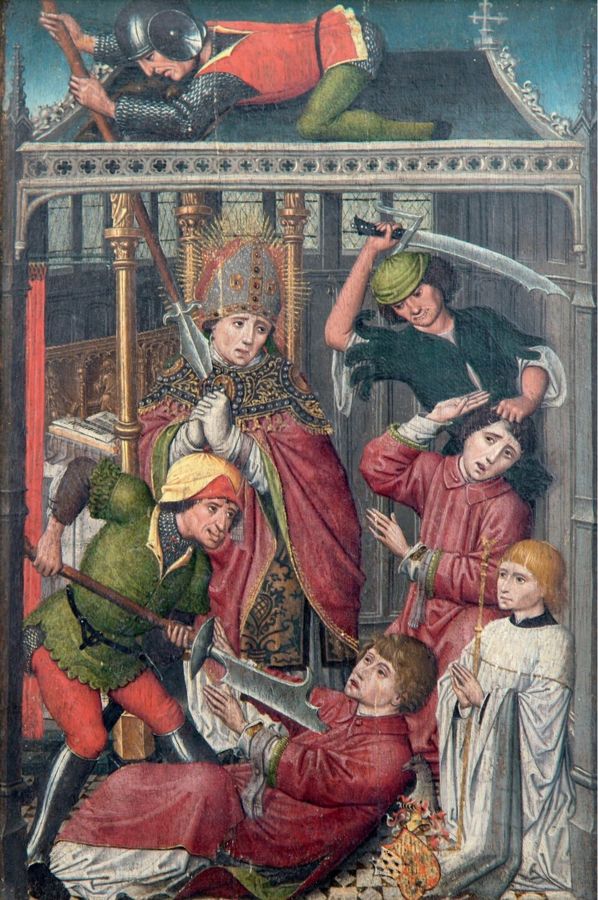
“ Open your psalter,” said Audolec, breathless with dealing blows, “and see what the Lord’s will is.” Then Lambert caught up an office book, opened it, and the words that first arrested his eye were, “ Quoniam requiret Dominus sanguinem servorum suorum.”1 Then the bishop said sadly, “ There, you hear the decision of God, who remaineth immovable.” Thereupon he retired into his chamber, and having put all forth, he cast himself on the ground, with his arms extended, and wept abundantly. Directly after, armed men burst in, killing every one in the house. Lambert’s door was fastened from within, wherefore one man mounted the roof, and ran him through with a spear which he flung at him from above.
1 Matt, xxlii. 35. Peter and Audolec receive local veneration as martyrs, but without office. The two earliest biographers of the saint give plainly the reason of the murder of the bishop, as stated above. But later, it was thought that the saint’s fame might be enhanced if a different motive were alleged, and it was felt that, according to Gotteschalk and Stephen, writers of the 3th and 10th centuries, the aggravation to the murder came from the side of S. Lambert, though he himself was doubtless guiltless of compassing the murder of Gall and Reihold. The biographers of the 12th century, therefore, pretended that Lambert had denounced the intercourse of Pepin of Herstal with Alpheid, the sister of his wife Plectrudis; and that in revenge for this, Alpheid set the murderers to kill the bishop. But there is not a shadow of evidence that this was the case. According to the same authorities, S. Hubert was at that time in Rome. Pope Sergius I. in dream saw an angel, who announced to him that Lambert was dead, and his successor was in the eternal city, and that his name was Hubert. At the same moment the angel placed Lambert’s pastoral staff in the Pope’s hand. Next morning the Pope woke, and found the staff there. He went to S. Peter’s, when a pilgrim approached him, and said that he came from Maestricht. “ What is your name ?” “ Hubert.-” The Pope instantly placed the crosier in his hand and consecrated him bishop. Unfortunately for the story, Sergius died in 701, eight years before the murder of S. Lambert. S. Columba [Irish abbot of Iona (d. 597), apostle of Scotland].