Baring-Gould’s sources: Belgian Martyrologies. Saussaye in his Gallican Martyrology. But at Munsterbilsen the festival is observed on July the 6th, instead of July 8th. Authority: — A life written by Theodoric, abbot of S. Trond, d. 1107.] Landrada was born at Bilsen, in Limburg, in the diocese of Li6ge; and was the only daughter of Wandregisl, count Palatine, under Dagobert, king of France, and Pharaildis, daughter of Hermanfrid, mayor of the palace. She was kinswoman of Pepin of Landen, and was brought up with all the care that became her rank. But from an early age she gave little thought to the honours and distinctions of which she was the object, and exhibited such sentiments of humility and devotion, that she was regarded, even as a child, as a model of Christian perfection.
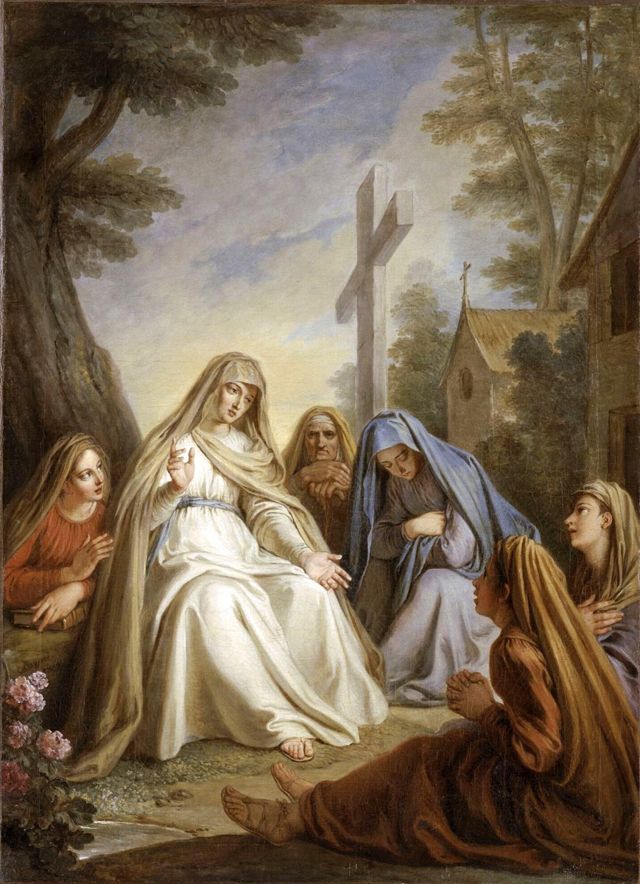
On reaching a marriageable age, several advantageous offers were made to her; and were refused by her, be[July f. cause she had chosen a bridegroom not of this world. In pursuance of her resolution, she kept aloof from all worldly pleasures, and devoted whole days to prayer. She quitted her home, and retired into the depths of the adjoining forest, which at that time extended throughout the neighbourhood of Munsterbilsen. Landrada walked there bare-foot, constructed a little hut with her own hands, and resided in it. Covered with a coarse habit, she slept on the earth, and ate only bread and drank water. From time to time she was visited and advised by S Lambert, bishop of Li£ge, and at his injunction, erected in the forest a chapel in honour of the Blessed Virgin, drawing the stones of which it was constructed from the quay with her own hands. S. Lambert consecrated this chapel in the year 689, and associated with Landrada other virtuous maidens, and thus laid the foundation of the abbey of Munsterbilsen. Landrada, after having passed the rest of her life in consolidating her new foundation, of which she was the first abbess, died about the year 6qo. According to the popular legend, her soul appeared to S. Lambert whilst he slept, and bade him bring her body to a spot which he would find designated by the apparition of a fiery cross. S. Lambert, on awaking, knew that the spot designed by S. Landrada was at Wintershoven. He went immediately to Munsterbilsen, where he found a great crowd assembled to celebrate the obsequies ot Landrada. Thereupon he informed them that the Saint had chosen another spot for her grave. All his remonstrances were in vain. The people of Bilsen would not part with their treasure, and Landrada was accordingly buried there. But three days after, S. Lambert ordered that a place should be dug at Wintershoven, and there a marble sarcophagus was dis* S. Paul the New.
covered containing the body of S. Landrada, transported thither, as the people at once supposed, by angelic instrumentality.
The feast of S. Landrada has been observed at Munsterbilsen ever since, three days before the day on which it is celebrated elsewhere. The body of the Saint was translated in 980 from Wintershoven to the church of S. Bavo at Ghent, where an office in honour of the saint is said annually on her feast. In 1624, to the church of Wintershoven were given back some fragments of her body, and other portions have since been separated and given to the church of Munsterbilsen. The convent was destroyed by the Normans in 880, rebuilt and secularized, and made over to noble canonesses who could prove their nobility by eight quarterings on both sides. The abbess took the title of princess, and bore it in spite of protests made by the bishops of Li£ge. But in 1793, the abbey, which then contained twenty-one canonesses, was suppressed.