Read Baring-Gould’s full account
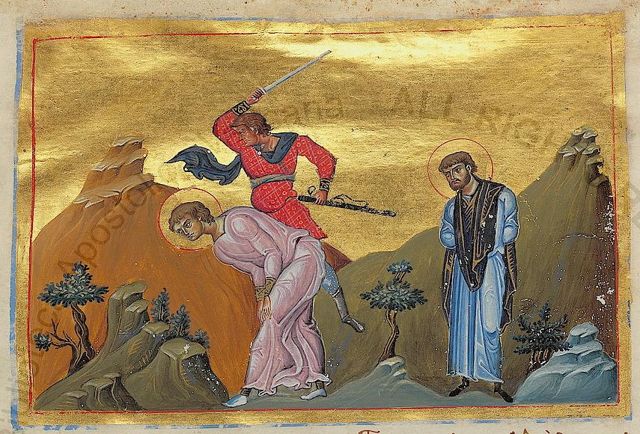
Baring-Gould’s sources: Irish Martyrologies. Authority: — A life written probably by an Englishman in the nth century; for the name Scotland is given in it, not to Ireland as is invariably the case in earlier writers, but to Caledonia.] S. Laserian was the son of Cairel, a nobleman of Ulster, and of Gemma, daughter of Aidan, king of the British Scots. The year of his birth is not known, and the early part of his life is involved in obscurity. According to one account he was a disciple of Fin tan Munnu, while another places him under an abbot Murin, probably Murgen of Giry, perhaps the most popular Hagiology in France, when I notice the manner in which they suppress facts, and place what they know to be apocryphal before the unsuspicious reader as h Istorical fact. As an instance, they give the events of this martyrdom from the apocryphal acts without a word of caution. Yet these acts are full of such absurdities as this, they make the woods of Italy swarm with lions and panthers j also S. Antia is said to have known and been instructed by S. Paul. Her son, S. Eleutherius,aged twenty, and a bishop, suffers in the sjtb year of the reign of Hadrian, i.*., in 142; but unfortunately tor the Acts, Hadrian died in X38. S. Paul suffered in the year 65, and according to the Acts, S. Eleutherios was born in 1x2; let us say S. Antia was 20 when S. Paul died, then she gave birth to Eleutherius when she was aged 77 1 Also S. Eleutherius is consecrated bishop in 132 by S. Anicetus the pope. But unfortunately S. Anicetus was not pope till more than twenty years after Eleutherius was dead. April x&] •S. Laserian.
Glen-Ussen. When arrived at a mature age, he is said to have proceeded to Rome, and to have remained there for fourteen years. Then, we are told that he was ordained priest by S. Gregory the Great, and soon after returned to Ireland. Coming to Old Leighlin, he was affectionately received by S. Cobban, who governed the monastery there. This saint conceived such a high opinion of S. Laserian, that he gave up to him his establishment and went to erect a monastery elsewhere. Laserian is said to have had 1,500 monks under him, at Leighlin. At this time there was controversy in Ireland as to the right time for celebrating Easter. Some were for adopting the new Roman method, but the bulk of the clergy and nation were attached to the old computation, until the year 630, when, in cbnsequence of an admonitory letter from pope Honorius I., a synod was held at or near Leighlin, which was attended by a great number of persons, and amongst others by the heads of several of the greatest religious establishments in the South of Ireland. S. Laserian spoke in favour of the Roman system, and was strenuously opposed by S. Fintan Munnu of Taghmon. The heads of the old establishments declared that they had been directed by their predecessors to follow the practice of the successors of the apostles, and accordingly proposed that Easter should for the future be celebrated at the same time with the Universal Church. This was agreed to, but the contest again breaking out, it was resolved by the elders that some wise and humble persons should be sent to Rome, as children to their mother. Among these was S. Laserian, in all probability, for he certainly was at Rome the same year, after the council of Maghlene. These deputies saw at Rome how people from various countries celebrated Easter at one and the same time, and they returned to Ireland to announce to those who had deputed them, that the Roman method of keeping Easter was that of the whole Christian world. Thenceforth, about the year 633, the new Roman cycle and rules were received in the Southern division of Ireland. Before his return to his native island, Laserian had been consecrated bishop by pope Honorius I. He survived his return only a few years, as he died on April 18th, 639. He was buried in his own church at Leighlin, and his memory is greatly revered in the province of Leinster.