L

St. Laumer kept his father's sheep near Chartres as a boy, then learned to read and felt called to God's service.

Read the essentials →
January 19 · Abbot

St. Launomar of Corbion

St. Launomar of Corbion

St. Laumer kept his father's sheep near Chartres as a boy, then learned to read and felt called to God's service.

Traditional feast

January 19
1914 / pre-1969 calendar, per Baring-Gould (1914)

Current feast

Not verified yet

Represents

Abbot

Their story

Adapted in modern English from Baring-Gould (1914) · original text below

St. Laumer kept his father's sheep near Chartres as a boy, then learned to read and felt called to God's service. He was ordained priest and made steward of a monastery, but that life did not suit him, and one stormy night he slipped away with only his staff into the forest. Disciples found him anyway.

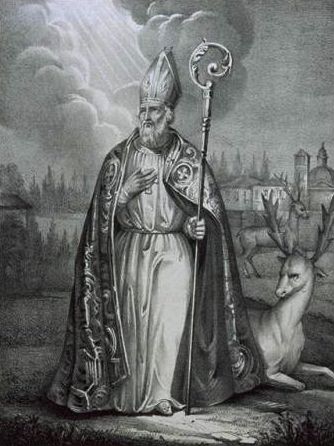
Two stories from his forest life resemble those told of other saints: the devil thrice put out his light as he prayed, and thrice it relit; and he called off wolves chasing a hind, which crouched at his feet until he blessed it and let it go. When his followers grew too many, he fled again deeper into the woods, to the place where the monastery of Corbion, near Dreux, later rose. Monks gathered around his hut of leaves and wattles, and the landowner gave him the land to build on.

One night robbers stole the monks' cow. Lost in the forest, they wandered all night and the next day until at evening the woods brightened and they came out at the monastery clearing, face to face with Laumer. They fell at his feet and begged pardon. He thanked them warmly for bringing back his strayed cow, fed them in his hut, and set them on the right road, without the cow.

Early life

Selected sentences from the original account, unaltered.

S. Laumer as a boy kept his father's sheep near Chartres; afterwards, having learned his letters, he heard the call of God, and gave himself up to his service.

What they represent

How they teach us to live

Drawn from themes in the original account

Build up the community you belong to. This life was lived with and for a community.

Make time for silence. Solitude and withdrawal to pray shape this life.

Read more

The full original · 440 words

Read Baring-Gould’s full account

Baring-Gould’s sources: S. Launomar, called in French Laumer or Lomer , is commemorated in the Gallican Martyrologies. His life was written by one who apparently knew him, as we may conclude from certain passages therein.

S. Laumer as a boy kept his father's sheep near Chartres; afterwards, having learned his letters, he heard the call of God, and gave himself up to his service. He was ordained priest, and entering a monastery, was appointed steward. However, such a life did not suit him, and he retired into the forest, escaping from the monastery one stormy night, when all the brethren were asleep, taking in his hand nothing save his staff. He took refuge in the depths of the forest, where he hoped none would find him, but his sanctity becoming known, disciples flocked to him. Two miracles occur in his forest life very similar to those related of other saints. One night as he prayed, the Prince of the power of the Air, hoping to frighten him, by leaving him in the dark, thrice extinguished his light, and thrice was it rekindled. One day he saw a hind pursued by wolves, he ordered the wolves to desist from pursuing the poor animal, which came and crouched at his feet, whilst he patted it. Then he gave the hind his blessing and dismissed it. When the number of his disciples increased, so that he felt his solitude dissolved, Laumer fled away again, and hid himself in the wood, where afterwards rose the monastery of Corbion, near Dreux. But a city set on a hill cannot be hid, his cell of green leaves and wattles soon became the centre of a colony of monks, and a nobleman whose land this was, gave it to him, that he might build thereon a monastery. One instance of the gentleness of S. Laumer deserves not to be passed over. During the night, some robbers stole a cow belonging to the monks. The brethren were in despair. The robbers however, had lost their way in the tangled forest, as they drove the cow away, and they wandered all night and the next day, unable to discover the road; when, as evening settled in, they saw the forest lighten, and they came out, driving the cow, upon the clearing of the monastery, and S. Laumer himself stood before them. They at once fell at his feet, asking his pardon, and imploring him to direct them aright; but he raised them, and said, "I thank you, kind friends, for finding and bringing back to me my strayed cow; you must be very tired and hungry, follow me." Then he led them into his hut, and set before them such things as he had, and they ate and were refreshed, and he set them on their right road, but of course, without the cow.
Feast days

Feast: January 19

Nine days · Free

Pray the novena
with us.

One short email a day for nine days. The day's prayer, a line from St. Launomar of Corbion's story, and a nudge to keep going.

Also on January 19
G

St. Germanicus

January 19 · Martyr
M

Sts. Maris

January 19 · Martyrs
St. Bassian of Lodi

St. Bassian of Lodi

January 19 · Bishop
← All 1726 saints in the library
Sources & notes

Feast-day sources

Story sources

Sources

Credits

From Sabine Baring-Gould, The Lives of the Saints, new and revised edition (Edinburgh: John Grant, 1914; first edition 1872). Public domain.

From Sabine Baring-Gould, The Lives of the Saints, new and revised edition (Edinburgh: John Grant, 1914; first edition 1872). Public domain in the United States. Reproduced unedited, except for short bracketed notes in grey that we added to explain names and terms (“S.” is the old abbreviation for Saint). Some history and judgments reflect 19th-century scholarship.