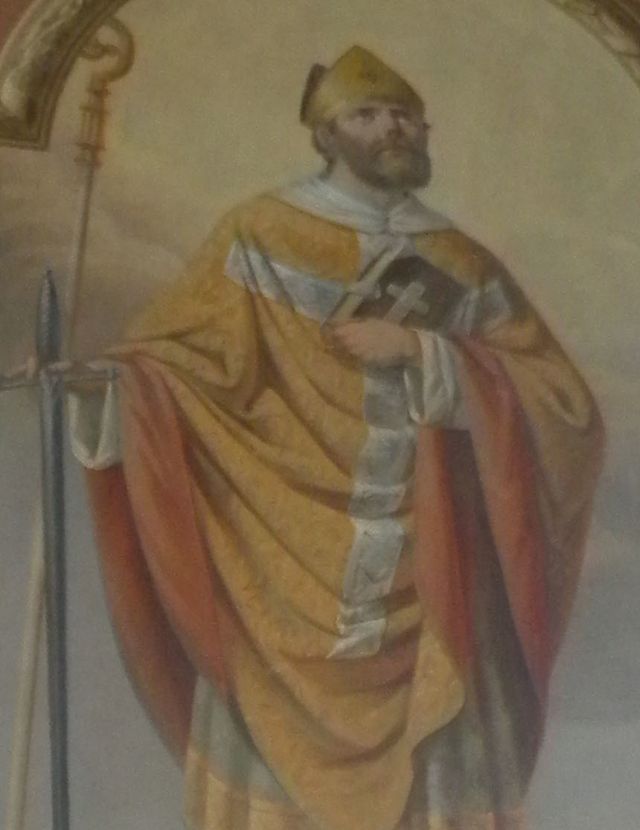
Baring-Gould’s sources: Roman Martyrology. Beatified by Clement VII. in 1524, canonized by Alexander VIII. in 1690. He died Jan. 8, but his festival is fixed for Sept. 5, the day of his consecration as bishop. Authorities His life by Bernard Giustiniani, who died A.D. 1489.] The family of Giustiniani was one of the noblest ii Venice, claiming descent from the Emperor Justinian. Bernardo Giustiniani married a lady of the Querini family, one scarce less noble, and died, leaving her a young widow with a number of little children. Like a good mother she devoted herself entirely to their welfare, formed their characters herself, and attended to their education. The little Laurence, one of her sons, from an early age manifested tokens of a deeply pious disposition. S. Laurence yustiniani.
One night, when he was nineteen years old, he had a dream, in which he saw the Eternal Wisdom manifest in human form as a maiden in dazzling raiment, and heard her say, “ Why seekest thou rest outside of thyself? Enter within, and seek peace in thine own soul. Seek it in me, who am the Wisdom of God. Take me for thy spouse, thy portion, and the lot of thine inheritance.5’ The dream produced a lasting effect on his mind, and he made the resolve to devote himself to God alone. A religious state appeared to him that in which he might best attain the great end which he proposed to himself. But before making a final determination, he sought to know the will of God by humble prayer, and addressed himself for advice to a holy and learned priest called Marino Querini, who was his uncle by the mother’s side, and a regular canon in the austere Congregation of S. George in Alga, established in a little isle which bears that name, situate a mile from the city of Venice, towards the continent. The prudent director, understanding that he was inclined to embrace a religious state, advised him first to make trial of his strength, by inuring himself to the habitual practice of austerities. Laurence readily obeyed, and in the night, leaving his soft bed, lay on knotty sticks on the floor. During this secret novitiate, he one day represented to himself on one side honours, riches, and worldly pleasures, and on the other, the hardships of poverty, fasting, watching, and self-denial, then said to himself: “ Hast thou courage, my soul, to despise these delights, and to undertake a life of uninterrupted penance and mortification ?” After standing some time in a pause, he cast his eyes on a crucifix, and said: “ Thou, O Lord, art my hope. In this tree are found comfort and strength.” The ardour of his resolution to walk in the narrow path of the cross, showed itself in the extreme severity with which he treated his body, and the continual application of his mind to the exercises of religion. His mother and other friends, fearing lest his excessive mortifications should prove prejudicial to his health, endeavoured to divert him from this course, and they contrived for him a marriage with a distinguished and beautiful maiden. The saint perceiving in this a conspiracy to turn him from the object of his desires, fled secretly to the monastery of S. George in Alga, and was admitted to wear the religious habit.
By this change he was not called upon to practise any new austerities which he had not before practised; his superiors even judged it necessary to mitigate the rigours which he exercised upon himself. He was only nineteen years of age, but surpassed, in his watchings and fasts, all his religious brethren. To gain a perfect mastery over his senses, he took no useless recreation, subdued his body by severe discipline, and never came near a fire in the sharpest weather, though his hands were often benumbed with cold; he allowed himself to eat only what the utmost necessity required, and never drank out of meals; when asked to do it under excessive heat and weariness, he used to say: “ If we cannot bear this thirst, how shall we endure the fire of purgatory ?” From the same heroic disposition proceeded his invincible patience in every kind of sickness. During his novitiate he was afflicted with swellings in the glands of his neck, brought on in part by a relaxed condition of body, through insufficient nourishment.
The surgeons prescribed cupping, lancing, and searing with fire. Laurence bore the painful operations with the utmost composure, without an exclamation of suffering. In his old age, seeing a surgeon tremble before inflicting an incision in his neck, he said, “ Cut boldly; your razor cannot exceed the burning irons that tortured the martyrs.” He loved to go about Venice in a tattered garb, with S. Laurence Justiniani.
wallet over his shoulder, asking alms. “ Let us go boldly in quest of scorn,” said he, when reprimanded by some of the brethren. “ It is nothing to have renounced the world in words, if we have not done so with our hearts in reality. Come to conquest over the world this day, with our old leather sacks !”
The saint often came to beg at his mother’s door. Whenever she heard his voice in the street, calling “ An alms, for the love of God !” she would burst into tears of shame and annoyance. However, she never failed to stuff his wallet with bread.
One day the storehouse, in which were laid up the provisions of the community, was burnt down, and the canons were loud in their lamentations. “ We have embraced poverty in word,” said the saint, “ and now we must feel what we have proposed.”
When he first renounced the world, he often felt it difficult to repress the desire to justify himself when wrongfully accused, and to do so would bite his tongue. One day when he was superior, he was rashly accused in chapter of having done something against the rule. The saint could have easily given a satisfactory account of his conduct; but he rose instantly from his seat, and walking gently, with his eyes cast down, into the middle of the chapter-room, fell on his knees, and begged penance and pardon of the fathers. The sight of his humility covered the accuser with such confusion, that he threw himself at the saint’s feet, and asked pardon for having brought a charge against him.
S. Laurence so much dreaded lest his natural love for his family, his dear mother, who had nursed him, his brothers and sisters, who had been his playfellows, should disturb his contentment with his self-chosen lot, that from the day on which he first entered the monastery, to that of his death, he never set foot in his old home, except when called to their death-beds, when he assisted with composed face and tearless eyes, as indifferent to them as to the rest of the world. Some months after his retreat from the world, a certain nobleman who had been his intimate friend, and then filled one of the first offices in the commonwealth, returning from the East, and hearing of the state he had embraced, determined to use all his endeavours to change his purpose. With this design he went to S. George’s with a band of musicians, as if a resolute mind like that of Laurence, which had long counted the cost, could be moved by a party of fiddlers and pipers ! The issue of the interview proved quite contrary to the nobleman’s expectation. At the first sight of the new soldier of Christ he was struck by the modesty of his countenance, and the gravity of his person, and stood for some time silent and astonished. At length he spoke out his mind, and both by the endearments of friendship, and by the sharpest reproaches, strove to shake the resolution of the young novice. Laurence suffered him to vent his passion: then with a mild countenance he discoursed to him so earnestly on death and the vanity of the world, that the nobleman was disarmed, and so moved with compunction, that he resolved upon the spot to embrace the holy rule which he came to violate; and the fervour with which he went through the novitiate, and persevered to his death in this penitential institute, was a subject of admiration and edification to the whole city.
S. Laurence was promoted to the priesthood, and the fruit of the excellent spirit of prayer and compunction with which he was endowed, was a discernment in spiritual matters, and prudence in the direction of souls. The tears which he abundantly shed at his devotions, especially whilst he offered the sacrifice of the mass, strongly affected all the S. Laurence Justiniani.
assistants, and awakened their faith; and the raptures with which he was favoured in prayer were wonderful. Much against his inclination he was chosen General of his Order. He governed it with singular prudence, and great reputation for sanctity. He reformed its discipline in such a manner as to be afterwards regarded as its founder. Even in private conversation he used to give pathetic lessons of virtue, couched in the simplest words and the shortest sentences; and such was the unction with which he spoke, that he softened the hearts of those who heard him. Knowing by sad experience how many mistook their vocations, or how much harm was done by forcing men into the religious life when they had no call to embrace it, he would receive very few into his Order, and these he thoroughly tried, saying, that a state of such perfection was for few, and zeal rarely survived the first enthusiasm. It is not therefore to be wondered at that he was very attentive and rigorous in examining and trying the vocation of postulants. The most sincere humility was the first thing in which he laboured to ground his religious disciples, teaching them that it not only purges the soul of lurking pride, but also that this alone inspires true courage, by teaching the soul to place her confidence in God alone, the only source of strength. He compared this virtue to a river which is low in summer, but full and high in winter. So, said he, humility is silent in prosperity, never elated by it; but it is high, and full of joy and invincible courage under adversity. He used to say, that there is nothing in which men more frequently deceive themselves than humility, and that there is nothing more difficult to acquire. As for that humility which consists in acts of humiliation, it is often deceptive, and at best is only a blind and imperfect sort of humility, preparatory perhaps to the other, but nothing more.
The saint never ceased to preach to the magistrates and senators in times of war and all public calamities, that, to obtain the divine mercy, they should in the first place become sensible of their own nothingness 5 for without this disposition of heart they could never hope for the divine assistance. His confidence in God's infinite goodness kept pace with his humility and distrust of himself; and assiduous prayer was his constant support. From the time he was made priest he never failed saying mass eveiy day, unless he was hindered by sickness; and he used to say, that it is a sign of little love if a person does not earnestly endeavour to be joined to his Blessed Lord in the sacrament of love as often as is possible. It was a maxim which he frequently repeated, that for a person to pretend to live chaste amid softness, ease, and continual gratifications of sense, was like trying to quench fire by throwing fuel upon it. Pope Eugenius IV. being acquainted with the virtue of our saint, obliged him to quit his cloister, and nominated him to the episcopal see of Venice [a bishop’s “see” is his diocese, named from his seat (Latin sedes)] in 1433. The holy man employed all manner of entreaties and artifices to prevent his elevation, and engaged his Order to write in the same strain to his Holiness, but to no effect. When he could no longer oppose the repeated orders of the Pope, he acquiesced with many tears; but such was his aversion to pomp and show, that he took possession of his church so privately that his own friends knew nothing of the matter till the ceremony was over. The saint passed that whole night in the church at the foot of the altar, pouring forth his soul before God with many tears: and he spent in the same manner the night which preceded his consecration. As a bishop he remitted none of the austerities which he had practised in the cloister. Light for guidance he sought in prayer, pleasure he found in alleviating the wants of the poor. He governed a great diocese in the most difficult times, and in the midst of most intricate affairs, with as S. Laurence Justiniani.
much ease as if it had been a single well regulated convent. Though he was bishop of so distinguished a see, in the ordering of his household he consulted only humility; and when others told him that he owed some degree of state to his illustrious birth, to the dignity of his church, and to the commonwealth, his answer was, that virtue ought to be the only ornament of the episcopal character, and that all the poor of the diocese composed the bishop's family. His household consisted of five persons* he had no plate, making use only of earthenware; he lay on a straw bed covered with a coarse rag, and wore no clothes but his ordinary purple cassock. His example, his severity to himself, and the affability and mildness with which he treated all others, won every heart, so that he was able to effect with ease certain salutary yet difficult reformations among the laity and clergy. The flock loved too much so holy and tender a pastor not to receive his ordinances with docility. When private persons opposed his designs, he overcame their repugnance by patience. A certain powerful man who was exasperated at a mandate the bishop had published against stage entertainments, called him a scrupulous old monk, and endeavoured to stir up the populace against him. Another time, an abandoned wretch reproached him in the public streets as a hypocrite. The saint heard him without changing countenance, or altering his pace. He was no less unmoved amidst commendations and applause. No sadness clouded his serene soul, and all his actions showed that he possessed that perfect peace which passes knowledge. He founded fifteen religious houses, and a great number of churches, and reformed those of all his diocese, especially with regard to the manner of performing the divine office, and the administration of the sacraments. Such was the order and devotion that he established in his cathedral, that it was a model to all Christendom. The number of canons that served it being too small, S. Laurence founded several new canonries in it; and he increased the number of parishes in the city of Venice from twenty to thirty.
Crowds every day resorted to the bishop’s palace for advice, comfort, or alms; his gate, pantry, and coffers were always open to the poor. He gave alms with wise discretion, chiefly in bread and clothes, not in money, which might be ill spent. If he gave money it was always in small sums. He employed pious matrons to find out and relieve the poor who were ashamed to ask for alms, or persons of family in decayed circumstances. When a poor man came to him, recommended by his brother Leonard, he said to him, “ Go to him who sent you, and tell him, from me, that he is perfectly able to relieve you himself.” No man ever had a greater contempt for money than our saint. He committed the care of his temporals to a faithful steward, and used to say that it is an unworthy thing for a pastor of souls to spend much of his precious time in casting up farthings.
The Popes held S. Laurence in great veneration. Eugenius IV. having ordered the good bishop to meet him at P.ologna, he saluted him thus: “ Welcome, ornament of bishops !” His successor, Nicholas V., sought an opportunity of giving him some token of his particular esteem; and when Dominic Michelli, Patriarch of Grado, died in 1451, his Holiness transferred the patriarchal dignity to the see of Venice. The senate, jealous of its prerogatives, raised objections, fearing lest the patriarchal dignity or authority should overshadow their own. Whilst this was being debated in the senate-house, S. Laurence repaired thither, and declared his earnest desire to resign a charge for which he was most unfit, and which he had borne against S. Laurence J zcstinianL his will eighteen years, rather than feel his burden increased by this additional dignity. His humility so affected the whole senate, that the doge himself was not able to refrain from tears, and cried out to the saint, conjuring him not to entertain such a thought, or to raise any obstacle to the Pope’s decree, which was expedient to the Church, and most honourable to their country. In this he was seconded by the whole house, and the ceremony of the installation of the new patriarch [the title of the bishops of the great ancient sees: Rome, Constantinople, Alexandria, Antioch, Jerusalem] was celebrated with great joy by the whole city.
S. Laurence, after this new exaltation, considered himself as bound by a new tie to exert his utmost strength in labouring to advance the glory of God, and the santification of the souls committed to his care. Rarely before was it shown how much a man could do for himself and for others who knew how to economize his time. S. Laurence never on his own account made any one wait who wanted to speak to him, but immediately interrupted his writing, studies, or prayers to give admittance to others, whether rich or poor; and received all persons that addressed themselves to him with sweetness and charity. His advice was always healing to the diseases of soul of those who applied to him as to a wise spiritual physician; and such was the universal opinion of his virtue, penetration, and judgment, that causes decided by him were never admitted to a second hearing at Rome; but in all appeals his sentence was confirmed.
S. Laurence was seventy-four years old when he wrote his last work, “ The Degrees of Perfection he had just finished it when he was seized with a sharp fever. In his illness his servants prepared a bed for him • but the servant of Christ was troubled, and said: 4 4 Are you laying a featherbed for me ? No: that shall not be. My Lord was stretched on a hard and painful tree. Do not you remember that S. Martin [St. Martin of Tours (d. 397), soldier turned bishop] said, in his agony, that a Christian ought to die on ashes ?” Nor could he be contented till he was laid on his straw. He forbade his friends to weep for him, and often cried out, in raptures of joy, “ Behold the Bridegroom cometh, let us go forth to meet him.” He added, with his eyes lifted up to heaven, “ Good Jesus, behold I come.” At other times, weighing the divine judgments, he expressed sentiments of holy fear. Some one remarked to him that he might go joyfully to his crown; he was much disturbed thereat, and said, “ The crown is for valiant soldiers; not for cowards like me.” So great was his poverty that he had no temporal goods to dispose of, and he made his testament only to exhort in it all men to virtue, and to order that his body should be buried without pomp, in his convent of S. George. This clause was however set aside by the senate after his death. During the two days that he survived, after receiving extreme unction, the whole population of Venice came in turns, according to their rank, to receive his last blessing. The saint would have even the beggars admitted, and gave to each class a short pathetic instruction. Seeing one Marcello, a pious young nobleman, his favourite disciple, weep bitterly, he comforted him, giving him the following assurance: “I go before, but you will shortly follow me. Next Easter we shall meet in mutual embraces/ Marcello fell sick in the beginning of Lent [the forty days of fasting before Easter], and was buried in Easter week. S. Laurence, closing his eyes, calmly expired on the 8th of January, in the year 1455, at the age of seventy-four years, having been honoured with the episcopal dignity twenty-two years, and four with that of patriarch. sept. 6.) SS. Onesiphorus and Porphyry. 8;