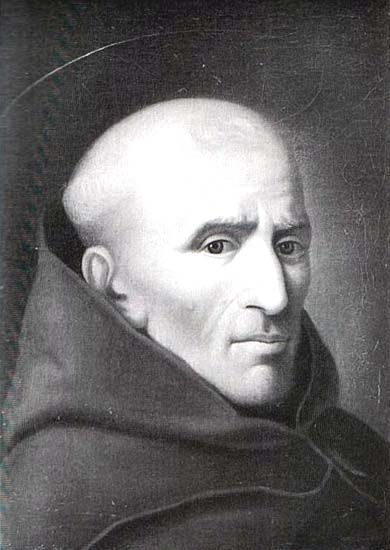
Baring-Gould’s sources: Roman and Franciscan Martyrologies. Beatified by Pius VI. in 1796, canonized in 1867 by Pius IX. Authority: — A Life by R. P. Salvator d’Ormea, O.M., published with his works.] Porto-Maurizio, a village on the Corniche road neai Oneglia, was the birthplace of S. Leonard. He was born on December 20, 1676, of well-to-do parents, and was named at the font Paul Jerome.1 His mother died when the youthful saint was two years old, and his father married again, and became the father of four more children. Paul Jerome instructed his half-brothers and sisters in making little altars, and dressing up and marching in procession from one to another, singing hymns, after the manner of the Corpus Christi solemnity. He was sent to study al Rome whilst living with his uncle. This worthy man treated him as one of his own children, and endured, without reproach, many of his eccentricities. But when Paul Jerome, after hearing a sermon, or reading the life of a saint, began to talk of it at supper-time, and continue an unflagging stream of pious but somewhat commonplace sentiments on the same, forgetting all the while to empty his plate, his uncle Agostino was obliged to interfere and say, “ Pray hold your tongue and eat your supper.”
One day, his biographer informs us, a companion — a specially “precious companion” — was walking with him, when they passed a gallows from which hung a dead and decaying criminal. “That will be the end of you, if you are a bad man,” was the brilliant observation of his “pre1 “ Because,” says a biographer, “in him were observed all the indications of a privileged soul born for heaven ” — in a baby at the breast ! It is clear, of course, that the names Paul Jerome are specially calculated to designate a privileged soul. cious ” companion. The remark struck the saintly youth profoundly, and from that moment he conceived a great terror of crime, or at all events of its punishment. He joined several pious societies of persons living in the world, and, though still young, occupied himself on festivals and Sundays in beating up loungers and laggers in the streets, and speeding them to church to hear the sermon. He fortunately got hold of a very wholesome and altogether admirable book, the “ Introduction to a Devout Life ” of S. Francis of Sales, and this served him as a guide in youth. He could hardly have found a better. He learned the greater part of it by heart, and was fond of repeating it aloud at meal times to his uncle and relations at home. In after years, when preaching, he exhorted all young people to join religious confraternities, assuring them that, in his belief, his having belonged to the oratory of Father Caravita and the congregation of the Chiesa Nuova saved him from falling into laxity of life, and quickened the sparks of devotion in him into a glowing fire.
He used various mortifications. The maids pointed out to his aunt and to each other that he had not slept in his bed, but lain on a board, and they rolled a stone from under his bed, which the women in consultation together over it decided must have served him as a pillow. With feminine inquisitiveness they turned out his drawers and box, and exposed hair shirts and scourges. A minute inspection of the latter revealed clots of blood and little bits of skin. The aunt talked among all her relations of what she had seen, the maids among all their friends, and Paul Jerome found that his self-mortification was a matter of public notoriety.
He had as his confessor [in old usage, a saint who was not martyred, or who suffered for the faith without being killed] Father Grifonelli, and to him the young saint announced his intention of joining a religious Order. The confessor, to prove his obedience, bade him go S. Leonard of Porto-Mciurizio.
to all the booksellers in Rome and ask for.^Esop’s fables, and those of Bertoldo and of Bertoldino, bound in one volume. Although the young man foresaw the impossibility of finding such a book, he at once set out in quest of it, and did not relax his efforts till he had visited ineffectually all the bookstalls in the city. After having been subjected to ridicule and rebuff, he returned to Grifonelli, and told him that he had not succeeded in obtaining the volume, but that he would endeavour next day to procure it in another quarter. Grifonelli scolded him, and called him a fool for not being able to get so common a work, and Paul Jerome took his scolding in good part, without answering a word. One day Paul Jerome saw passing by the Gesu, two friars, whose appearance specially delighted him. Whether it was their quaint costume, or their sanctified demeanour, which attracted him cannot be said, but he followed them to ascertain to what Order they belonged. They led him to the Minorite convent of S. Bonaventura, on the Palatine, and he entered the church as the friars began Compline with the words " Converte nos, Deus, salutaris noster” (Turn thou us, O God our Saviour). The words struck him as a call, and he said to himself, “ Hsec requies mea ” (This is the place of my rest), and resolved to join the Order, which wore snuff-coloured, coarse, hooded habits, were girded with a knotted rope, were sandalled, and did not shave. When he announced his intention to his uncle, he met with strong opposition. What did the lad know of the Order, and its rules, except that the friars wore an antiquated and picturesque habit? He had made no personal acquaintances among the Minorites; why should he enroll himself among them with such precipitation ?
But Paul Jerome had made up his mind, and he was received as a novice by the Minorites on October 2, 1697, when he was aged twenty-one, and received at the time the name of Leonard, abandoning for ever those of Paul and Jerome, which had been given him at the font as adapted beyond all others to express the character of his soul as meet for heaven and highly privileged to receive Divine favours.
The year of his novitiate was spent in a condition of exaltation and highly wrought enthusiasm. In after years he looked back to this period and said that it was his Holy Year, and that he had done nothing but go back since his novitiate. His feelings had naturally become less excitable, but religious progress, as is too often forgotten, is not marked by tumultuous emotion, but by moral conquests. He made his solemn profession on October 2, 1698, and at once applied himself to the study of theology. He had one rare but most precious gift, which he never squandered away — love of study. He loved books — they were his companions, his friends, his guides. He often urged, when he was a preacher much sought after, that he never could have obtained the influence he possessed, or been able to arrest attention, without constant study.
However, if he had the gift of study, he had also the gift of talking. His uncle and cousins had experienced this, and had sometimes wished he would have mortified himself a little more in this particular, but this was a gift which would be of eminent service to him as a preacher. A student unable to give forth fluently the substance of what he had read and thought over, might make a man of letters, but not a pulpit orator.
When walking with his brethren in the garden in time of recreation, he could not refrain from moral exhortation. Whenever the restraint of silence was removed, his tongue was heard going in the delivery of wholesome, edifying advice. He was so evidently cut out by nature to be a preacher, that his superiors would not allow him to turn to literature, or spend himself in mission work among heathen, but urged him to devote himself to the evangelization of the Italian people — a people which, with an episcopate almost equal in number to all the other bishoprics of Europe, literally swarming with clergy and monks, more preached to, and, no doubt, prayed for, than any other Christian people, is yet the most backward in morality, and sense of truth, and honesty, and the dignity of labour, of any nation that has embraced the Gospel.
Accordingly Leonard of Porto-Maurizio, after recovering from a long illness, which had reduced him to skin and bone, set to work to carry on missions in his native Italy. He began at Artallo, not far from Porto-Maurizio, whither he had been sent to regain his health, and where it began to be completely re-established. He walked over every morning to Artallo with bare feet, and returned late in the evening. Once, when on his way home in the dusk, a man followed him, sighing heavily. S. Leonard waited till he came up, when the man fell at his feet and said, bursting into tears, “ My father, you have before you the greatest of sinners ! ” “ And you have in me,” answered the saint, “ a father full of tenderness.” He led the penitent to the convent at PortoMaurizio, heard his long confession, and sent him away comforted, and strengthened to lead a better life. But the zeal of Leonard urged him occasionally to inveigh against harmless customs which it was quite impossible for him to root out.
He was invited to preach on the feast of S. Bartholomew at Caramagna. He found that there, as everywhere else on a festa, the people danced in the afternoon. He preached vehemently against this. The people listened with interest, and then hastened home to get ready for the ball. Father Leonard, finding that his sermon had not produced the smallest effect, ordered the crucifix and candle bearers to precede him, and he went direct to the booth where the dance was to be held, and right in among the merry-makers, whilst the band was playing, and the young men and women were capering. The apparition of the vested preacher and the acolytes in scarlet and white, with burning tapers and uplifted crucifix, arrested the orchestra, and the saint at once raised his voice and exerted his greatest powers of eloquence against the ball. His excitement, vehement gestures, and evident earnestness, impressed a naturally excitable people, and when it was noticed that one of the arms of the figure on the cross was loose and waggled about, the dancers, or some of them at all events, took it as a sign of Divine concurrence in the denunciation. The cross-bearer at emphatic portions of the address gave a dexterous jerk to the crucifix, and made the arm wag threateningly, and some of the women screamed, and their screams drowned the titters of the men. When S. Leonard ceased, the hearers dispersed, some overawed, most actuated by that graceful courtesy which distinguishes even peasants in Italy, and postponed their dance till next Sunday, to humour the excited and respected preacher.
The grand-duke Cosmo III. of Tuscany summoned S. Leonard to preach missions in his duchy, and offered to find him the means for travelling and subsistence. “ I thank your highness,” said the saint; u but my Master makes me independent.” And, in fact, wherever he went, he was always supplied with abundant alms. However, the grand-duke sent a commissioner to attend him, and see that he wanted nothing. This officer wrote, after a mission held at Pitigliano; “ I cannot refrain from announcing to you with feelings of the liveliest joy, the happiness which Pitigliano has had in possessing this great servant of God, who is just closing his mission, to proceed to Sorano and sanctify that place in turn; for, indeed, conversion is not the only word for designating the results, sanctifying expresses them far better. Father Leonard is an instrument of the Holy Spirit, who by his sweetness attracts all who hear him, even the most hardened. I had the honour of being charged by his royal highness to attend him and obtain for him all that was needed; but I have had scarcely any occasion for executing my office, for the little the father and his companions eat they obtain by begging. I had prepared for him a little house containing five rooms, with a bed for him, supplied with mattress and all necessary furniture; but no sooner had he arrived than he carried in some planks on which he sleeps, and turned out the bed. I think, 1 ” added the courtier, accustomed to a featherbed and plenty of nourishing food and wine, “ I think that there is something miraculous in the maintenance of life in this manner, accompanied by such fatigue and such severe penances.”
As a plague which had appeared in parts of Northern Italy did not enter Tuscany, a procession was organized to carry a miraculous image of the Virgin down and then up a hill on which was a pilgrimage chapel that contained it. It was said that a hundred thousand persons assisted in this ceremony. Leonard preached to the people from the chapel steps at the top of the hill before the procession dispersed, and gave his benediction. At the same moment, according to preconcerted signal, a cannon was fired and was answered by cannon a little way off, and these by other ordnance at a distance, so as to announce to all Tuscany the moment of benediction, that all might kneel and all receive the blessing. It was remarked that the banging of the cannon, the reverence of the vast crowd, the benediction of the saint, worked so powerfully on an impressionable multitude that many cried. Father Leonard held missions at Massa, Arezzo, Volterra, Siena, &c. He was in the greatest request. The bishop of San Miniato, in a letter thanking the guardian of San Francesco del Monte for having sent him the missioner, said: “ Father Leonard returns to retreat laden with merits. He has laboured during fifteen days, I might add fifteen nights, with admirable zeal for the salvation of my beloved flock. Nothing can surpass his devotion, except, let us hope, the fruits which it has produced. I should say that Divine grace triumphs in him, for it does not seem to me possible that one man could do so much, unassisted by the special help of God.”
The priest of San Rocco, near Pistoia, wrote, after a mission: “Blessed be the hour when the thought came into my head to ask you, reverend father, to send me Father Leonard. God alone knows all that He has deigned to work by means of His servant. The whole town venerates Father Leonard as a saint, as a learned preacher, as a fervent missioner, and all hearts have been enchained by his words of fire. He breaks the callous hearts of those who readily lend the ear to those that flatter, and close it to the truth. None have been able to resist him but those who have not heard him. He has had immense congregations of hearers: in the second procession of penitence there must have been as many as fifteen thousand persons, and at the papal benediction about twenty thousand. All the confessors in the town have had their hands full, and extraordinary dispositions marked the penitents — a very lively anxiety about the affairs of their souls, and forgetfulness of everything else. He has carried away with him the regrets of everyone, as manifested by the tears of the faithful, who strove to retain him. And the whole town is looking forward to the chance of his revisiting it on some future occasion. The most notable inhabitants of Pistoia, men and women, came to San Rocco at hours most inconvenient to themselves, and in spite of the great heat, to hear him, and to make their confessions to him. Many persons snent the night in the church porch. God be praised, who deigns to visit His Church by sending it such servants ! One may judge of the fruit of the mission by merely observing the fervour with which the Way of the Cross is gone through. It is quite exceptional to see men and women of position in Pistoia, so opposed in general to outward demonstrations of piety, yet making the Stations of the Cross with so much recollection and fervour, that they are not ashamed to kiss the earth, and that, moreover, after the conclusion of the mission.”
In 1715, whilst labouring at missions in Tuscany, he was appointed guardian of the convent of San Francesco del Monte at Florence. He established regularity of discipline in it, finding this greatly relaxed. For his own part he lived with great austerity, eating only vegetables, wearing a ragged and patched habit, and sleeping on hard boards. The excitement and strain of mission work was so exhausting that he felt the necessity for entire rest and seclusion from the world. The mind could not bear the effort without being allowed time to recruit. He therefore obtained a grant of a hermitage called Santa Maria del Incontro, situated at some little distance from Florence on a mountain, and he determined to place there a few religious who aspired to a solitary life, and amongst whom he might rest at intervals, and in the peace of the mountains draw in fresh inspiration. He started from Florence for his hermitage, barefoot, when snow was on the ground, attended by a few friars, on the feast of the Annunciation. They ascended the mountain singing psalms. Everywhere the spring flowers were bursting forth: among the coppice the ground was pink with cyclamen, and here and there shone the scarlet anemone.
The hermitage was small. Each cell was so diminutive that the occupant could touch the walls by stretching out both hands — cells containing too few cubic feet of air to be healthy habitations, had not windows and doors been badly fitted, and allowed ventilation.
No member of the community was allowed to administer the sacraments, to write, or receive letters — except from very exalted personages — without leave. The fasting was severe, and almost perpetual: nine Lents were observed in the year, and on only fifteen or sixteen days were eggs and cheese and milk permitted. On all others, these, together with fish, and, of course, meat, were strictly forbidden. Vegetables and fruit formed their diet.
S. Leonard retired twice in the year to this solitude: he would gladly have remained there all the rest of his life, and made there, as he called it, his novitiate for Paradise; but this was impossible — his line of life was already marked out for him by Providence, and he must follow it. Cosmo III., grand-duke of Tuscany, invited the saint to examine the case of a young girl condemned to death by the magistrates, but whose sentence he was reluctant to sign, as he hesitated about her being really guilty. S. Leonard went carefully through the evidence, was satisfied that the girl was innocent, and Cosmo pronounced her discharge. In a town in the diocese of Pisa he preached against giving occasion of scandal, and, as his manner was, during the sermon, bared his back and lashed himself till the blood flowed, before all the congregation in the church. This offensive spectacle no doubt produced effect on coarse and ignorant minds. It so wrought on the priest of the place, who was notorious for his immorality, that he got up into the pulpit, plucked the scourge from the hands of the preacher, bared his own back, and to the great edification of his parishioners, to whom he had been a scandal for many years, whacked vigorously till the blood began to spurt out and drop from the scourge on the upturned faces nearest the pulpit. At Livorno, during a mission, forty women on the streets having entered the church, were so touched that they went to him for confession. He gave them a special sad-coloured habit, and during the rest of the mission they were marched in file to the church from a house which he had secured as a home and refuge for them, and created the liveliest emotion and satisfaction in the breasts of the audience by their contrition.
In 1730 S. Leonard went to Rome to conduct a mission there. To create a more startling effect, he provided himself with an iron bar, or thick piece of wire, and having stripped for his sermon to the waist, whacked himself at appropriate intervals, and showed his bloody back to the delighted people. The vulgar are always greedy of horrors. The blood smears and groans and whacks gave zest to the discourse.
From Rome he went to Velletri, where one fruit of his mission was that all the people were induced to write the name of Jesus over their doors. From Velletri he went to Lucca. Whilst there he made happy use of an accident. Whilst preaching, he saw through a window that a thundercloud was gathering. He waited his opportunity, and at a flash cried, “ If my voice cannot shake your hearts, then may God speak from heaven.” A tremendous crash of thunder followed, and scared the people nearly into fits. One day, a woman with a little child was very curious to hear him. She did not like to leave the child alone, and she could get no one to supply her place. However, as the mission was drawing to an end, her female curiosity got the mastery over her maternal love. She put the child to bed, and ran off to the church to hear the famous preacher, and see him beat his back till it spurted blood. She gratified at once her devotional instincts and taste for excitement, and when the sermon and scourging were over, returned much edified and delighted to her lodging. But what was her horror, on entering the bedroom, to see no trace of the infant ! She set up a piteous cry, and ran about the house. On reaching the foot of the back stairs she saw a bundle like a blue bag with two very pink legs depending from it. Her child had scrambled out of bed, got to the stairs, crept between the banisters, and fallen, but had been caught by a projection, which gathered the clothes over its head and held the child suspended, kicking its exposed nether limbs in space. The report of this miracle spread through the town, and greatly enhanced the popular opinion of the saint.
When the scourge and the iron bar had ceased to draw congregations, Leonard adopted a crown of thorns, which he pressed on to his temples so that the blood trickled over his face when he preached, and he hung an iron chain round his neck and made it clank loudly whilst he beat his naked body. And this proved very attractive to coarse natures requiring startling sights to awaken them. Genoa and Corsica were indulged with this spectacle, and it drew as many as a hundred thousand persons at Genoa to witness it. After the mission at Genoa the names of Jesus and Mary were inscribed in letters of gold on the gate of Monte-Reale, to the firing of cannons and the pealing of all the bells in the town. The Pope called him to Rome in 1751; he was then ill. He left Tolentino, where he had been staying, when the mountains were covered with snow. He felt the cold severely, and looked like a corpse. His fellow traveller, seeing that he was ghastly pale, asked him anxiously how he felt. “Iam ill," he answered. No suffering had drawn a word of complaint from him for five-and-twenty years. On reaching Foligno he attempted to say Mass; his comrade remonstrated with him; but Leonard said, “ My brother, one Mass is worth more than all the wealth of the world." The reverse of Henry IV.;s “ Paris vaut bien une messe.”
When they passed through the gates ot Rome, he said S. Leonard of Porto- Mater izio. 561 to his fellow traveller, “ Begin the Te Deum; I will respond.” Thus chanting together the hymn of praise, they arrived at the convent of S. Bonaventura on November 26, after sunset.
He was removed from the conveyance in which he was seated, but he could not walk; he was therefore carried at once to the infirmary. His pulse was failing. He asked to be confessed, and to receive the viaticum. Having received the Holy Sacrament, he implored the doctor not to order him meat, as he desired to keep his rule to the end. The sacrament of extreme unction was then administered, and he sank into a state of coma, which passed imperceptibly into death. He died at the age of seventy-four, wanting only a few days of being seventy-five.
His relics [the bodily remains of a saint, or objects they used, kept with honor] are in the church of S. Bonaventura at Borne.