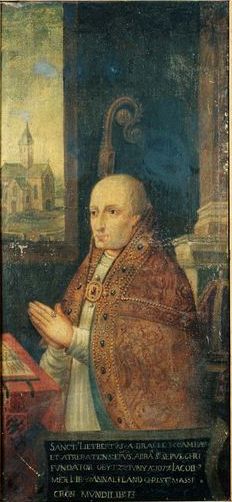
Baring-Gould’s sources: Belgian and Gailican Martyrologies. Au'hority: -The Gesta Episcoporum Cameracensium, continued from 1051 to 1076 by Balderic, in Pert*, Mon. Ger. VII., p. 489-599. There is a life by Rodolph. monk of S. Sepulchre at Cambrai, written about the year 1290, but it is a mere amplification of the life in Baldric's supplement to the Gesta Episcop. Cameracensium.] S. Lietbert, or Liebert, as he is often called, was closely related to Gerard I. de Florines, bishop of Cambrai and Arras, and was probably his sister’s son. He was educated in the bishop’s house and under his eye. On completing his studies, Lietbert taught at Cambrai, and his school was frequented by numerous scholars. His uncle ordained him deacon, and called him from his work of instruction to attend to his house, and exercise such duties as the prelate was unable to discharge, on account of his advanced age. The bishop made him archdeacon of Cambrai and provost of the chapter, two offices requiring a man of spirit and resolution to fill them, on account of the continuous encroachments of the castellans, vogts, or voues of the diocese. It was the custom for bishops and abbots in these troublous times to appoint nobles to be the voues or vogts, that is, protectors of the Church lands. These officers undertook to defend the Church property from invasion and robbery, and in return were given certain privileges and fees. But these officers in many cases became intolerable tyrants, robbing and oppressing the retainers of the Church instead of defending them from foreign assault. Jon* 1J.J 6*. Lietbert.
Cambrai was at that time suffering from such a castellan, named Watier; but his violence and rapacity brought him to a tragic end, and his widow marrying John, Vou6 of Arras, transferred to him, without consulting the diocese, the rights of her former husband. This Lietbert resented on behalf of his uncle and the retainers of the see, and he made himself master of Hugh, the son of the late castellan, who was a child, and placed him under tutelage approved by himself, hoping thereby to train up a future defender of the Church lands of Cambrai in docility to the clergy and with respect to the liberties of the people. The old Bishop Gerard expired in the arms of his nephew on the 14th March, 1051, and Lietbert was immediately elected in his room by the people and clergy of Cambrai. The Emperor Henry TIL, who was then at Cologne, immediately ratified the election, and invested Lietbert with the temporalities [the lands and income attached to a bishopric] of the see. This took place on Easter Day, March 31st, in the same year, 1051. The bishop-elect at once returned to Cambrai, but on approaching the town, found that John of Arras, profiting by the vacancy of the see for three weeks, had installed himself and his wife in the palace, had driven the clergy out of the church of Notre Dame, and had plundered the treasury. The town was occupied by his soldiers, who held the people in subjection, and committed grave disorders. Lietbert retired to the castle of Chateau Cambresis, where he remained till Baldwin V., count of Flanders, at his request, compelled John of Arras to allow the bishop-elect to enter his episcopal city, and occupy his palace there. After S. Lietbert had repaired the damages done by the vou6 and his soldiers, he set out to Rheims to receive holy unction from the hands of his metropolitan [the archbishop who heads a group of dioceses]. (June 23 But on his way he visited Ch&lons-sur-Mame, where he was ordained priest by the bishop, Roger II. The emotion of S. Lietbert, on receiving the sacred commission, was very great. When the words, “Receive the Holy Ghost, whose sins you remit they are remitted,n were uttered, he trembled violently, and his cheeks were bathed in tears.
From Chalons he betook himself to Rheims, where all the bishops of the province were assembled at the summons of the archbishop. Henry I., king of France, who had just espoused the daughter of the grand duke of Russia, was present with his youthful queen. At his request, the new bishop blessed his bride and placed the royal crown on her head.
On his return to Cambrai, Lietbert went at once to the great church of Our Lady to olfer his thanks to God and the Virgin Mother, and then turning to the people, exhorted them to lead godly and virtuous lives. The life of the bishop was one offering a striking contrast to that of most other prelates of his time, who lived in splendour and luxury. His biographer says: “ He was an example to his flock. He avoided all luxury in dress, all devotion to frivolous pastimes, long sleep and inactivity. He had a horror of jealousy, detraction, envy, and pride. Avarice he regarded as poison. Everything he did was done gravely, without bustle, but also without dilatoriness. He avoided all quarrels, and endured hostility with great composure, labouring to soften it by every means in his power. He never had recourse to force, but always tried persuasion and counsel... He was gentle, affable, diligent in discharge of his duties, full of kindness to his people, listening with indulgence to the complaints of the oppressed, and showing himself considerate towards all, giving to the poor and indigent Lietbert.
all that he could spare, and acting with holy boldness and evangelical liberty towards the great and mighty of this world. Often he addressed the soundest advice to his people, visited them in their homes, patched up their quarrels, reconciled differences, and studied to please all that he might win them to Jesus Christ.” The churches of Cambrai and Arras had been in the enjoyment of rest for some years under the good and firm government of S. Lietbert, when the desire to make a pilgrimage to the Holy Land came upon him. He therefore created Hugh, son of Watier, castellan or vou6 of Cambrai, and placed him under the tutelage of Anselm, a good knight of high moral character. He took with him Walcher his archdeacon, Hugh his chaplain, Erlembold the city judge, and Erlembold the Red, and at the head of three thousand pilgrims started for the Holy Land across Germany, in the spring of 1054. As long as they were on German soil, the pilgrims fared well enough, but on reaching Bulgaria, they found none but men who inhabited the forests and subsisted upon plunder.
To shorten their voyage, the immense train crossed the Danube, and entered Pannonia [a Roman province roughly covering western Hungary and parts of Austria and Croatia]. The king of Hungary, uneasy at the invasion of such a swarm, and uncertain of their purposes, ordered a party of the crusaders to appear before him. Lietbert headed the deputation, bearing the cross on his breast. The king, touched by the dignity of the prelate, invited him to sit down near him, and inform him of the object of his journey. He was incredulous when the real motive which had actuated this great swarm was disclosed to him, and he ordered armed men to watch the pilgrims through his territories, and with great courtesy provided them with the necessaries of life. From Hungary the crusaders passed into Bulgaria, where the barbarian inhabitants fell on a marauding band of pilgrims, and killed and wounded many of them. The prelate, on hearing of the onslaught, exhorted his followers to advance in faith, and not to be discouraged at the dangers which beset their path. For the next seven days they were unmolested, but on the eighth they saw men on horseback, half naked, their heads adorned with floating ribands, armed with bows and arrows, and wearing long cloaks and high boots, emerge from the forest. The pilgrims fled in dismay, but the prelate encouraged them, and leading the way, was allowed to pass unmolested, and the barbarians even acted as guides to them, indicating their road. After a while the pilgrims reached Laodicea, where they embarked, and were cast on the coast of Cyprus by a tempest. The bishop had now seen the greater part of his companions in this ill-judged expedition perish from disease and famine in Bulgaria, or swallowed up in the sea near Cyprus. Those who survived were sinking under their various miseries, and were morally and physically disorganized. Returning to Laodicea, they learnt that still greater dangers awaited them on the route to Jerusalem. The bishop of Cambrai felt his courage abandon him, and believed that God himself was opposed to his pilgrimage. Perhaps his conscience reproached him for his fool-hardy enthusiasm, which had cost over two thousand poor Picards end Flemings their lives. His crusade had been more destructive to life, and conducive to misery, than many a war of his time. He returned through a thousand dangers to his diocese, where he built a church in honour of the Holy Sepulchre, which he had never seen.
Shortly after his return, the emperor restored the jone »3.i «S. Lietbert. 315 ■* castellanship to John of Arras, but the bishop succeeded in withdrawing the city again from his dangerous protection, and consigning it to the young Hugh, who was under the guardianship of his own creature, the knight Anselm. The advantage to the city became speedily apparent. “ The inhabitants,” says the biographer, “ who had for long been exposed to degradation, and were reduced to poverty, recovered a new life under the blessings of peace, and seemed like men escaping from their tomb. Thanks to the care and solicitude of their pastor, in the town of Cambrai and in its neighbourhood, mercy and truth met together, justice and peace kissed each other.
44 All the gates were open, no robbers, no ravishers, no one who sought to defraud his neighbour, was to be found. The clerks abundantly provided for, sang the praises of God, and the laity exercised their trades in all tranquillity. Happy are the people that are in such a case, but more happy the pontiff who procured them these advantages.”
But this time of prosperity drew to a close. The young Hugh turned out like his father, and only awaited an opportunity to shake off the fetters that had been placed on him, and use his liberty to harass and despoil the unfortunate people of Cambrai. That opportunity speedily presented itself. The bishop had been summoned to assist at the consecration of Philip I., son of Henry I., at Rheims, on May 23rd, 1069, together with twenty-three other prelates. The archbishop Gervase had the highest respect for his suffragan [a bishop under the authority of an archbishop] of Cambrai, and he was pleased to give token of his regard in a signal manner.
On Holy Thursday, the metropolitan, in his pontifical habits, was advancing to the altar to celebrate the divine mysteries, when he perceived S. Lietbert: he at once divested himself of his sacred ornaments, laid them upon S. Lietbert, and insisted on his chanting the solemn offices of the day in presence of all the people, and in the place of the archbishop.
On his return to the city of Cambrai, the venerable Lietbert found that young Hugh had asserted his independence, and held Cambrai against him. The bishop was driven from Cambrai, from Poijgival, from Inchy and other places, and Hugh overran the country, exacting fines, spreading disorder, and allowing his followers to pillage the citizens and peasants. Thereupon the bishop excommunicated Hugh, and the sentence worked among his followers, so that the castellan was obliged to come to terms with the prelate. He was the more inclined so to do, that he desired to marry the niece of Richildis, countess of Mons, and he knew that this was not possible till the ban was removed. But his submission was only feigned. Shortly after, hearing that S. Lietbert was at the village of Buricellum,1 to dedicate a church, and to confirm children. Hugh gathering around him some of his most determined partizans, surrounded the house by night in which the bishop was sleeping, broke into it, killed those who opposed him, drew the old prelate from his bed, and carried him off to Oisy, his castle, where he threw him into a dungeon.
The news spread, and aroused general indignation. Arnold, count of Flanders, and his mother Richildis, countess of Mons, united their troops and marched to Oisy, where they forced Hugh to restore the bishop to liberty and to his cathedral. S. Lietbert shortly after 1 Boiri-Bcguesel, Boiri-St.-R»ctrude or Boiri-St-Martin, or Bourlon; it is not known which of the four.
S. Lietbert assembled his troops and the citizens who adhered to his party, and drove the turbulent castellan out of the country, and destroyed his castle.
One weird story told by his biographer must not be omitted. S. Lietbert was wont at night to visit the churches of Cambrai, and pray in them for the welfare of his flock. He made these rounds barefoot, accompanied by his chaplains. One night — it was Easter eve — the prelate, after having visited all the churches and oratories of his episcopal city, came to the little chapel of the Holy Sepulchre adjoining a large grave-yard. The Easter moon shone ghostly in at the windows of the circular chapel and over the cemetery without. It was the night on which Christ’s body lay in the tomb, but his spirit preached to the spirits in prison, and Lietbert, in harmony with the occasion, thought of the dead, and uttered a solemn prayer for those who lay in the churchyard outside, and whose bones mouldered under the flagstones of the chapel in which he knelt. When the prayer was ended, his chaplains, with curdling blood, heard, or in their alarm fancied they heard, the dead respond Amen from their tombs and graves. Under the prudent and peaceable government of the bishop, the city again recovered its prosperity. “The town,” says the historian, “formerly ill-fated through troubles and wars which desolated it so frequently, by degrees became populous and flourishing.” But the tranquillity was again threatened in the old age of S. Lietbert. Robert the Frisian, having taken possession of the county of Flanders after the death of his nephew Arnold, killed in the battle of Cassel, marched towards Cambrai to dissever it and the whole of the Cambresis from the empire of Germany. His troops, dispersed over the country, caused great misery. The (June aj.
bishop, broken by age and sickness, had sent to Robert a deputation of the most honourable citizens of Cambrai, to entreat him to desist, but Robert had replied that unless the bishop surrendered the city, he would destroy it with fire and sword.
On hearing this, the dauntless old man ordered his litter to be got ready, and in spite of his sickness, ordered his servants to carry him into the hostile camp. On arriving in the presence of Count Robert, he reproached him, and ordered him to leave the lands of his mistress and lady, S. Mary. The count scornfully refused.
Then the old bishop with painful effort raised himself on his litter, and bidding his clerks give him a stole, and his pastoral staff, he excommunicated the count and the whole army, till they should make satisfaction for the wrong done.
Robert was struck with dismay. The firmness of the old man, the respect he inspired, and the consciousness of wrong worked on the fears of the count, and that day he gave orders for the army to withdraw. Thus the city was delivered from a serious peril which menaced it, by the courage of its holy bishop. He died not long after, after a pontificate of twentysix years.