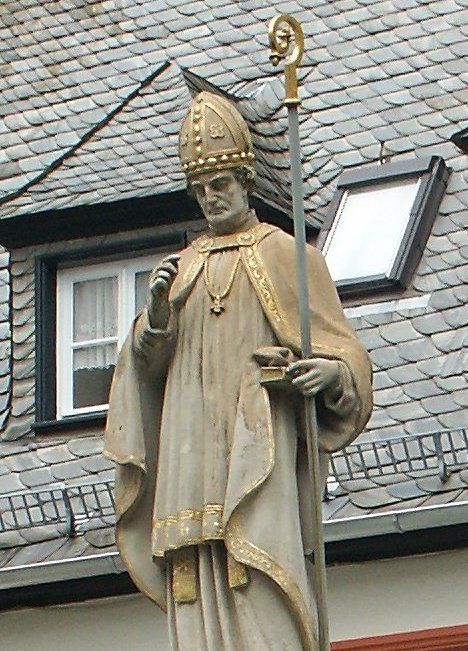
St. Lullus of Mainz

A shepherd who carried a whole region through hard times.

Read the essentials →
October 16 · Archbishop

St. Lullus of Mainz

St. Lullus of Mainz

A shepherd who carried a whole region through hard times.

Traditional feast

October 16
1914 / pre-1969 calendar, per Baring-Gould (1897)

Current feast

October 16 (also listed: June 1)
Secondary source · Wikipedia

Represents

Archbishop

Their story

Adapted in modern English from Alban Butler's Lives of the Saints · Baring-Gould original below

Lullus was an Englishman, probably a West Saxon. He was educated at Malmesbury and finished his studies at Jarrow under the Venerable Bede (the English monk-historian, d. 735). In 732 he went to Germany to join his kinsman St Boniface, who gave him the monastic habit, ordained him deacon, and set him to preach to pagans. In 751 Boniface ordained him priest and sent him to Rome to consult Pope Zachary.

Boniface chose him as his successor, and with King Pepin's consent Lullus became archbishop of Mentz. After Boniface's martyrdom he had the body taken to Fulde for burial. He governed Mentz for thirty-four years, attended councils, was consulted on hard questions from Rome, France and England, and worked to obtain good books for Germany.

He resigned before his death and withdrew to his monastery of Harsfeld, where he died on 1 November. Butler says the year was 787, not 786; Baring-Gould, the text on this page, gives 786. The sources differ.

Struggles & surrender

What they wrestled with, and how they gave it to God

  • Misled into an injustice ·
    Butler says false reports led him to side against St Sturmius, abbot of Fulda, when Sturmius was accused of treason; he later made amends, as a charter he signed for the abbey shows.

Early life

Selected sentences from the original account, unaltered.

…answer to the call of S. Boniface, he went in 725 to Germany, being then quite young, scarcely twenty years old.

What they represent

How they teach us to live

Drawn from themes in the original account

Build up the community you belong to. This life was lived with and for a community.

Share your faith, in words and by example. Preaching and conversion are central here.

Make time for silence. Solitude and withdrawal to pray shape this life.

Learn from the kind of life it was. A shepherd who carried a whole region through hard times.

Read more

The full original · 265 words

Read Baring-Gould’s full account

Baring-Gould’s sources: Roman Martyrology, not in any ancient Martyrology. Authorities: — Mention in the Life of S. Stnrmi and that of S. Boniface. There is a late Life of S. Lullm by a monk of Hersfeld, but it is of little value.] Lullus, a native of England, probably of Wessex, was brought up in the monastery of Malmesbury, under Abbot Eaba, and was there elevated to the office of deacon. In 1 Name unknown; no diplomas with his signature exist Oct. xd.] S. Lullus.

…answer to the call of S. Boniface [English missionary to Germany, martyred 754], he went in 725 to Germany, being then quite young, scarcely twenty years old. In Germany he was ordained priest in 735, and acted as archdeacon to S. Boniface, whom he constantly attended. S. Boniface sent him on a legation to Pope Zacharias, in 751, to obtain privileges for the monastery of Fulda, which S. Boniface had founded. In 742, S. Boniface had besought permission of the Pope to nominate a successor, but this request was not granted till 748. Then Boniface obtained permission to the same effect from King Pepin, and in 754 resigned the archiepiscopal see to Lullus, and departed into Frisia [the North Sea coast of the Netherlands and Germany] on that missionary enterprise which ended in his martyrdom. On hearing of the death of his loved master, Lullus removed his body to Fulda, against the wishes of the people of Utrecht and Mainz, who severally claimed the sacred relics [the bodily remains of a saint, or objects they used, kept with honor].

An important quarrel broke out between S. Lullus and S. Sturmi, Abbot of Fulda. The latter claimed independence for his monastery, and Lullus wished to bring it under his authority. He deposed Sturmi, and set up a young disciple as abbot in his room. But after a while the monks of Fulda succeeded in persuading King Pepin to establish their independence and replace Sturmi. i S. Lullus governed the diocese of Mainz during thirtyfour years. Before his death he resigned his dignity, and retired to the monastery of Hersfeld which he had built. In this retreat he died happily on Nov. 1st, a.d. 786. • Some of his relics at Hildesheim, others at Mainz.

Feast days

Feast: October 16

Nine days · Free

Pray the novena
with us.

One short email a day for nine days. The day's prayer, a line from St. Lullus of Mainz's story, and a nudge to keep going.

Also on October 16
T

St. Thecla

October 16 · Virgin, Abbess
T

St. Theresa

October 16 · Virgin
B

St. Bolonia

October 16 · Virgin, Martyr
← All 1726 saints in the library
Sources & notes

Feast-day sources

Story sources

Sources

Credits

Image: Lullus statue hersfeld (cropped).jpg · 2micha · CC BY-SA 3.0, via Wikimedia Commons

From Sabine Baring-Gould, The Lives of the Saints, new edition in 16 vols. (London: John C. Nimmo, 1897–98); text from the Internet Archive scan (OCR, lightly cleaned; errors possible). Public domain.

Image: 2micha, Wikimedia Commons (CC BY-SA 3.0)

From Sabine Baring-Gould, The Lives of the Saints, new edition in 16 vols. (London: John C. Nimmo, 1897–98); text from the Internet Archive scan (OCR, lightly cleaned; errors possible). Public domain in the United States. Reproduced unedited, except for short bracketed notes in grey that we added to explain names and terms (“S.” is the old abbreviation for Saint). Some history and judgments reflect 19th-century scholarship.