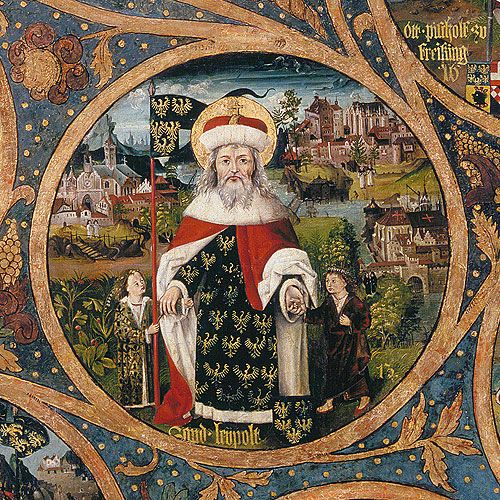
Baring-Gould’s sources: Roman, Benedictine, and Gallican M art yro logics. Sarum, York, Hereford, and Anglican Reformed Kalendars as S. Machutus. The Translation at S. Malo on July 11. Authorities: — A Life by Balderic of Angers (d. 1131), without name of author, in Mabillon, Acta SS. O.S.B. t. i. Another Life by Sigebert of Gemblours, written between 1076-99, in Surius. Also the old MS. Legendaries of the Churches of Nantes, Leon, Treguier, and Follgoat, from which Albert Le Grand compiled the Life in his “ Vies des Saints de Bretagne,” some of which are now lost. There is also a fragmentary Life of S. Maclovius in Bosdus, BibL Floriac.] S. Malo,1 called variously in Latin S. Maclovius and S. Machutus, was a native of Wales, the son of Caradog ab Ynyr Gwent, by Derwela, a sister of Amwn Ddu. S. Samson of Dol was a son of Amwn Ddu, by Anna, daughter of Meurig ab Tewdrig; and S. Maglorius, who succeeded S. Sampson, was son of Umbrafel, a brother of Amwn Ddu. S. Tathan, another son of Amwn Ddu and Anna, was the spiritual director of Caradog, the father of S. Malo. The saint was bom at Caer-gwent, in Monmouthshire, when both his father and mother were advanced in age. He is said to have been given to S. Brendan, abbot of Llancarvan, at the age of twelve, but S. Brendan was never abbot of that monastery; S. Brendan was in Brittany, and founded a monastic establishment at Aleth, and it was there, doubtless, that Malo was trained.
Any one who has been at S. Malo knows the extraordinary rapidity and height to which the tide there mounts* It is a 1 Also in French S. Maclou. In Welsh Maelog; not, howerer, to be confounded with S. Maelog, son of Caw, and disciple of Cattwg. a MALO, aliaa MACHUTUS and MACLOV1U3. After Cahier. Nov. 15. S. Maclovius.
well-known phenomenon connected with the place, and is occasioned by the configuration of the coast.1 One day S. Malo and some of the boys of the monastery school were playing on the sands, when Malo, feeling tired, lay down on a heap of kelp, and fell asleep. The children returned to school without missing him. The tide rushed over the sands, and rose roaring up the rocks of Aaron and Grand Bey. S. Brendan, alarmed at the disappearance of his pupil, ran out on the rocks and called, but received no answer. S. Malo was not, however, overwhelmed by the waves, says the legend; the sand and kelp on which he lay rose with the tide, and formed an islet, high and dry above the waters. Next morning Brendan went down again to the shore. He saw above the waves the new islet, with Malo reposing on it. The boy called to his master to pass him over his breviary, as he wished to recite his offices. Brendan, full of faith, flung his psalter into the waves, and the tide carried the book to the feet of the disciple On reaching years of discretion S. Malo received the habit from his master. His virtues aroused the jealousy of some of the other monks. When it was his turn to light the candles for matins, some of them out of malice extinguished every lamp in the dormitory and church. Malo went to the fireplace, and tried to rake out live coals, but they were all dead. Then he put some cinders in his bosom, and hastened to the abbot, and, lo ! the warmth of his zeal had kindled the charcoal, and when he took the pieces from his breast they were red and glowing.2 1 "The tides rise here higher than at any other point in the Channel, viz. to an elevation of forty-five to fifty feet above low-water mark.” — Murray’s Handbook of France.
3 The hymn for his festival mentions these miracles. " Fluctibus tutus mediis quiesdt Gestat et prunas, nihil inde laesa, Veste; hie parent famulo Potentis Ignis et unda.”
VOL. XIII. 22 Next day S. Brendan summoned the mischievous and envious monks before him, but finding them incorrigible, he determined to abandon them, and taking with him S. Malo, he left them by ship, and sailed in search of some solitary islet, in which they might serve God unmolested.1 But an angel bade them return, and they came back to Aleth, and Malo became bishop of that see. Aleth was an old city on the mainland, at the mouth of the Ranee, and the isle of Aaron, now occupied by the town of S. Malo, was then inhabited by a hermit named Aaron. Malo converted the island into a monastery, and filled it with monks. Many wonderful miracles are told of Malo. He blessed a marble cup, and it was transformed into crystal A chiefi who owed him a grudge, tied the baker of his monastery hand and foot to a stone, and left him on the sands at low water. The tide rose and covered him, with the exception of his head, and the water left a chimney between his mouth and the upper air, by which he was enabled to breathe till the tide fell. S. Malo made a wolf which had eaten an ass belonging to an old woman, carry faggots for her on its back.
However, the perversity of the people, and the opposition of the chiefs in the neighbourhood, obliged Malo to leave his see for a while, and he went to Saintes, where he was well received by the bishop, Leontius,2 who gave him a cell at Brie, and there he remained till he was recalled to Aleth. 1 According to Sigebert, Malo was born “ citra oram Britannia maris," which may mean that he was born in Brittany, and not in Britain; and some think his father was Count of Gien on the Loire (Gianum); but from the Welsh accounts it is clear that he was son of Caradog, brother of Amwn Ddu, and probably bora at Caer-gwent. The biographers make him disciple of S. Brendan at Llancanran, and after the voyage carry him back to Llancarvan, and then to Aleth. But as S. Brendan was abbot of Aleth. and not of Llancarvan, it would seem that Malo on his return from the voyage settled again at Aleth, and that what is said of his having been elected in Wales to the bishopric of Caer-gwent is to be omitted. of which is doubtful. He probably died in 626. Nov. xsO S. Maclovius.
He did not, however, remain long there, but went back to Saintes, and settled at Archambray with some monks he had brought with him from Brittany, and there he died. The relics [the bodily remains of a saint, or objects they used, kept with honor] remained there till the 7 th century, when the church of Aleth, or S. Malo, recovered them in a not very creditable manner.
A young man was obliged to fly from Brittany to escape the daggers of his brothers, who sought his estate. He took refuge at Archambray with the sacristan, who kindly received and sheltered him. After some years the youth, thinking he was safe, revisited Brittany, and on going to Aleth, told Bili, the bishop, where he was lodged, how easily he could get hold of the body of S. Malo, and carry it off. Bili urged him to return to Archambray, dissemble his purpose, and on the first opportunity make off with the relics. The young man accordingly went back to his host the sacristan, saying that his life was not yet in security from his brothers, and the sacristan, as readily as before, offered him hospitality. The youth waited till the sacristan was obliged to make a journey, and had left him in charge of the keys, when he packed up the body of the saint, and ran away with it to Aleth, after having prepared himself for the theft by confession and communion. The relics were received with great pomp by the bishop and clergy and people of Aleth, and were divided. One portion was given to the monastery of the isle of Aaron, the other was kept in the cathedral In 975 they were taken to Paris. They were lost at the Revolution. The only relic that remains is a shoulder-bone a S. Maclou-de-Moiselles, near Versailles.