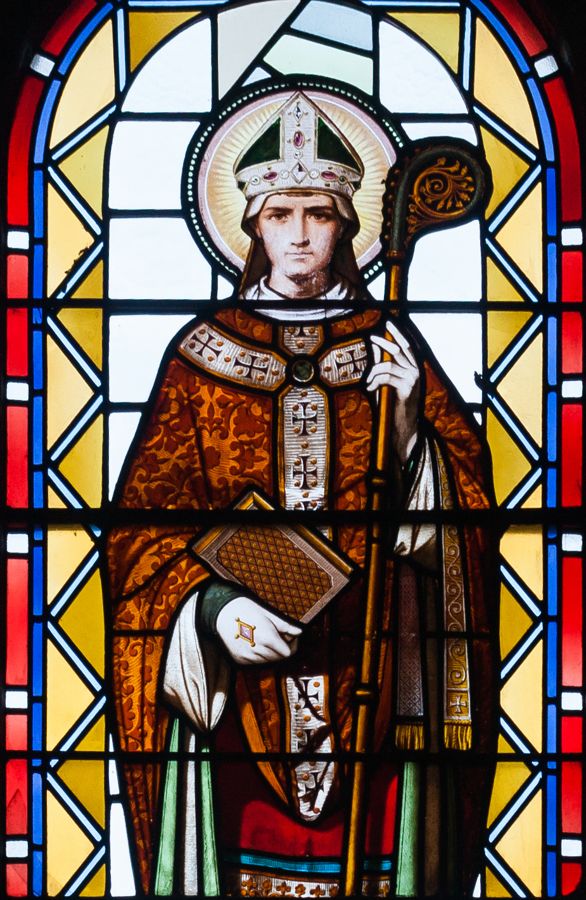
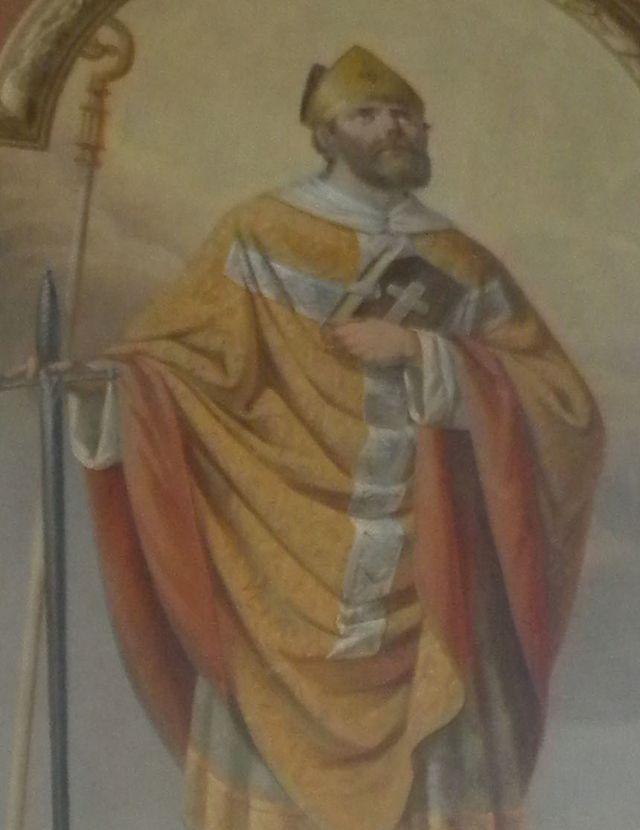
Baring-Gould’s sources: Roman, Benedictine, and Irish Martyrologies. By the Cistercians on Nov. 4. Authority:— A Life of the Saint, written by his friend S. Bernard, not long after his death.] This great saint belonged to the ancient and noble family of the O’Morgairs, supposed to be the same as the O’Doghertys, and his true Irish name was Malcmaodhog, or servant of S. Madoc (of Ferns). It is highly probable that he was bom at Armagh. This much is certain, that it was there he was reared from his earliest age. His birth must, in all proLwes of the Saints.
[Nor. j. bability, be assigned to the year 1095. The mother of S. Malachy was a God-fearing woman; she sent him early to school, and used her best efforts to instil the love of God and desire of perfection into his dawning mind and conscience. He was a grave, thoughtful boy, with a great love of praying in churches and meditating on divine things. His master was in the habit of taking a walk to a village near Armagh, and was wont to associate Malachy with him on these excursions. The boy took opportunities of tarrying a little behind his master, so as to pray, which he did with arms outspread towards heaven.
When boyhood was past, Malachy placed himself as disciple with an ascetic named Imar O'Hagan, who lived in a cell near a church in Armagh. This displeased his friends, who thought him too young to adopt so severe a life, which must, they thought, injure his constitution. Others contemptuously remarked that a boy would soon tire of praying seven times a day, and going without two meals. But Malachy, in spite of opposition and derision, persevered in his resolutions, and inured himself to a life of austerity. S. Celsus was then bishop of Armagh. He kept an eye on the promising young ascetic, and on his attaining the age of twenty-three he ordained him deacon. He executed the ministerial office imposed on him with the utmost enthusiasm and charity, and was so assiduous in burying the dead poor folk that his sister was offended, and strongly reprimanded him for thus demeaning himself. His birth, his position, was one which lifted him above caring for the poor. He, however, paid no attention to his sister's remonstrances. Celsus, with the consent of Imar, ordained Malachy priest at the age of five-and-twenty. He then appointed him his vicar, and urged him to assist him in extirpating the peculiar features of the Irish Church, and bringing it to Roman uniformity. The greatest confusion reigned in Ireland from each Her. 3.] & McUdchy. 8j diocese, and perhaps also each monastery, having a different use. Gilbert of Limerick complains 1 that a man accustomed to the offices of the Church in one diocese on going into another found himself like an idiot in the church, not understanding what was being said or done. In the diocese of Armagh the public recital of the canonical hours had ceased, probably through the disorders introduced into that church by the archbishopric having fallen during a century into the hands of laymen, who drew the revenues and exercised authority without — if we may trust S. Bernard — being real bishops. It is certain that they were married men, and that the archbishopric became hereditary in one family. S. Malachy restored the public recitation of the offices, and established the Roman usage throughout the diocese. The practice of confession was not habitual. It was urged by the saint as of the utmost importance on the indifferent and semi-barbarous people. He also took care that the sacrament of confirmation should be regularly administered. Under the lay archbishops it had been omitted altogether. Next he remodelled the contract of matrimony.
The famous abbey of Bangor on Carrickfergus Bay had been destroyed by the Danes [Viking raiders from Scandinavia] in 956, when the abbot, Tanaidh Maguire, had been killed. The lands belonging to it were then in the possession of its erenachs, or churchfarmers. These were the heads of the respective clans in which the abbey lands had been originally vested under the old Brehon laws. Generally speaking, the erenachs were the descendants of the persons who had giyen the lands to the church. They were bound to pay certain rents to the abbey, and to perform other specified duties. The erenach who was in possession of Bangor in the time of S. Malachy, was a maternal uncle of the saint In 1120, when S. Malachy was only twenty-five years old, he was made abbot of the 1 D« usu Eccledutioo.
desolate abbey, and drew its revenues, or some part of them. But as there were no monks at Bangor, his office was a sinecure.
Doubting of his being sufficiently acquainted with the discipline of the Church, S. Malachy placed himself under the instruction of the venerable Malchus, bishop of Lismore, and having received the blessing of his master I mar, and a letter from his bishop Celsus, he went to Lismore about the year 1123. During his stay there he became acquainted with Cormac MacCarthy, the pious prince of Desmond, who was deprived of his principality in 1127.
While S. Malachy was at Lismore his sister died. He was so displeased with her on account of her worldly manner of life that he had determined not to see her again. One night he heard a voice in his dream tell him that his sister stood outside the house in the court, fainting for want of food, of which she had been deprived for thirty days. Malachy, on awakening, thought over this dream, and conjectured that it had reference to his omission of her name, when he prayed for the dead at his daily mass. He now began again to pray for her, and after some days he saw her in a dream standing near the church door in a dark penitential robe. As he continued to offer the sacrifice for her, she appeared to him a second time, in a whitish dress, within the church, straining to reach and touch the altar, but unable to do so. At length he saw her again, now united with the great assembly of the saints, clothed in the shining white garment which had been washed in the blood of the Lamb. He had pleaded daily for her.
Meanwhile S. Celsus and Imar O’Hagan had been wishing for his return, and they wrote to recall him. He obeyed their summons, and came back to Armagh in 1127. During his absence Celsus had repaired and re-roofed the cathedral, which had remained partly uncovered since 1020, in which S. Malachy.
year the city had been laid waste by the Danes, who had burned the greater part of the town. In 1126 he had consecrated the church of SS. Peter and Paul in Armagh, erected by Imar, the master of Malachy.
When S. Malachy returned to Ulster it was with the resolution of restoring the abbey of Bangor, of which he was titular abbot His uncle, the erenach, offered to surrender the lands and the site of the monastery to S. Malachy, but the saint was satisfied with the site, for he had a great horror of the monastery being wealthy, and lapsing into ease and luxury. The uncle of the saint then resigned his office, and became a monk at Bangor under his nephew, and the lands passed to another erenach. S. Malachy took with him ten brethren from Armagh, disciples of the abbot Imar, and set about erecting the necessary buildings of wood, and an oratory of boards. After awhile he proposed to build a stone church, beautiful in design and ornament; but the son of the new erenach, probably fearing that a large portion of the expenses must devolve on his father, in accordance with the recognized code that then regulated the reciprocal duties of erenach and abbot, excited the people against the undertaking, and proceeding at their head to the building, thus addressed the saint: — “ O, good man ! what hath induced you to introduce such a novelty into our country ? We are not Gauls, but Scots. Whence this levity? What need have we of a building so useless and so splendid ? ” Shortly after this, various misfortunes befel the family of the erenach. His son died, and he himself becoming afflicted with epilepsy, acknowledged the chastizing hand of God, and embraced the monastic state under S. Malachy.
A little later the adjoining see of Connor [a bishop’s “see” is his diocese, named from his seat (Latin sedes)] fell vacant, and S. Malachy was chosen to fill it, but declined accepting it until ordered to do so by his master Imar, and his metropolitan [the archbishop who heads a group of dioceses] Celsus. He is said to have been about thirty years Murchertach ruled and drew the revenues. The saint did not venture into the city, or within reach of the titular archbishop, lest he should fall a victim to his jealousy and anger. Two years after, in 1 134, Murchertach died, leaving the see to his kinsman Niel, apparently the brother of Celsus, with the intention of keeping the archbishopric still in the same family. Niel, at the head of his retainers and clansmen, prepared to take forcible possession of the see, but a king, the papal legate [an official representative sent by the pope], and several influential bishops and chiefs, interfered, and surrounding S. Malachy, prepared to force their way to Armagh. The hostile parties came within sight of one another, at Tullyhog, in Tirone, the party of Niel being drawn up on a hill to oppose the passage of the saint and his friends. When Malachy saw that there was a prospect of bloodshed, he retired into a church and prayed. Then a furious thunderstorm burst over the hill on which the followers of Niel were assembled, and a stroke of lightning killed their leader and eleven others of the party. This so scared the rest that they allowed the friends of Malachy to pass and take possession of the city and see of Armagh. Niel fled, carrying with him two of the treasures of the cathedral, the text of the Gospels, which had belonged to S. Patrick [apostle of Ireland (5th century)], and the famous “Staff of Jesus.” Invested with these insignia of his right to the archbishopric, Niel was everywhere received by the people as the rightful possessor of the see, except in the city of Armagh itself, where S. Malachy was hailed as a reformer of gross abuses. Niel organized a plan to obtain possession of, and assassinate, Malachy, but was overcome by the courage and confidence of the bishop, who presented himself unarmed and without followers before the men commissioned to kill him, and quailed them by his look of command and sanctity. By degrees the good sense of the country rallied numbers round Malachy, and Niel, finding himself deserted, surrendered the Gospels and the staff.
not.3j S.Malachy. 93 Some time after S. Malachy was firmly seated on the archiepiscopal throne of Armagh, he made a visitation of Munster. After having held the see for three years, reformed abuses, and broken through the tradition of hereditary holding of the archbishopric, he resigned it into the hands of Gilla Maclieg, abbot of the great Columban monastery of Derry, and was appointed bishop of Down, to which his old see of Connor was united.
Not long after his being stationed at Down, he lost his brother, Gilla Criost, bishop of Clogher, who died in 1138, and was buried in the church of SS. Peter and Paul at Armagh.
S. Malachy had long had a desire to visit Rome, as such devotional pilgrimages were usual with the Irish from the earliest period; and he was specially anxious to obtain a formal recognition of the archiepiscopal sees in Ireland, by the granting of palliums. On his way to Rome he visited England, arrived at York, and made the acquaintance of Waltheof of Kirkham.
A story told of their meeting, and the gift by Waltheof to the bishop of a grey horse, is told elsewhere (August 3, p. 31). In traversing France, he visited S. Bernard at Clairvaux, and thus commenced and cemented the friendship which forms so interesting a feature in the lives of these two saints. It is probable that his account of the state of the Irish Church took a tinge of gloom from the heavy trials he had endured in his efforts to remove its temporary abuses S. Bernard's ardent and impetuous character, even his very affection for Malachy, would lead him to look darkly on the picture; hence the somewhat overcoloured accounts he has given of its state at that eventful period.
On reaching Rome, the first favour S. Malachy asked of Pope Innocent II. was that he might be allowed to retire to Clairvaux for the rest of his days; but this the Pope would not permit. Malachy then asked for thepalliums for the archbishops of Ireland, but the Pope declined to give them until they had been formally demanded by the Irish prelates assembled in council. Then taking the mitre off his own head he placed it on that of Malachy, and gave him the stole and mantle which he used to wear when officiating; then, saluting him with the kiss of peace, he dismissed him, having invested him with legadne power to the Irish Church.
On his return to Ireland the saint rebuilt and restored many churches, and in 1142 he built the famous Cistercian [strict Benedictine reform begun at Cîteaux in 1098] abbey of Mellifont near Drogheda. This monastery was liberally endowed by Donogh O’Carrol, King of Oriel, and was peopled by Irish monks, whom S. Malachy had sent to Clairvaux, to be trained in the Benedictine [monks following the Rule of St. Benedict] rule and observances.
But his great act was the convocation of the synod of Inis Padraig (Holmpatrick), held in the year 1148. S. Malachy presided as legate of the Holy See; fifteen bishops, two hundred priests, and some religious were present at the deliberations, which lasted four days. The members of the synod were unwilling that Malachy should leave Ireland again to ask for the palls; but Eugenius III., who had been a Cistercian monk, was visiting Clairvaux, and it was hoped that he might grant the favour there.
S. Malachy immediately set out, and was accompanied as far as the sea shore by some brethren. Just as he was entering the ship two of them told him that they wanted to ask a favour of him, but that they would not name it unless, beforehand, he would promise to grant them their request; he did so, and then they told him what weighed on their loving hearts, his welfare, and that they might see his face again. “ Your reverence will please to give us your word that you will return safe to Ireland.’’ The promise had been made, and could not be recalled. Malachy.
The sail was spread and he departed; but a contrary wind sprang up, blew a gale, and the ship was obliged to put back into port, and so the promise was very speedily and unexpectedly fulfilled.
On reaching England he found that King Stephen was engaged in some dispute with the Pope, and would not allow any bishops to pass over into France. Tliis delayed Malachy, and consequently he lost the opportunity of seeing Pope Eugenius III. at Clairvaux, for the Pope had returned to Italy before Malachy had obtained leave to sail. He arrived at Clairvaux in October, 1148, and was received with the utmost joy by S. Bernard and his holy monks. Having spent with them four or five of the happiest days m his life, he was seized with a fever, after having celebrated mass on S. Luke’s day, and obliged to take to his bed. At first it was thought to be of little consequence, but he knew better. “ Malachy,” said he, “must die this year. Behold the day is approaching which I always desired should be my last” He asked for extreme unction, but would not allow the priest to come upstairs to where he lay to administer it, but crept down the ladder out of the loft where he slept to meet him. After having been anointed, he received the holy Viaticum, and recommending himself to the prayers of the brethren, he returned to bed. When his last night on earth drew on, he was filled with great joy, and said to those about him: “Take care of me; I shall not forget you, if it be permitted. I have believed in God, and believe now that all things are possible. I have loved God; I have loved you; and charity never faileth.” Then looking up to heaven, he said: “ O, God, preserve them in Thy name, and not them only, but likewise all those who, through my words and ministry, have bound themselves to Thy service.” Then placing his hands on the heads of each of his brethren, he bade them go to rest, as his hour was not yet come. About midnight the whole community assembled, and several abbots were in attendance with S. Bernard and the brethren to watch his departure. Not long after he expired, on the 2nd of November, 1148, in the place, Clairvaux, and at the time, All Souls’ Day, which he had wished for and foretold. His death was like a falling asleep, so gentle and painless was it, and so placid and sweet did his face appear when the spirit was fled. His body was carried to the oratory, where the holy sacrifice was offered for him. S. Bernard, having observed a boy in the chapel with a dead arm, beckoned him to come forward. The boy did so, and applied the dead arm to the hand of Malachy. He recovered at once the use of his arm. This fact is told us by S. Bernard himself, and cannot be disputed.
S. Malachy was canonized not many years after his death, by Pope Clement III. His festival is observed on Nov. 3, the day of his death being All Souls’ Day.