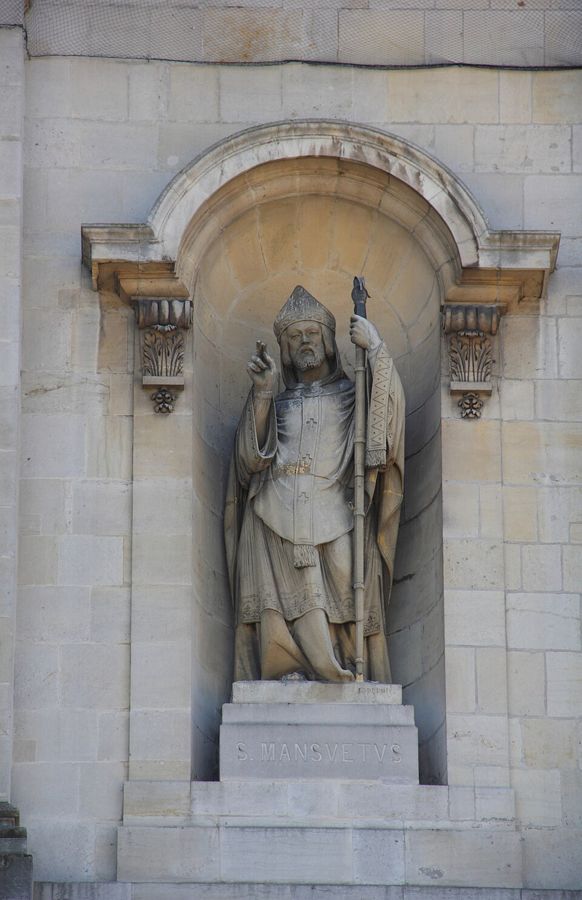
St. Mansuetus

Mansuet was the first Bishop of Toul in Lorraine and the apostle of that region.

Read the essentials →
September 3 · Bishop

St. Mansuetus

St. Mansuetus

Mansuet was the first Bishop of Toul in Lorraine and the apostle of that region.

Traditional feast

September 3
1914 / pre-1969 calendar, per Baring-Gould (1897)

Current feast

September 3
Secondary source · Wikipedia

Represents

Bishop

Their story

Adapted in modern English from Alban Butler's Lives of the Saints · Baring-Gould original below · little is known

Mansuet was the first Bishop of Toul in Lorraine and the apostle of that region. Some thought he was a disciple of St Peter, but Butler, following the Bollandist Limpen, places him in the time of Constantine and his son. He died about 375.

In 971 St Gerard, Bishop of Toul, solemnly moved his relics, repaired his church and founded the monastery that bears his name.

Early life

Selected sentences from the original account, unaltered.

Thin entry · the 1897 book gives only 171 words. We have not filled the gap with invented detail.

A native of Ireland (Scotus) lost his pig, which thieves had carried off, killed and eaten.

What they represent

How they teach us to live

Drawn from themes in the original account

Keep their day. Remember them on September 3 with a short prayer, and ask for their help.

Read more

The full original · 171 words

Read Baring-Gould’s full account

Baring-Gould’s sources: Roman and Gallican Martyrologies. In Dempster's Scottish Menology on March 19 and Sept. 3. Authorities: — Two Lives, both long posterior, the second an amplification of the first, full of legendary matter, by Adso, Abbot of Moutier-en-Der, in the 10th cent.] Mansuetus of Toul was the first bishop of that see. It is pretended by his biographer, trusting to popular tradition, that he was consecrated and sent into Gaul by S. Peter. But what seems more probable is that he was long posterior. He is said to have been an Irishman (Scotus), and Dempster supposing that Scotus meant Scotchman, introduced him into his Scottish menology. If he were one of the many Irish missionaries who carried the light of the Gospel into Gaul and Germany and Switzerland, his date is later. The fables related of Mansuetus are many. The son of the prince of Toul fell into the river and was drowned; Mansuetus prayed, the boy came to the surface of the Moselle and revived, after having been under water a night and a day.

Nor were his miracles of restoring to life confined to boys. A native of Ireland (Scotus) lost his pig, which thieves had carried off, killed and eaten. He invoked S. Mansuetus, and made a pilgrimage to Toul to deplore the loss of his pig over the tomb of the saint. Great was his delight to find a pig on his way back, which he could appropriate and drive home to Ireland, under the assurance that it was his own pig.

In 1790 the relics [the bodily remains of a saint, or objects they used, kept with honor] of S. Mansuetus were divided among the canons of the church of Toul, that they might be preserved from the fury of the revolutionists. Many of the fragments have been restored, and the cathedral of Toul now possesses a shoulder, the church of S. Gengolf the head, that of S. Nicholas-de-Port a rib. The old crypt in which was the tomb of S. Mansuetus (in French Mansuy) is now private property. On the tomb he is represented trampling on paganism, with the resuscitated prince at his side.

Feast days

Feast: September 3

Nine days · Free

Pray the novena
with us.

One short email a day for nine days. The day's prayer, a line from St. Mansuetus's story, and a nudge to keep going.

Also on September 3
P

St. Phcebe

September 3 · Feast
B

St. Basilissa

September 3 · Virgin, Martyr
M

St. Macniss of Connor

September 3 · Bishop
← All 1726 saints in the library
Sources & notes

Feast-day sources

Story sources

Sources

Credits

Image: Sculpture façade Notre-Dame-de-L'Annonciation de Nancy 2.jpg · Caroline Léna Becker · CC BY 3.0, via Wikimedia Commons

From Sabine Baring-Gould, The Lives of the Saints, new edition in 16 vols. (London: John C. Nimmo, 1897–98); text from the Internet Archive scan (OCR, lightly cleaned; errors possible). Public domain.

Image: Caroline Léna Becker, Wikimedia Commons (CC BY 3.0)

From Sabine Baring-Gould, The Lives of the Saints, new edition in 16 vols. (London: John C. Nimmo, 1897–98); text from the Internet Archive scan (OCR, lightly cleaned; errors possible). Public domain in the United States. Reproduced unedited, except for short bracketed notes in grey that we added to explain names and terms (“S.” is the old abbreviation for Saint). Some history and judgments reflect 19th-century scholarship.