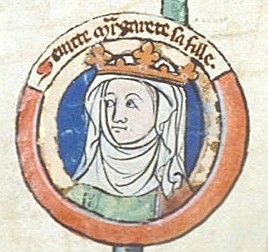
Baring-Gould’s sources: Canonized by Pope Innocent IV. in 1251. Her feast was removed from November 16th to June 8th by Innocent XI. in 1698, and by Innocent XII. in 1693 to Junexoth. Authority Her life written by Theodoric of Durham, her confessor, by order of Henry I. of England. S. Aelred also wrote concerning her. Also the Scottish historians.] S. Margaret was the sister of Edgar Etheling, and fled with him to Scotland from the power of William the Conqueror. They found protection from Malcolm III., who refused to surrender them to the Norman Conqueror, and, struck with the beauty and accomplishments of Margaret, married her, and she was crowned queen in 1070. Malcolm was a rough and unlettered man, but Margaret softened and refined him, so that he became one of the best of the early Scottish kings. They had six sons — Edward, Edmund, Edgar, Ethelred, Alexander, and David — and two daughters, Maud or Mathilda, who afterwards married Henry I. of England, and Mary, who married Eustace, count of Boulogne. Of the sons, Edgar, Alexander, and David, came successively to the throne of Scotland, and governed the kingdom with prudence and justice.
S. Margaret took the greatest pains with the instruction of her children, from their earliest years instilling into their young hearts the principles of religion and equity. She ruled her household with the utmost wisdom, attending to her servants and setting them an example. The king was led by her to love God's service, and to unite with her in reforming inany ecclesiastical abuses which disfigured the Church in Scotland. “The king,” says Theodoric, “learnt from her to watch the night in prayer on certain occasions. I could not sufficiently admire the fervour of this prince at June zo.) S. Margaret prayer.” Another ancient writer says: — “She excited the king to do works of justice, mercy, alms-deeds, and other virtues; in all which, by divine grace, she induced him to comply with her pious desires. For he seeing that Christ dwelt in the heart of his queen, was always willing to follow her advice.”
In Lent [the forty days of fasting before Easter] and Advent she rose at midnight, and went to church to hear matins. On her return she distributed alms, and then lay down on her bed for a couple of hours' sleep, after which she returned to her chapel to hear mass, and sometimes attended as many as six in a morning. She ate very little, and that of the plainest description. “She was endowed with a wonderful spirit of compunction,” says Theodoric, “when speaking to me of the sweetness of everlasting life; her words were hill of unction, and her eyes would swim with tears, so that they brought tears down my cheeks also. In the church no one was more quiet and wrapt in prayer than she.” In 1037, the castle of Alnwick, which belonged at that time to Scotland, was taken by William Rufus, and the garrison put to the sword. Malcolm demanded restitution, and when it was denied, besieged the castle. The English garrison reduced to the greatest extremity, offered to surrender, and desired the king to receive the keys with his own hand; but the soldier who presented them to him on the point of a spear, thrust the spear at him and pierced his eye, as the king approached to receive the keys. His wound produced his death, and his son, Edward, was also killed in the assault made to revenge this act of treachery. At the same time S. Margaret was ill and dying. Theodoric says: “She had a prevision that she would soon die, and she repeated to me in private all the acts of her life, weeping bitterly. And then she said, ‘Farewell, I shall not be long here. Two things I commend to you, [June xo.
masses and prayer for my soul when I am dead, and care of my dear children that they may be brought up in the fear and love of God. These things you must promise me here in the presence of God, who alone witnesses our discourse.*”
When she was very ill, her son Edgar arrived from Alnwick, and she asked him how his father and brother were faring. Fearing to alarm her, he answered that they were welL But she saw that he was not speaking the truth, and she cried out, “ I know how it is !” Then throwing up her arms, she praised God, saying, “ I thank Thee, Almighty God, that in sending me so great an affliction in the last hour of my life, Thou wouldst purify me from my sins.”
She died on Nov. 16th, and her body was buried in the church of the Holy Trinity, at Dunfermlin. When Scotland fell away from the Catholic faith, the remains of S. Margaret and her husband were saved from the brutal rabble and carried to Spain. King Philip II. built a chapel in the Escurial in honour of S. Margaret for their reception. There they remain. June xi.] 6". Barnabas.
Jane 11. S. Barnabas, Ap. M. at Salaminot in Cyprus, a d. 53. SS. Felix and Fortunatus, MM. at Aquileia, a.d. 296. S. Macra, V.M. at Fismes in France, circ. a.d. 297. S. Amabilis, P. at Riome in Auvergne, 5 th cent. S. Blithar, P.H. at Verday near Sexanne in France, jth cent. S. Achas, Boy at Thourhout, in Belgium, a.d. 1220. B. Aleydis Scharembekr, V. at Cambie, near Brussels, A.D. 125a S. Rosseline, V. at Arcquex in Provence, a.d. 1329. S. BARNABAS, AP.
[Singularly enough S. Barnabas was not commemorated either in the East or West till late. The commemoration of S. Barnabas was at length added to that of S. Bartholomew by the Oriental Church, and thence passed into the Russian Kalendar. In Cyprus alone was S. Barnabas venerated. In the ancient Roman Martyrology, erroneously attributed to S. Jerome [translator of the Bible into Latin (d. 420)], and in that of Bede [English monk and historian (d. 735)], neither S. Barnabas nor S. Bartholomew occurs. Floras of Lyons first introduced the name of S. Barnabas into the Western Martyrology. He was followed by Ado, and Usuardus [a 9th-century monk of Paris who compiled a list of saints for each day]. Radulph de Rivo, in the beginning of the 15th cent, speaks of the feast of S. Barnabas as being very generally observed; but Paul III. was the first to allow proper lessons in the Breviary of Cardinal Quignon, for this day. But the Abyssinian Church commemorates S. Barnabas on Dec. 17. Authorities: — Mention in the Acts of the Apostles. The Clementine Recognitions, an apocryphal work of the 3rd century, con'ains many details, but it is very doubtful whether they are to be relied upon. There are also the " Periods" or Acts and Passion of S. Barnabas purporting to be by John Mark, his disciple, but they are not genuine, though probably containing the tradition of the Church of Cyprus concerning the apostle. Also an encomium on S. Barnabas, by Alexander, a Cypriot monk in 5th cent., which also contains traditions.] JARNABAS, a name which signifies “Son of prophecy,” or “exhortation,” or — but not so probably — “consolation,” as is given in the Anglican version, was given by the apostles to Joseph or Joses,1 a Levite of the island of Cyprus, who [June it was an early disciple of our Blessed Lord. He was educated at the feet of Gamaliel, together with S. Paul, and it was this fact of their having been old school-fellows which induced S. Paul in after times to associate Barnabas with him in the work of his apostleship. In Acts ix. 27, we find Barnabas introducing the newly converted Saul to the apostles at Jerusalem, in a way which seems to imply their previous acquaintance.
On tidings coming to the Church at Jerusalem that men of Cyprus and Cyrene had been preaching to the Gentiles at Antioch, S. Barnabas was sent thither by the apostles,1 and, perhaps feeling his need of a:i energetic assistant he went to Tarsus, in quest of Saul,8 and having brought him to Antioch, he was sent with him to Jerusalem with relief for the brethren in Judaea.8 On their return to Antioch (a.d. 45), they were ordained for special missionary work, with the laying on of hands. From this time SS. Barnabas and Paul enjoy the title and dignity of apostles. Their first missionary journey did not extend beyond the island of Cyprus and Asi 1 Minor.4 Some time after their return to Antioch (a.d. 47 or 48), they were sent (a.d. 50), to Jerusalem, to determine with the apostles and elders the difficult question respecting the necessity of circumcision for the Gentile converts.6 On that occasion SS. Paul and Barnabas were recognized as the apostles of the uncircumcision. They were given as companions Judas and Silas, and were sent with an epistle from the apostles at Jerusalem to Antioch. “ So when they were dismissed they came to Antioch: and when they had gathered the multitude together, they delivered the epistle; which when they had read, they rejoiced for the consolation.” S. Paul and S. Barnabas S. BARNABAS, APOSTLE.
Prom the Vienna Misaal. I Jana 11. Jane xz.] S. Barnabas • continued in Antioch a short while longer, and then Paul said to Barnabas, “ Let us go again to visit the brethren in every city where we have preached the word of God, and see how they do. And Barnabas determined to take with them John, whose surname was Mark,” and who was the nephew, “ sister's son ” of Barnabas. But S. Paul differed in opinion from his fellow apostle, on account of John Mark having deserted them in Pamphylia, and as he considered, having neglected his duty, “he went not with them to the work."
S. Barnabas may have felt that the young man was not so much to be blamed as the more vehement and enthusiastic Paul thought, and this gave rise to an unfortunate separation. “ The contention was so sharp between them, that they departed asunder, one from the other f and S. Barnabas, taking with him John Mark, sailed for his native island, Cyprus.
Here the Scripture notices of him cease. What became of S. Barnabas subsequently to the separation of the two apostles, after a joint labour in the ministry of almost fourteen years, is very uncertain. Traditions differ. According to one account, he went to Milan, and became first bishop of the church there, but this is more than improbable. There is extant an apocryphal work, probably of the 5th century, “ Acta et Passio Barnabae in Cypro," according to which, the remainder of his life was spent in his native island, where he also suffered martyrdom; being, at the instigation of certain Jews who came from Syria to Salamis, shut up in a synagogue, where he had disputed with them, and at night was stoned by them. The apostle was buried near the site of his martyrdom, where, more than four centuries later, in the time of the Emperor Zeno, his relics [the bodily remains of a saint, or objects they used, kept with honor] were found and removed to Constantinople, a stately church being erected over them and dedicated in his honour. It is said that at the discovery of the relics of & Barnabas, there was found lying on his breast a copy of the Gospel according to S. Matthew, written in the Hebrew tongue, and, as was supposed, by S. Barnabas’ own hand.
On the occupation of Cyprus by the Saracens [medieval Christian name for Arab and Muslim peoples] in the 7th century, the head and some other relics of S. Barnabas are said to have been translated to Milan.1 At Toulouse on May 27th, is observed the feast of the invention of the body of S. Barnabas there, and Saussaye in his Gallican Martyrology says on June nth: “ The Nativity of S. Barnabas the Apostle, whose precious body reposes at Toulouse, in the church of S. Satuminus, with the entire bodies of five other apostles (James the son of Zebedee, Philip, James son of Alphaeus, Simon and Jude) and the spoils of many other martyrs and confessors,” and he adds, “ the head is now exposed there to veneration, apart from the body, which reposes in its own shrine.” This body is believed to have been brought from Constantinople, in the reign of Charlemagne [king of the Franks, crowned emperor in 800], but this seems to be only conjecture. The head was examined and verified in 1807, by Clement de Barbazan, Vicar General, and it is still at Toulouse. But the Church of Edna, in the district of Bergamo claims to possess the head of S. Barnabas; at Pavia are particles of bone from the head; in Genoa, in the cathedral, the head entire; a jaw at Cremona; some bones in the cathedral of Toumai; the head entire, and a rib at Andechs in Bavaria, part of the head at Prague, the head entire also in the Jesuit Church at Naples, a leg at Florence. There is some strange error which 1 “Quomodo, unde et a quo fuerint tunc Mediolanum translata, cquidem ignorare me dixerlm Ubentius, quatn incertas Mediolanensium conjecturas amplecti.” D. Papebroech. The translation to a new shrine was made in the year 1531, and an annual festival instituted to commemorate it, to which the Pope attached an indulgence of a hundred years. Jane n.] SS. Felix & Fortunatus.
demands investigation in the matter of the relics of S. Barnabas. S. Barnabas is generally represented carrying the Gospel in his hand; he also frequently bears a pilgrim's staff; and sometimes a stone.
There is extant an epistle attributed to S. Barnabas. Its authenticity has been defended by some great writers, but it is now very generally abandoned, and is supposed to have been written early in the 2nd century.