M

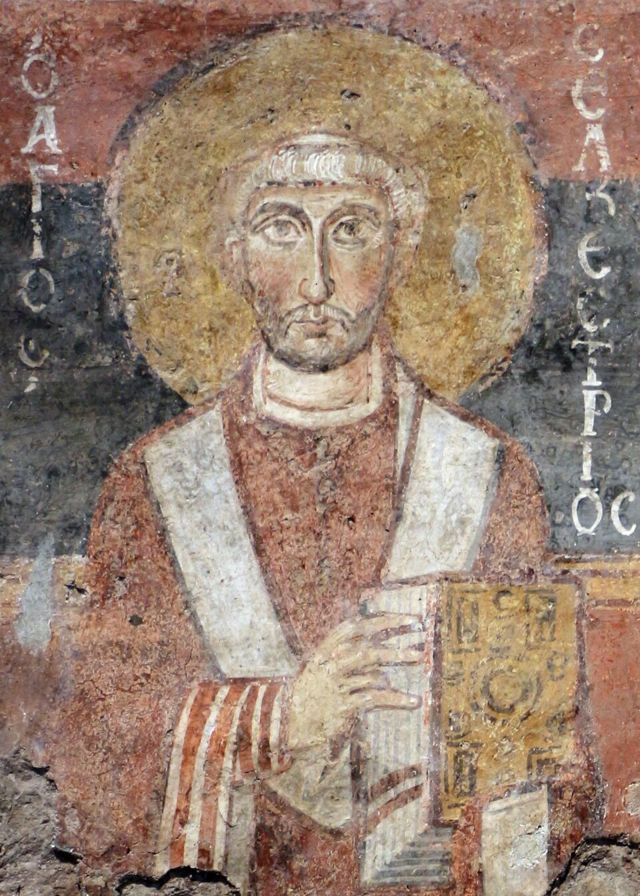
A shepherd who stayed with his people through hard times.

Read the essentials →
December 31 · Bishop

St. Marius of Avenches

St. Marius of Avenches

A shepherd who stayed with his people through hard times.

Traditional feast

December 31
1914 / pre-1969 calendar, per Baring-Gould (1897)

Current feast

Not verified yet

Represents

Bishop

Their story

Adapted in modern English from the Catholic Encyclopedia (1913) · original text below

Marius was born about 530 in what is now the Diocese of Autun, into a rich and distinguished family. He became a cleric young. In 574 he was made Bishop of Avenches, attended the Council of Macon in 585, and soon moved his see from declining Avenches to Lausanne.

His epitaph praises him as an ideal bishop: a skilled goldsmith who made the sacred vessels with his own hands, a protector of the poor, a man of prayer and a keen scholar. In 587 he consecrated the church of St Mary at Payerne, which he had paid for.

He also wrote a chronicle covering 455 to 581. Its notes are dry, but they are valuable for Burgundian and Frankish history. He died at Lausanne on 31 December. The church where he was buried came to be called St Marius.

Early life

The book says little or nothing about early life. This is how the account begins.

Thin entry · the 1897 book gives only 0 words. We have not filled the gap with invented detail.

What they represent

How they teach us to live

Drawn from themes in the original account

Learn from the kind of life it was. A shepherd who stayed with his people through hard times.

Keep their day. Remember them on December 31 with a short prayer, and ask for their help.

From the Catholic Encyclopedia

1913 · 338 words

Bishop of Avenches (Switzerland) and chronicler, born about 530 in the present Diocese of Autun; died at Lausanne, 31 December, 594. Of the events of his life little is known. From an inscription on his tomb in the church of St. Thyrsius in Lausanne (published in the "Monumenta Germ. Scriptores", XXIV, 795), we learn that he came of a distinguished, rich and probably Roman family, and at an early age embraced the ecclesiastical state. In 574 he was made Bishop of Avenches, took part in the Council of Mâcon in 585, and shortly afterwards transferred his episcopal see from Avenches, which was rapidly declining, to Lausanne. He is extolled as an ideal bishop; as a skilled goldsmith who made the sacred vessels with his own hands; as a protector and benefactor of the poor; as a man of prayer, and as a scholar full of enthusiasm for serious intellectual studies. In 587 he consecrated St. Mary's church at Payerne, which had been built at his expense and through his efforts. After his death he was venerated in the Diocese of Lausanne as a saint, and his feast was celebrated on 9 or 12 February. The church of St. Thyrsius received at an early date the name of St. Marius. A chronicle of his is still preserved, and purports to be a continuation of the chronicle of Prosper Tiro, or rather of the "Chronicon Imperiale". It extends from 455 to 581, and, although consisting only of dry, annalistic notes, it is valuable for Burgundian and Franconian history, especially for the second half of the sixth century. This explains the fact that, notwithstanding its brevity, it has been frequently published - first by Chifflet in André Duchesne's "Historiæ Francorum Scriptores", I (1636), 210-214; again by Migne in P. L., LXXII, 793-802, and finally by Mommsen in "Mon. Germ., Auctores antiqui", XI (1893), 232-9.

ARNDT, Bischof Marius von Aventicum. Sein Leben u. seine Chronik (Leipzig, 1875); MOMMSEN in his edition, Prœfatio, 227-31; POTTHAST, Bibl. hist. med. œvi, I (Berlin, 1896), 667.
Read more

The full original · 0 words

Read Baring-Gould’s full account

Baring-Gould’s sources: G&llican Martyrology. Authority: — Acts of 2nd Council of M&con.] Marius, bishop of Aventiacum, an old Roman city in Switzerland, now represented by Avenches, assisted with S. Palladius of Saintes, S. Prsetextatus of Rouen, S. Evantius of Vienne, and other illustrious prelates of his age in the second council of M&con in 585. S. Marius is the author of a continuation of the Chronicle of Prosper from the year 455, at which that of Prosper closes, to the year 581. It contains chiefly events which occurred in Burgundy, and in the neighbourhood of the Lake of Geneva.

Feast days

Feast: December 31

Nine days · Free

Pray the novena
with us.

One short email a day for nine days. The day's prayer, a line from St. Marius of Avenches's story, and a nudge to keep going.

Also on December 31
C

St. Columba

December 31 · Virgin, Martyr
St. Sylvester, Pope

St. Sylvester

December 31 · Feast
St. Melania the Younger

St. Melania the Younger

December 31 · Feast
← All 1726 saints in the library
Sources & notes

Feast-day sources

Story sources

Sources

Credits

From Sabine Baring-Gould, The Lives of the Saints, new edition in 16 vols. (London: John C. Nimmo, 1897–98); text from the Internet Archive scan (OCR, lightly cleaned; errors possible). Public domain.

From “Catholic Encyclopedia (1913)/St. Marius Aventicus,” The Catholic Encyclopedia (New York: Robert Appleton Company, 1907–1914), via Wikisource. Public domain. Matched by name and feast date; text unedited except for our bracketed notes in grey.

From Sabine Baring-Gould, The Lives of the Saints, new edition in 16 vols. (London: John C. Nimmo, 1897–98); text from the Internet Archive scan (OCR, lightly cleaned; errors possible). Public domain in the United States. Reproduced unedited, except for short bracketed notes in grey that we added to explain names and terms (“S.” is the old abbreviation for Saint). Some history and judgments reflect 19th-century scholarship.