St. Mark the Evangelist

Mark the Evangelist is taken to be the John Mark of Acts, the Mark of St Paul's letters and the Mark whom St Peter calls his son.

Read the essentials →
April 25 · —

St. Mark the Evangelist

St. Mark the Evangelist

Mark the Evangelist is taken to be the John Mark of Acts, the Mark of St Paul's letters and the Mark whom St Peter calls his son.

Traditional feast

April 25
1914 / pre-1969 calendar, per Baring-Gould (1897)

Current feast

April 25
Verified · General Roman Calendar

Represents

Feast

Their story

Adapted in modern English from the Catholic Encyclopedia (1913) · original text below

Mark the Evangelist is taken to be the John Mark of Acts, the Mark of St Paul's letters and the Mark whom St Peter calls his son. No ancient writer of note questioned that these were one man. His mother's house in Jerusalem was a meeting place of the first Christians, and Peter went there when he escaped from prison. Mark was a cousin of Barnabas.

About 45 or 46 Barnabas and Saul took him to Antioch, and he went with them on Paul's first missionary journey as a helper. At Perga he turned back to Jerusalem, perhaps fearing the hardship. Because of this Paul refused to take him on the second journey, and Paul and Barnabas parted, Barnabas sailing with Mark to Cyprus. Later Mark was with Paul in Rome during his first imprisonment, and shortly before his death Paul asked Timothy to bring Mark, 'for he is profitable to me for the ministry'. Peter's first letter shows Mark with him at 'Babylon', which the early Fathers understood as Rome.

Papias, writing by about 130, says Mark was Peter's interpreter and wrote down Peter's teaching accurately, though not in order. A widespread, somewhat later tradition makes him founder of the Church of Alexandria. The Acts (the written account of a martyr's trial and death) of Mark say he was martyred by being dragged through the streets of Alexandria, but there is no evidence of his martyrdom earlier than the fourth century. His emblem is the lion, and his relics were later taken to Venice.

Struggles & surrender

What they wrestled with, and how they gave it to God

  • Turning back ·
    On Paul's first missionary journey Mark left at Perga and returned to Jerusalem, perhaps fearing the toil; Paul refused to take him again, though years later he called Mark 'profitable to me for the ministry'.

Early life

The book says little or nothing about early life. This is how the account begins.

…preter: for though the Apostles were divinely inspired and, among other miraculous powers, had the gift of languages conferred on them, yet the interpretation of tongues was a gift more peculiar to some than to others. It was probably S. Mark's talent in expounding S. Peter's discourses, whether by word or writing, to those who did not understand the language wherein they were delivered that caused him to be so constantly in attendance on S. Peter, whom he accompanied in his Apostolical progress, when he preached the Gospel in Italy and at Rome.

What they represent

How they teach us to live

Drawn from themes in the original account

Share your faith, in words and by example. Preaching and conversion are central here.

Keep their day. Remember them on April 25 with a short prayer, and ask for their help.

From the homilies

Preached on Scripture

“The chief points of St. Mark's history are these:—first, that he was sister's-son to Barnabas, and taken with him and St. Paul on their first apostolical journey; next, that after a short time he deserted them and returned to Jerusalem; then, that after an interval, he was St.”

Text: “Lift up the hands which hang down, and the feeble knees.”

From the Catholic Encyclopedia

1913 · 2011 words

It is assumed in this article that the individual referred to in Acts as John Mark (xii, 12, 25; xv, 37), John (xiii, 5, 13), Mark (xv, 39), is identical with the Mark mentioned by St. Paul (Col., iv, 10; II Tim., iv, 11; Philem., 24) and by St. Peter (I Peter, v, 13). Their identity is not questioned by any ancient writer of note, while it is strongly suggested, on the one hand by the fact that Mark of the Pauline Epistles was the cousin (ho anepsios) of Barnabas (Col., iv, 10), to whom Mark of Acts seems to have been bound by some special tie (Acts, xv, 37, 39); on the other by the probability that the Mark, whom St. Peter calls his son (I Peter, v, 13), is no other than the son of Mary, the Apostle's old friend in Jerusalem (Acts, xxi, 12). To the Jewish name John was added the Roman pronomen Marcus, and by the latter he was commonly known to the readers of Acts (xv, 37, ton kaloumenon Markon) and of the Epistles. Mark's mother was a prominent member of the infant Church at Jerusalem; it was to her house that Peter turned on his release from prison; the house was approached by a porch (pulon), there was a slave girl (paidiske), probably the portress, to open the door, and the house was a meeting-place for the brethren, "many" of whom were praying there the night St. Peter arrived from prison (Acts, xii, 12-13).

When, on the occasion of the famine of A.D. 45-46, Barnabas and Saul had completed their ministration in Jerusalem, they took Mark with them on their return to Antioch (Acts, xii, 25). Not long after, when they started on St. Paul's first Apostolic journey, they had Mark with them as some sort of assistant (hupereten, Acts, xiii, 5); but the vagueness and variety of meaning of the Greek term makes it uncertain in what precise capacity he acted. Neither selected by the Holy Spirit, nor delegated by the Church of Antioch, as were Barnabas and Saul (Acts, xiii, 2-4), he was probably taken by the Apostles as one who could be of general help. The context of Acts, xiii, 5, suggests that he helped even in preaching the Word. When Paul and Barnabas resolved to push on from Perga into central Asia Minor, Mark, departed from them, if indeed he had not already done so at Paphos, and returned to Jerusalem (Acts, xiii, 13). What his reasons were for turning back, we cannot say with certainty; Acts, xv, 38, seems to suggest that he feared the toil. At any rate, the incident was not forgotten by St. Paul, who refused on account of it to take Mark with him on the second Apostolic journey. This refusal led to the separation of Paul and Barnabas, and the latter, taking Mark with him, sailed to Cyprus (Acts, xv, 37-40). At this point (A.D. 49-50) we lose sight of Mark in Acts, and we meet him no more in the New Testament, till he appears some ten years afterwards as the fellow-worker of St. Paul, and in the company of St. Peter, at Rome.

St. Paul, writing to the Colossians during his first Roman imprisonment (A.D. 59-61), says: "Aristarchus, my fellow prisoner, saluteth you, and Mark, the cousin of Barnabas, touching whom you have received commandments; if he come unto you, receive him" (Col., iv, 10). At the time this was written, Mark was evidently in Rome, but had some intention of visiting Asia Minor. About the same time St. Paul sends greetings to Philemon from Mark, whom he names among his fellow-workers (sunergoi, Philem., 24). The Evangelist's intention of visiting Asia Minor was probably carried out, for St. Paul, writing shortly before his death to Timothy at Ephesus, bids him pick up Mark and bring him with him to Rome, adding "for he is profitable to me for the ministry" (II Tim., iv, 11). If Mark came to Rome at this time, he was probably there when St. Paul was martyred. Turning to I Peter, v, 13, we read: "The Church that is in Babylon, elected together with you, saluteth you, and (so doth) Mark my son" (Markos, o huios aou). This letter was addressed to various Churches of Asia Minor (I Peter, i, 1), and we may conclude that Mark was known to them. Hence, though he had refused to penetrate into Asia Minor with Paul and Barnabas, St. Paul makes it probable, and St. Peter certain, that he went afterwards, and the fact that St. Peter sends Mark's greeting to a number of Churches implies that he must have been widely known there. In calling Mark his "son", Peter may possibly imply that he had baptized him, though in that case teknon might be expected rather than huios (cf. I Cor., iv, 17; I Tim., i, 2, 18; II Tim., i, 2; ii, 1; Tit., i, 4; Philem., 10). The term need not be taken to imply more than affectionate regard for a younger man, who had long ago sat at Peter's feet in Jerusalem, and whose mother had been the Apostle's friend (Acts, xii, 12). As to the Babylon from which Peter writers, and in which Mark is present with him, there can be no reasonable doubt that it is Rome. The view of St. Jerome: "St. Peter also mentions this Mark in his First Epistle, while referring figuratively to Rome under the title of Babylon" (De vir. Illustr., viii), is supported by all the early Father who refer to the subject. It may be said to have been questioned for the first time by Erasmus, whom a number of Protestant writers then followed, that they might the more readily deny the Roman connection of St. Peter. Thus, we find Mark in Rome with St. Peter at a time when he was widely known to the Churches of Asia Minor. If we suppose him, as we may, to have gone to Asia Minor after the date of the Epistle to the Colossians, remained there for some time, and returned to Rome before I Peter was written, the Petrine and Pauline references to the Evangelist are quite intelligible and consistent.

Read the rest of the article

When we turn to tradition, Papias (Eusebius [Eusebius of Caesarea (d. c. 339), the first historian of the Church], "Hist. eccl.", III, xxxix) asserts not later than A.D. 130, on the authority of an "elder", that Mark had been the interpreter (hermeneutes) of Peter, and wrote down accurately, though not in order, the teaching of Peter (see below, MARK, GOSPEL OF SAINT, II). A widespread, if somewhat late, tradition represents St. Mark as the founder of the Church of Alexandria. Though strangely enough Clement and Origen make no reference to the saint's connection with their city, it is attested by Eusebius (op. cit., II, xvi, xxiv), by St. Jerome ("De Vir. Illust.", viii), by the Apostolic Constitutions (VII, xlvi), by Epiphanius ("Hær.", li, 6) and by many later authorities. The "Martyrologium Romanum" (25 April) records: "At Alexandria the anniversary of Blessed Mark the Evangelist . . . at Alexandria of St. Anianus Bishop, the disciple of Blessed Mark and his successor in the episcopate, who fell asleep in the Lord." The date at which Mark came to Alexandria is uncertain. The Chronicle of Eusebius assigns it to the first years of Claudius (A.D. 41-4), and later on states that St. Mark's first successor, Anianus, succeeded to the See of Alexandria in the eighth year of Nero (61-2). This would make Mark Bishop of Alexandria for a period of about twenty years. This is not impossible, if we might suppose in accordance with some early evidence that St. Peter came to Rome in A.D. 42, Mark perhaps accompanying him. But Acts raise considerable difficulties. On the assumption that the founder of the Church of Alexandria was identical with the companion of Paul and Barnabas, we find him at Jerusalem and Antioch about A.D. 46 (Acts xii, 25), in Salamis about 47 (Acts, xiii, 5), at Antioch again about 49 or 50 (Acts, xv, 37-9), and when he quitted Antioch, on the separation of Paul and Barnabas, it was not to Alexandria but to Cyprus that he turned (Acts, xv, 39). There is nothing indeed to prove absolutely that all this is inconsistent with his being Bishop of Alexandria at the time, but seeing that the chronology of the Apostolic age is admittedly uncertain, and that we have no earlier authority than Eusebius for the date of the foundation of the Alexandrian Church, we may perhaps conclude with more probability that it was founded somewhat later. There is abundance of time between A.D. 50 and 60, a period during which the New Testament is silent in regard to St. Mark, for his activity in Egypt.

In the preface to his Gospel in manuscripts of the Vulgate, Mark is represented as having been a Jewish priest: "Mark the Evangelist, who exercised the priestly office in Israel, a Levite by race". Early authorities, however, are silent upon the point, and it is perhaps only an inference from his relation to Barnabas the Levite (Acts, iv, 36). Papias (in Eusebius, "Hist. eccl.", III, xxxix) says, on the authority of "the elder", that Mark neither heard the Lord nor followed Him (oute gar ekouse tou kurion oute parekoluthesen auto), and the same statement is made in the Dialogue of Adamantius (fourth century, Leipzig, 1901, p. 8), by Eusebius ("Demonst. Evang.", III, v), by St. Jerome ("In Matth."), by St. Augustine ("De Consens. Evang."), and is suggested by the Muratorian Fragment. Later tradition, however, makes Mark one of the seventy-two disciples, and St. Epiphanius ("Hær", li, 6) says he was one of those who withdrew from Christ (John, vi, 67). The later tradition can have no weight against the earlier evidence, but the statement that Mark neither heard the Lord nor followed Him need not be pressed too strictly, nor force us to believe that he never saw Christ. Many indeed are of opinion that the young man who fled naked from Gethsemane (Mark, xiv, 51) was Mark himself. Early in the third century Hippolytus ("Philosophumena", VII, xxx) refers to Mark as ho kolobodaktulos, i.e. "stump-fingered" or "mutilated in the finger(s)", and later authorities allude to the same defect. Various explanations of the epithet have been suggested: that Mark, after he embraced Christianity, cut off his thumb to unfit himself for the Jewish priesthood; that his fingers were naturally stumpy; that some defect in his toes is alluded to; that the epithet is to be regarded as metaphorical, and means "deserted" (cf. Acts, xiii, 13).

The date of Mark's death is uncertain. St. Jerome ("De Vir. Illustr.", viii) assigns it to the eighth year of Nero (62-63) (Mortuus est octavo Neronis anno et sepultus Alexandriæ), but this is probably only an inference from the statement of Eusebius ("Hist. eccl.", II, xxiv), that in that year Anianus succeeded St. Mark in the See of Alexandria. Certainly, if St. Mark was alive when II Timothy was written (II Tim., iv, 11), he cannot have died in 61-62. Nor does Eusebius say he did; the historian may merely mean that St. Mark then resigned his see, and left Alexandria to join Peter and Paul at Rome. As to the manner of his death, the "Acts" of Mark give the saint the glory of martyrdom, and say that he died while being dragged through the streets of Alexandria; so too the Paschal Chronicle. But we have no evidence earlier than the fourth century that the saint was martyred. This earlier silence, however, is not at all decisive against the truth of the later traditions. For the saint's alleged connection with Aquileia, see "Acta SS.", XI, pp. 346-7, and for the removal of his body from Alexandria to Venice and his cultus there, ibid., pp. 352-8. In Christian literature and art St. Mark is symbolically represented by a lion. The Latin and Greek Churches celebrate his feast on 25 April, but the Greek Church keeps also the feast of John Mark on 27 September.
Read more

The full original · 1211 words

Read Baring-Gould’s full account

Baring-Gould’s sources: Some versions of the Martyrology of S. Jerome on Sept, i^rd, but almost all others in April 25th; as Bede, Hrabanus, Ado, Ui>uardus, Notker, the Greek Menology and Menaea, and the Ro man Martyrology. In the Roman, Jan. 31st is the feast of the translation of his relics to Venice; at Venice is also observed the least of his apparition, on June 25th.] W^a IB f 3 HIS holy Evangelist is believed to have been flrj k° ni J ew ^ s ^ P ar ents, deriving their origin KS] from the tribe of Levi, and of the line of the MramM priesthood. He has also been thought to have been sister’s sou to the Apostle S. Peter, though some have, without reason, confounded him with John sumamed Mark, and Mark, sister’s son to S.. Barnabas. His name, which is Roman in form, was probably assumed by him, according to the usual custom of the Jews, as illustrated in this case of S. Paul (see Jan. 25th), on his removing into Italy. He was converted by some of the Apostles, and probably by S. Peter; indeed, he was his constant attendant in his travels, supplying the place of an amanuensis and inters' Maccail gave the veil to S. Bridget, see Feb. xst., p. 17. This is nearly all that is known of him except the date of his death. April a$0 S. Mark Evangelist.

…preter: for though the Apostles were divinely inspired and, among other miraculous powers, had the gift of languages conferred on them, yet the interpretation of tongues was a gift more peculiar to some than to others. It was probably S. Mark's talent in expounding S. Peter's discourses, whether by word or writing, to those who did not understand the language wherein they were delivered that caused him to be so constantly in attendance on S. Peter, whom he accompanied in his Apostolical progress, when he preached the Gospel in Italy and at Rome. He is traditionally said to have founded the Church in Aquileia, and there to have written the Gospel which bears his name. 1 From Aquileia he sent Hermagoras, its first bishop, to be ordained by S. Peter.

S. Mark was next sent into Egypt to plant Christianity in that country, fixing his main residence at Alexandria, and the places thereabouts; where so great was the success of his ministry, that he converted multitudes, both of men and women, not only to the embracing of the Christian religion, but to more than ordinarily strict profession of it, insomuch that some have traced the institution of the monastic life to his followers.

S. Mark did not confine his preaching to Alexandria and the Oriental parts of Egypt, but removed westwards towards Libya, where, though the people were both barbarous in their manners and idolatrous in their worship, yet by his preaching and miracles he made way for the reception of 1 This copy, or one supposed to be the original, was long preserved in the cathedral at Aquileia. In 615 we hear of it In the monastery of S* John at Friuli. In 1085, it was in that of Belinese, whence It was conveyed to the Cathedral of Aquileia, at the end of the 13th century, or the beginning of the 14th. It formed a portion of a volume containing the four Evangelists. Charles IV. obtained, in 1357, sheets of it, which he gave to the Cathedral of Prag. The five other sheets were taken to Venice, in 1400, where they still are. The sheets containing the other Evangelists are preserved at Clvidale, in Friuli. The MS. is in Latin, in uncial letters; it belongs to the 6th century. the Gospel, and left them not till he had not only gained them to, but confirmed them in the profession of it Returning to Alexandria he preached freely, and ordered and disposed the affairs of the Church, and wisely provided for its perpetuation by constituting governors and pastors of it But the restless enemy of the souls of men would not long suffer him to be quiet It was the season of Easter, at which time the great solemnities of Serapis happened to be celebrated, when the minds of the people being excited to a passionate vindication of the honour of their idol, the mob broke in upon S. Mark, then engaged in the solemn celebration of Divine worship, and binding his feet with cords, dragged him through the streets and the most craggy places to the Bucellus, a precipice near the sea, and for that night thrust him into prison, where his soul was supported and encouraged by a Divine vision. Early the next morning the tragedy began again, he was dragged about in the same manner till his flesh being tom off, and his blood run out, his spirit failed, and he expired. But their malice did not die with him, for they burnt the saint’s body; the Christians however collected his bones and ashes, and decently entombed them near the place where he was wont to preach. His relics [the bodily remains of a saint, or objects they used, kept with honor] were removed with great pomp from Alexandria, in the beginning of the 9th cent, to Venice, where they are greatly venerated. The Saint is adopted as the patron of the state, and one of the richest and stateliest churches that the world can boast of at this day is there erected in his honour. However, the body of S. Mark was also supposed to be at Constantinople, whence his head was brought, and given to the Church at Soissons. At Cambrai is one arm, at Leth another arm and hand; but the Benedictines [monks following the Rule of St. Benedict] at Marolles claim another arm. But it is certain that the body at Venice has not lost its arms; there must consequently be a mistake S. MARK, EVANGELIST.

From the Vienna Missal. L April 25. April a$.j S. Mark Evangelist. somewhere. In the Church of S. Mark, at Rome, are also a portion of the skull and of an arm.

S. Mark suffered on April 25th; though the certain year of his martyrdom is not precisely determined by the ancients; he seems, however, to have survived SS. Peter and Paul His Gospel, the only book which he left behind him, was written, doubtless, for the use of Gentile Christians: some have thought (but apparently without sufficient reason) that it was composed at the entreaty of the converts at Rome, who, not content to have heard S. Peter preach, pressed his disciple, S. Mark, to commit to writing an historical account of what he had delivered to them. S. Mark's close intimacy with S. Peter must have afforded him great opportunities of obtaining full information for this purpose: his great impartiality in his relations is shown in that he, so far from concealing the shameful lapse and apostasy of S. Peter his dear tutor and master, sets it down with some particular circumstances and aggravations of which the other Evangelists take no notice. It is uncertain whether S. Mark's Gospel was originally written in the Greek or the Latin language; though probably the former. The Liturgy of S. Mark, anciently used in the Church of Alexandria, seems, in its main order and substance, to be coeval with the Apostolic age, and to be derived from the instructions and appointment of the blessed Evangelist On this day (April 25th), the Church sings her Great Litanies in solemn procession, to thank God for His benefits, and beseech Him to bless the fruits of the earth.

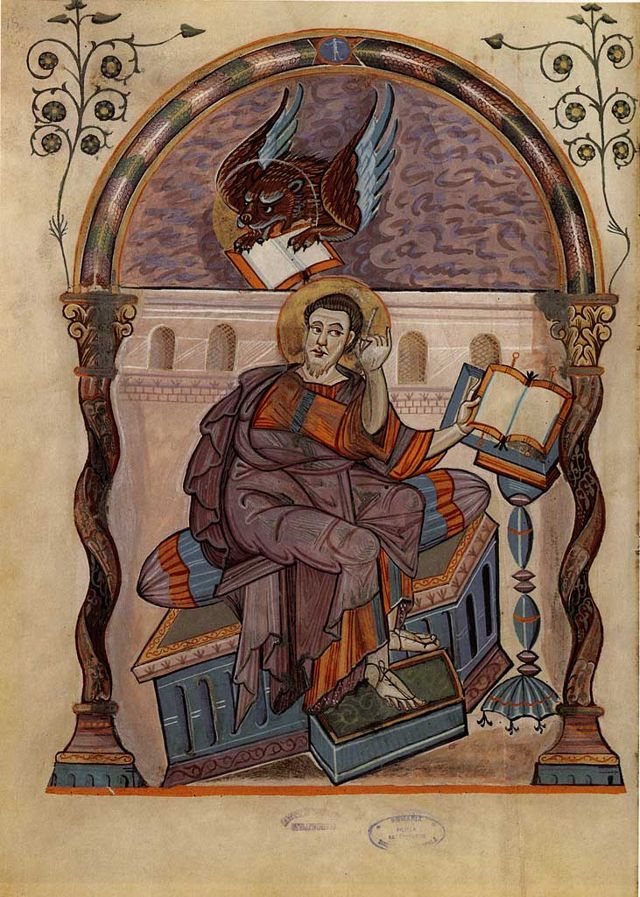
S. Mark has the Lion as his symbol, because he has set forth the royal dignity of Christ; or, according to others, because he begins with the mission of S. John the Baptist, “the voice of one crying in the wilderness,” which is figured by the Lion; or, according to a third interpretation, the Lion was allotted to S. Mark because there was, m the (April *5.

middle ages, a popular belief that the young of the lion was bom dead, and after three days was awakened to vitality by the breath of its sire; some authors, however, represent the lion as vivifying his young not by his breath but by his roar. In either case the application is the same; the revival of the young lion was considered as symbolical of the Resurrection, and S. Mark was commonly called the “Historian of the Resurrection.” Another commentator observes that S. Mark begins his Gospel with “ roaring “ the voice of one crying in the wilderness and ends it fearfully with a curse, “He that believeth not shall be damned and that, therefore, his appropriate attribute is the most terrible of beasts, the lion.

Feast days

Feast: April 25

Nine days · Free

Pray the novena
with us.

One short email a day for nine days. The day's prayer, a line from St. Mark the Evangelist's story, and a nudge to keep going.

Also on April 25
M

St. Maccald or M Aug…

April 25 · Bishop
E

St. Ermine

April 25 · Abbot
← All 1726 saints in the library
Sources & notes

Feast-day sources

Story sources

Sources

Credits

Image: Codexaureus 21.jpg · Scriptorium of the Lorsch Abbey (Hofschule Karls des Großen), Germany · Public domain, via Wikimedia Commons

From Sabine Baring-Gould, The Lives of the Saints, new edition in 16 vols. (London: John C. Nimmo, 1897–98); text from the Internet Archive scan (OCR, lightly cleaned; errors possible). Public domain.

Image: Scriptorium of the Lorsch Abbey (Hofschule Karls des Großen), Germany, Wikimedia Commons (Public domain)

John Henry Newman, “Religious Cowardice” (Sermon 16) · Scripture: Hebrews xii. 12
John Henry Newman, Parochial and Plain Sermons, vol. 2 (London: Rivington, 1835). Written in English; public domain. Published 1835 (before 1931): public domain in the U.S. Read the full text →

From “Catholic Encyclopedia (1913)/St. Mark,” The Catholic Encyclopedia (New York: Robert Appleton Company, 1907–1914), via Wikisource. Public domain. Matched by name and feast date; text unedited except for our bracketed notes in grey.

From Sabine Baring-Gould, The Lives of the Saints, new edition in 16 vols. (London: John C. Nimmo, 1897–98); text from the Internet Archive scan (OCR, lightly cleaned; errors possible). Public domain in the United States. Reproduced unedited, except for short bracketed notes in grey that we added to explain names and terms (“S.” is the old abbreviation for Saint). Some history and judgments reflect 19th-century scholarship.