Baring-Gould’s sources: Roman Martyrology. In some Martyrologies the Conversion of S. Mary Magdalen on April 7th. In the Hildesheim Breviary, her Conversion on March rst. The Invention of her relics on May 5th. On various days in different churches are commemorated the Translations of her relics. By the Greeks S. Mary, the sister of Lazarus, on March r8th; but Mary Magdalen on July 22nd; as also the Syriac, Coptic, Chaldaic, and Russian Kalendars. In the Sacramentary of S. Gregory is no mention of S- Mary Magdalen or of S. Mary, sister of Lazarus; nor in the Martyrology attributed to S. Jerome. In the Martyrologium Parvum, drawn up in the 8th cent., S. Mary Magdalen appears, and from that time forward the festival was observed in the West.] ||HE history of S. Mary Magdalen is one which has been disputed over without any certainty having been attained on some points.
S. Luke (viii. I, 2, 3) says that Onr Blessed Lord travelled from place to place, “and the twelve were with him, and certain women, which had been healed of evil spirits and infirmities, Mary called Magdalene, out of whom went seven devils, and Joanna, the wife of Chusa, Herod’s steward, and Susanna, and many others, which ministered unto him of their substance.” This was in the first year of his ministry. S. Mark (xvi. 9) confirms the statement of S. Luke, that Christ had cast seven devils out of the Magdalen. When He was on the cross, “ There stood by the cross of Jesus his mother, and his mother’s sister, Mary the wife of Cleopas, and Mary Magdalene.” S. Mary Magdalen was also one of the women u which came with him from Galilee, who followed after, and beheld the sepulchre, and how his body was laid, and returned and prepared spices and ointments; and rested the Sabbath day according to the commandment.” “ Now on the first day of the week, very early in the morning, they came unto the sepulchre, bringing the spices which they had prepared, and certain others with them. And they found the stone rolled away from the sepulchre.” And when they had seen a vision “ they returned from, the sepulchre, and told all these things unto the eleven, and to all the rest. It was Mary Magdalene, and Joanna, and Mary the mother of James, and other women that were with them, which told these things unto the apostles.” 1 It is not easy at first sight to harmonize this account with the order of events as related by S. John; but it is probable S. Luke is running two visits into one. S. John tells us that Mary Magdalen went early to the sepulchre while it was dark, and found the stone rolled away. She was not alone, the other women were with her. They returned to the apostles and told them, “They have taken away the Lord out of the sepulchre, and we know not where they have laid him.” Then S. Peter and S. John ran to the tomb, and found it even as the women had told them. Then Mary Magdalen, who had gone back to the sepulchre, with SS. Peter and John, and who was also perhaps accompanied by the other women, saw the vision of angels. In S. Luke all the women see it; in S. John, Mary Magdalen alone.
But there were probably two visions; the first when the other women were with her. The account in S. Matthew perplexes the matter further, as he relates the descent of the angel and the rolling back of the stone, and flight of the keepers, after mention of the starting of u Mary Magdalene and the other Mary ” for the sepulchre. But it is probable that this took place before the women reached the sepulchre. Then, when they saw the stone rolled away, and had seen the vision of angels, they ran and told the apostles; but — this is probably the order — Mary Magdalen returned, and after the apostles had gone, remained standing “ without at the sepulchre weeping: and as she wept, she stooped down and looked into the sepulchre, and saw two angels in white sitting, one at the head, and the other at the feet, where the body of Jesus had lain. And they say unto her, Woman, why weepest thou ? She saith unto them, Because they have taken away my Lord, and I know not where they have laid him. And when she had thus said, she turned herself back, and saw Jesus standing, and knew not that it was Jesus. Jesus saith unto her, Woman, why weepest thou ? Whom seekest thou ? She, supposing him to be the gardener, saith unto him, Sir, if thou have borne him hence, tell me where thou hast laid him, and I will take him away. Jesus saith unto her,, Mary. She turned herself, and saith unto him, Rabboni; which is to say, Master. Jesus saith unto her, Touch me not, for I am not yet ascended to my father; but go to my brethren, and say unto them, I ascend unto my Father, and your Father; and to my God, and your God.” Mary Magdalen came and told the disciples that she had seen the Lord, and that he had spoken these things unto her. 1 This is all that Holy Scripture tells us about Mary Magdalen by name. But it has been supposed that Mary, the sister of Lazarus, and the woman who was a sinner, and who anointed Christ with ointment at Nain, are the same person.
That the woman who anointed Christ at Nain was Mary Magdalen is probable enough. Magdala is a small town, or village, on the sea of Tiberias, in Galilee, and Mary was no doubt called Magdalen because she was a native of that place. It was in Galilee, at Nain, that the touching event took place which is recorded by S. Luke (vii. 36-50): — “ And one of the Pharisees desired him that he would eat with him. And he went into the Pharisee’s house, and sat down to meat. And, behold, a woman in the city, which was a sinner, when she knew that Jesus sat at meat in the Pharisee’s house, brought an alabaster box of ointment. And stood at his feet behind him weeping, and began to wash his feet with tears, and did wipe them with the hairs of her head, and kissed his feet, and anointed them with the ointment. Now when the Pharisee which had bidden him saw it, he spake within himself, saying, This man, if he were a prophet, would have known who and what manner of woman this is that toucheth him: for she is a sinner. And Jesus answering said unto him, Simon, I have somewhat to say unto thee. And he saith, Master, say on. There was a certain creditor which had two debtors: the one owed five hundred pence, and the other fifty. And when they had nothing to pay, he frankly forgave them both. Tell me therefore, which MARY MAGDALEN WASHING THE FEET OF CHRIST. After an Engraving by Mark Antony.
juiy aa.j S' Mary Magdalen. of them will love him most? Simon answered and said, I suppose that he to whom he forgave most. And he said unto him, Thou has rightly judged. And he turned to the woman, and said unto Simon, Seest thou this woman ? I entered into thine house, thou gavest me no water for my feet: but she hath washed my feet with tears and wiped them with the hairs of her head. Thou gavest me no kiss: but this woman since the time I came in hath not ceased to kiss my feet. My head with oil thou didst not anoint; but this woman hath anointed my feet with ointment. Wherefore I say unto thee, Her sins, which are many, are forgiven: for she loved much: but to whom little is forgiven, the same loveth little. And he said unto her, Thy sins are forgiven. And they that sat at meat with him began to say within themselves, Who is this that forgiveth sins also ? And he saith to the woman, Thy faith hath saved thee; go in peace.”
This took place in the first year of our Lord’s ministry, and directly after, we find Mary Magdalen following him. Of Mary, the sister of Lazarus, it is said “ Now a certain man was sick, named Lazarus, of Bethany, the town of Mary and her sister Martha. It was Mary which anointed the Lord with ointment, and wiped his feet with her hair, whose brother Lazarus was sick.” 1 But this anointing refers to that which took place at Bethany, in the house of Simon the Leper, in the third year of his Ministry, as recorded by S. Matthew. 2 “Now when Jesus was in Bethany, in the house of Simon the leper, there came unto him a woman having an alabaster box of very precious ointment, and poured it on his head, as he sat at meat. But when his disciS. John ati. j, a.
pies saw it, they had indignation, saying, To what purpose is this waste ? For this ointment might have been sold for much, and given to the poor. When Jesus understood it, he said unto them, Why trouble ye the woman ? for she hath wrought a good work upon me. For ye have the poor always with you; but me ye have not always. For in that she hath poured this ointment on my body, she did it for my burial. Verily I say unto you, Wheresoever this gospel shall be preached in the whole world, there shall also this, that this woman hath done, be told for a memorial of her.” It is difficult to understand how that Mary of Magdala and Mary of Bethany can be the same person; but it is quite possible that Mary Magdalen may have been the woman whose act is related in the 7th chapter of S. Luke. Origen mentions that in his time some supposed “ the woman who was a sinner,” the Magdalen, and Mary of Bethany, to be one and the same person. “But I,”' says he, “rather think that they were three separate persons.”
Victor of Antioch, who flourished about a.d. 400, says: — “ Apollinaris and Theodorus assert that what is written by all the evangelists refers to the same woman, but that John gave the history of her more fully than the others.” These are the earliest passages referring to the identification, and it shows that it had not taken place firmly in the first four centuries. In the Eastern Church it has been always supposed that the Mary of Bethany and the Mary of Magdala were distinct. Nothing trustworthy is known of what became of S. Mary Magdalen after the Resurrection. The Greeks say that she went to Ephesus, to S. John the Divine, where she died, and was buried in the entrance to the cave in which afterwards the Seven Sleepers took July as.] S. Mary Magdalen.
refuge. Her relics [the bodily remains of a saint, or objects they used, kept with honor] were translated thence by the emperor Leo VI., and laid in the monastery of S. Lazarus at Constantinople.
But there is a tradition that she came to Gaul [roughly modern France and Belgium] with Lazarus and Martha — for she is identified in mediaeval Western belief with Mary of Bethany — and that she settled at Marseilles, where she is regarded as the apostle of Provence. Two churches in France dispute the possession of her body, that of Vezelai, which exhibits bulls of popes Lucius II., Urban III., Clement III., and Innocent III., affirming the authenticity of the body preserved there, and that of Marseilles, where the body was discovered in the 13th century; but in addition to these there are innumerable other relics. 1 There is a long story told of the voyage of S. Mary Magdalen with her brother Lazarus and her sister Martha, to Provence, and of her mission work at Marseilles; but this is all so apocryphal and modern, that the Bollandists [Jesuit scholars who since the 1600s have critically studied the lives of the saints] did not deign to insert it in their collection.
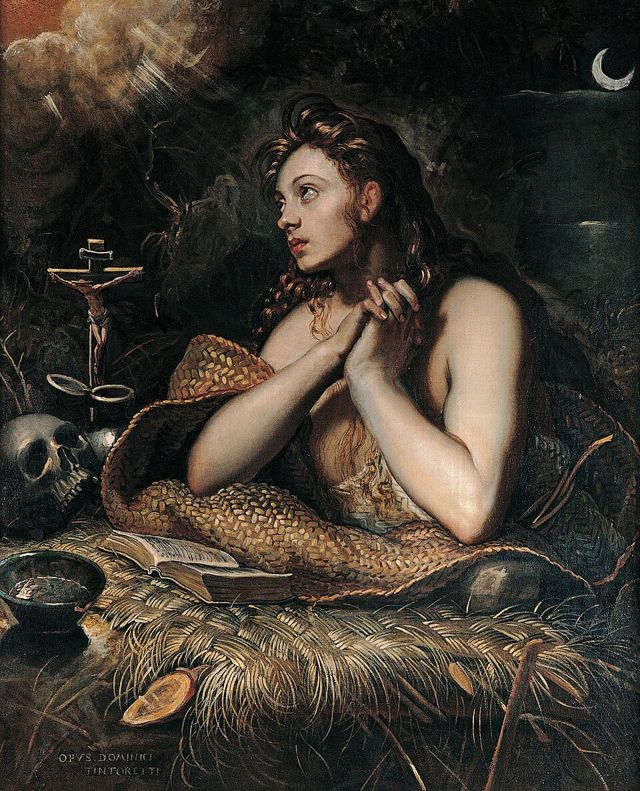
In Art S. Mary Magdalen is represented with the vessel of ointment, her hair loose and flowing. 1 “ Superest modo immensa adhuc rerum congeries, si loca omnia percurrenda sint, in quibos sacrae S. Marias Magdalenze reliquiae asservari honorarique dicuntur." And after enumerating a host of arms and fingers, &c., the Bollandist adds, *‘De his omnibus aliisque sexcentis sub S. Mariae Magdalenae nomine reliquiis, nemo ex me queeserit, verasne et genuinas ejus esae censeam.” — Act m [July aa.