Baring-Gould’s sources: By the Greeks on April 1st, and S. Zosimus on April 4th. Anciently the Roman Martyrology on the 9th; Usuardus on the 2nd; Baronius, in re-arranging the Roman Martyrology, followed Usuardus. S. Zosimus is given by Peter de Natali bus, Maurolycus and Wytford on the 30th; Alban Butler gives both S. Mary the Egyptian, and S. Zosimus on the 9th. The best, and only really trustworthy authority is a mention in the life of S. Cyriacus (d. 556) written by his disciple Cyril of Scythopolis. Cyriacus inhabited the desert beyond Jordan, where none had penetrated before. One day two of his disciples, penetrating further into the wilderness saw a human being moving among the bushes; but when they went to look, it had disappeared. Then, thinking it was a snare of the devil, they prayed, and after that they found the figure again, in a cave, and when they would have approached, it cried to them not to come near, for she was a woman and was naked. They asked her who she was, and she replied that she was a grievous sinner named Mary, who had lived as a public singer and player on musical instruments, and had waxed wanton, and led many into gross sin; but touched by repentance, she had retired into the wilderness to expiate her guilt. The two disciples returned to the monastery and related what they had seen to S. Cyriacus; and after some time, they went again to see her, and lo, she was lying dead in her cavern. Then they brought spades from the laura of Susac, and buried her where she had died. This story by a contemporary author is perfectly authentic, but the same cannot be said for the Greek Acts of S. Mary of Egypt, which are a romance founded on fact. The author of this life has used up the story told by the monks of S. Cyriacus, and has added to it what was traditionally reported, (April*.
Land has supplied the details from his own imagination, for the purpose of making the narrative interesting and edifying. The framework of the story is artificial, and the narrative of S. Mary given by her to the monk Zozimus is unquestionably the composition of the author of the life, who has filled it with ejaculations, apologies, and has even recorded the prayers made by the penitent on her conversion. This life is attributed by Nicephorus Callistus (d. 1341) to S. Sophronius, Patriarch of Jerusalem (d. 639), but Papebroeck has disputed this, and claims for the life a higher antiquity by 150 years. S. Gregory the Great in one of his letters to the priest Candidus, (about 596) alludes to lions burying S. Paul the first hermit "and S. Mary of Egypt," but these few words may be, and most probably are, an addition by a transcriber. There is much to be said in favour of the authorship by S. Sophronius. He makes much in the story of the Holy Cross at Jerusalem, of which he was patriarch [the title of the bishops of the great ancient sees: Rome, Constantinople, Alexandria, Antioch, Jerusalem], and he is also the author of two orations on the Cross. His friend, John Moschus, was long in the monastery of S. Sabas, which S. Cyril of Scythopolis the original narrator of the incident inhabited for long. S. John Damascene attributes the famous Spiritual Meadow, a collection of lives of the Fathers of the Desert, to S. Sophronius, and it is probable that he assisted his master John Moschus in composing it. The life of S. Mary the Egyptian may well be by the same hand which wrote the lives of so many other desert dwellers. The Life of S. Mary of Egypt gives no very certain indication of a date except one passage, which materially differs in the Greek text from the early Latin translation, and which fixes her death upon the 1st April, being then Good Friday; this will agree with the year 421 chosen by the Bollandists [Jesuit scholars who since the 1600s have critically studied the lives of the saints], and with 423, 427, 51 1, 516 or 522. I think one of these latter is more probable, as it will permit of reconciliation with the story in the life of S. Cyriacus. But if the early Latin version of the date be correct, Good either of these latter dates would fit in with the the time of S. Cyriacus better than 522.
The writer of the life plainly states that he derived his information from long tradition. He says, " the monks continued to hold this narrative by tradition, and to narrate it to those desiring to hear something tending to edification, and I, knowing letters, committed it to writing. Possibly others before may have written the life of the holy woman, much more magnificently and sublimely than I have done, though I have not met with such a life, therefore I have written it as best I could, wishing to add nothing to the truth."
The Greek life was early translated into Latin, it is supposed by Paulus Diaconus (d. 797). A metrical paraphrase was made by Hildebert, B. of Mans, and afterwards of Tours (d. 1232). Portions of an Anglo-Saxon translation from the Latin have been published in " Gloucester Fragments," by J, Earle, London, 1863, a^d an ancient Spanish version by Mussafia, April a.].SS. Mary & Zosimus.
The Life of S. Mary of Egypt was quoted in the second council of Nicseo, on the cultus of images, a.d. 787.] There lived a holy anchorite [a hermit, sometimes walled into a cell beside a church] named Zosimus in Palestine. He had been educated from childhood in the monastery, having ever before his eyes the most perfect way. And as the fame of his sanctity spread abroad, as the perfume of a flower attracts the bees, so did his virtue draw about him a swarm of disciples, to gather the honey of doctrine and example from his lips and life.
But now, so it was, that his heart was lifted up, and he thought that he had attained to a high state of perfection. Then one day a stranger told him that near Jordan dwelt a company of holy men who served God in a closer walk than he. Now when he heard this, he went forth and sought, till he found this monastery of which the stranger had spoken. And as he dwelt with these holy solitaries and saw their conversation, he was humble in his heart, and he tare up the roots of self-esteem which had grown in his breast Now it was the custom of these solitaries, on the first Sunday in Lent [the forty days of fasting before Easter], after having partaken of the Holy Mysteries to meet for a light refection, and then, having given one another the kiss of peace, to depart into the wilderness in procession, chanting the psalm, “ The Lord is my light and my salvation, whom then shall I fear; The Lord is the strength of my life; of whom then shall I be afraid.” And when all had passed over Jordan they dispersed through the desert, carrying with them such food as they needed, and met not again till Palm Sunday. And during all the time, each monk followed his own rule, and none had to give an account to their Superior of how they had practised Lent And this they did, that they might have God only as witness to their penitence, lest some should be puffed up, and others should be cast down.
VOL. iv. 2 So Zosimus went forth with the rest, and set his face Eastward, and saw but the brown desert before him lying like a dead sea, and the hot air quivering over the burning sand as over a kiln. Only at long intervals stood clumps of date palms, with their hard leaves black and motionless against a brassy sky.
Zosimus walked on every day over the desert, turning sometimes to the right, and sometimes to the left; now resting in the shade of a barren hill, then kneeling in the rank grass beside a little pool. And at night watching the white moon that glared over the scene and cast fantastic shadows from the rocks, and listening to the howl of the jackall, and anon seeing the red eyes of the hysena watch him from some hole among the rocks, and then starting and shivering as it burst into its hideous laugh and trotted past him, its black shadow running beside it on the white moonlit sand. After wandering thus for twenty days, at noon he said his usual prayers, with his face towards the East, and his eyes lifted to heaven, when, on his right at a short distance, he saw through the corner of his eye, some hairy creature, upright like a human being, but strange, moving among the stones. Fearing an illusion of the devil, with a great effort he overcame his fear, withdrew his eye to heaven, and finished his prayer. Then he looked, and beheld a figure, naked, tanned almost black, with white hair, and was satisfied that he beheld a hermit So his fear was changed into joy, and he ran towards him. But the strange person, on beholding him, fled, and Zosimus pursued, crying to him to stay. But the other fled on till he came to a dry water course into which he leaped, and scrambled across to the other side. Thereat Zosimus came up, panting, and said, “ Whoever thou art, servant of God, stay thy foot, and fly not from me, a miserable sinner. I am an old and feeble man, and I desire thy prayers and benediction.” Then answered the other, “ I pray thee, for the love of God, approach not nearer; for I am a woman, and I have nothing wherewith to cover my nakedness; cast me across thy mantle, and then I will speak with thee.” Then Zosimus threw his cloak to her, and turned his face another way, whilst she clothed herself therewith. And after that, he cast himself down on one side of the watercourse, and besought her to give him her blessing; but she, kneeling on the other side, prayed him to give her his benediction. And so there was, for a while, a contest of humility between them. But she said, “It is for thee to call the name of God upon me, for thou art a priest, and hast long offered the Sacrifice upon the altar of God. But Zosimus all the more amazed at her knowing this, said, “ O my spiritual mother, dead to the world, thou art raised nigh to God by thy holy charity, I conjure thee, by the love of the Saviour, to give me thy benediction.” Then the woman said, “ May the Lord who taketh care of our bodies and souls, so lovingly, be praised for ages of ages T and Zosimus responded, “ Amen.” So after that they had prayed, they sat down, and she said, “ I am a grievous sinner, but I have had the blessing of receiving holy Baptism,” and then she signed her brow, her eyes, her lips and her heart with the holy cross.
At his earnest solicitations, she told him her story. It was a sad one, too shocking to be fully told here. She was an Egyptian by birth. At the age of twelve she ran away from home to the pleasure-loving wicked city of Alexandria, where she spent seventeen years of her life in wantonness, working all uncleanness with greediness.” One day she joined a party on the way to Jerusalem by sea, to keep the solemn festival of the Exaltation of the Holy Cross, 1 but with no religious purpose in her heart, only a wicked desire 1 Instituted first by Constantine, in 325. to introduce disorder and vice among the pilgrims, and in her evil purpose she was only too successful. Now when she reached Jerusalem, she went with the crowd on the feast day to the Church, but a mysterious power held her back, that she could not force her way in. Filled with shame and fear, she raised her eyes to a figure (eikon) of the holy Virgin Mother, and then — suddenly, like a dark sea rising and sweeping over her, there rushed upon her soul the consciousness of her vile, hateful life. The girl cast herself on the broad flat stones, and watered them with her tears, swaying herself in the agony of her remorse to and fro, as one in physical pain. Below, writhing like a crushed worm, with her tears flooding the pavement, shaken with sobs — with tom garland — the polluted one; above, the figure of the undefiled, calm, radiant, crowned. When the first paroxysm was past, she raised eyes and hands to the Virgin Mother, and vowed to renounce for ever the old foul life, and stand through the rest of her days beneath the dear Cross of J esus, like Magdalen, if only she might now enter in and adore the sacred wood “on which the Prince of Glory died.”
And when she had so resolved, she crept to the door, and the angelic barrier was withdrawn, and the penitent entered in. After that she had seen the Cross, she come forth once more, and going before the image, renewed her vows of amendment Then a voice came to her as from a mighty distance, “ Pass over Jordan, and thou wilt find rest” She hasted to put this command into execution, and having drawn near the church of S. John the Baptist by Jordan, where Christ had been baptized, she bathed hands and face in the sacred water, and then went to the church and was communicated with the Body and Blood of her Lord and Redeemer, Who came on earth to seek and to save those that were lost April a.] •S^*. Mary & Zosimus.
That night she slept on the ground, and on the morrow she was ferried over the river, taking with her a few loaves, and praying the B. Virgin to be her guide. Now when she had told her story thus far, the abbot Zosimus asked her how long she had been in the desert, and she answered that she believed she had spent fortyseven years in that wilderness, seeing no man, and living on herbs and wild dates. For seventeen years she suffered from sore temptation, the memory of the past haunting, alluring her back, poisoning her present peace, and making her tremble for the future. The old wanton songs she had sung sounded and sounded again in her ears, and the scenes she had gone through painted themselves in their liveliest colours before her imagination. Her clothes wore out, and she suffered from alternate cold and heat, and often from hunger; but, through all, the gentle Heavenly Mother who had called her sustained her, drawing her nearer to God. And now Zosimus could restrain himself no more, for his heart burnt with love and gratitude to God, for the miracles of mercy He had wrought, and he lifted up his voice, and wept, and cried, “ Blessed be the Lord who only doeth great marvels. Blessed be He whose wondrous works are so many. Blessed be He for having made me to see and hear how His mercy is towards them that fear Him. O, my God! I know in very deed that Thou forsakest not those that seek Thee." And when it was time that they should part, the one from the other, the penitent made Zosimus promise not to divulge what she had told him till after her death, and she desired him to return next Lent, and bring with him on Maundy Thursday the most precious Body and Blood of our Lord, and to wait for her on the bank of Jordan nearest to the desert in which she dwelt Having thus spoken, she once more entreated his prayers, and left him. L ives of the Saints.
Zosimus thereupon fell on his knees, and kissed the ground whereon she had stood. He was thoroughly humbled now; his self-esteem had been swept clean away. Next year, on the first Sunday in Lent, when the brethren dispersed, he was detained in the monastery by sickness, but by the end of Lent he recovered, and taking with him the sacred Body and Blood of Christ in a small chalice, on the appointed day, and a few figs, dates and lentils in a little basket, he made his way to Jordan. Night drew on, and the holy woman had not come. Zosimus grew uneasy, fearing that she had mistaken the day, and not finding him, had gone away; and troubled also at their being no boat near by which the river might be crossed. But now the moon rose, and he saw the woman on the other bank; and she came boldly into the stream, and God sustained her, that she came to the other side in safety. And when she reached him, he said the Creed and the Lord’s Prayer, and he gave her the kiss of peace, and then he communicated her. And when she had received the sacred mysteries, she murmured with eyes and hands lifted to the night sky, “Lord, now lettest Thou Thy servant depart in peace, according to Thy word, for mine eyes have seen Thy salvation.” After that she said to Zosimus, “ Permit me, my father, to ask thee one favour more. Next Lent return to the spot where thou didst find me at first, and there shalt thou see me as it pleases God.” Then the abbot offered her what he had in his basket, but she would only receive a few lentils.
Next Lent, Zosimus again traversed that vast solitude, till he reached the spot where he had seen her two years before. And all the way he felt a regret that he had not hitherto asked her name. But when he came to the banks of the dry torrent, he found lying there, wrapped in the shreds of his old mantle, the poor penitent, quite dead. j Aprils.] iSVSl Mary & Zosimus.
She had heard once more the call “Pass over Jordan and thou shalt find rest !" but this time it was the Jordan of death, and the rest was that which remaineth for the people of God Then Zosimus, stooping down, saw traced on the sands these words, “Abbot Zosimus, bury here the body of the sinner Mary.”
But he had no spade. Then, if the legend is to be believed, a lion came out of the desert, and with his feet dug a hole by the torrent side, and there, reverently, the old man Zosimus laid the penitent to await the resurrection of the just A great number of churches claim to possess relics [the bodily remains of a saint, or objects they used, kept with honor] of S. Mary the Egyptian. Pope Hormisdas is said to have given relics of this saint to S. Eleutherius of Toumai; but as the life of Eleutherius was not written before 880, this statement is questionable. In Rome, itself, relics are preserved in S. Peter's, in the churches of S. Paul, S. Peter ad Vincula, S. George on the Coelian Hill, S. Caecilia on the other side of the Tiber, S. Sabina, &c. However, in 1059 Luke, abbot of Carbonne in Calabria, carried away the entire body from Jerusalem and placed the body in the Abbey church, but gave the head to the convent of S. Mary of Egypt at Naples. This body was afterwards translated to the cathedral of Urbino. A finger of the saint was given to the same convent at Naples in 1335 by the Queen of Aragon, but whence she obtained it is not known, and the nuns claim also to possess other bones. However, the larger portion of the body is claimed to be at Cremona, in the Church of S. Peter, the jaw in that of S. Erasmus, and other portions in the parish Church of S. Matthias. Other portions are said to be in the Church of S. Charles at Antwerp, brought from Portugal in 1610.
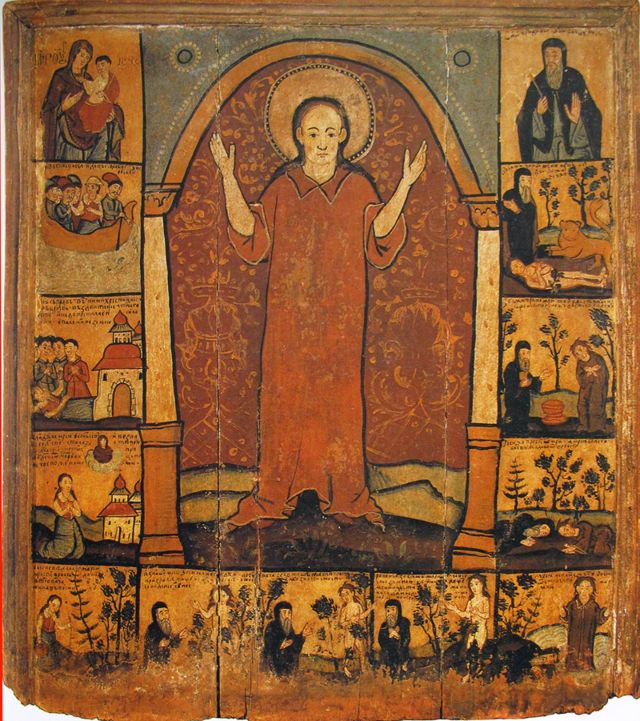
In art S. Mary of Egypt appears as a woman in the desert veiled in her long hair, though the life says it did not descend to her shoulders; or carrying three loaves, which was all the food she took with her when flying from the world.