St. Matthew, Evang

Matthew is named five times in the New Testament.

Read the essentials →
September 21 · Apostle, Martyr

St. Matthew

St. Matthew, Evang

Matthew is named five times in the New Testament.

Traditional feast

September 21
1914 / pre-1969 calendar, per Baring-Gould (1897)

Current feast

September 21
Verified · General Roman Calendar

Represents

Apostle
Martyr

Their story

Adapted in modern English from the Catholic Encyclopedia (1913) · original text below

Matthew is named five times in the New Testament. He is the same man the Gospels of Mark and Luke call Levi, 'sitting at the receipt of custom'. Levi was probably his original name, and Matthew ('gift of the Lord') the name Christ gave him when he called him. He was the son of Alpheus and a Galilean, although Eusebius (bishop of Caesarea, d. c. 339, the first historian of the Church) says he was a Syrian. As a tax-collector at Capharnaum he gathered customs duties for Herod Antipas, and though a Jew he was despised by the Pharisees, who hated all publicans.

When Jesus called him, Matthew got up and followed him, and he gave a feast in his house where tax-collectors and sinners sat at table with Christ and his disciples. When the Pharisees protested, Jesus answered: 'I came not to call the just, but sinners.' From then on Matthew followed Christ up to the Passion. He was among the witnesses of the Resurrection in Galilee and among the apostles present at the Ascension, and afterwards he prayed in the upper room in Jerusalem with Mary, the mother of Jesus.

The source says that what we know of his later career is inaccurate or legendary. St Irenaeus (bishop of Lyon, d. c. 202, who listed the early popes) says he preached the Gospel among the Hebrews; St Clement of Alexandria says he did so for fifteen years; and Eusebius says he gave them his Gospel in their own language before going to other lands. Most ancient writers say he went to an Ethiopia south of the Caspian Sea. Almost all ancient testimony says he died a martyr, but it is not known where, or whether he was burned, stoned or beheaded, and the source calls the apocryphal (outside the Bible and not accepted as Scripture) account of his martyrdom worthless as history. The Roman Martyrology (the Church's official list of saints for each day) says only that he suffered martyrdom while preaching in Ethiopia. The Latin Church keeps his feast on 21 September.

Early life

The book says little or nothing about early life. This is how the account begins.

The publicans, properly so called, were persons who farmed the Roman taxes, and they were usually, in later times, Roman knights, and persons of wealth and credit. They employed under them inferior officers, natives of the province where the taxes were collected, called properly portitores, to which class Matthew belonged. Eusebius says that after our Lord's ascension, S. Matthew preached in Judaea, some add for fifteen years, and then went to foreign nations.

What they represent

How they teach us to live

Drawn from themes in the original account

Keep their day. Remember them on September 21 with a short prayer, and ask for their help.

From the homilies

Preached on Scripture

“Unless we were accustomed to read the New Testament from our childhood, I think we should be very much struck with the warnings which it contains, not only against the love of riches, but the very possession of them; we should wonder with a portion of that astonishment which the Apostles at first felt, who had been brought up in the notion that they were a chief reward which God bestowed on those He loved.”

Text: “Woe unto you that are rich! for ye have received your consolation.”

From the Catholic Encyclopedia

1913 · 794 words

Apostle and evangelist. The name Matthew is derived from the Hebrew Mattija, being shortened to Mattai in post-Biblical Hebrew. In Greek it is sometimes spelled Maththaios, B D, and sometimes Matthaios, CEKL, but grammarians do not agree as to which of the two spellings is the original. Matthew is spoken of five times in the New Testament; first in Matthew 9:9, when called by Jesus to follow Him, and then four times in the list of the Apostles, where he is mentioned in the seventh (Luke 6:15, and Mark 3:18), and again in the eighth place (Matthew 10:3, and Acts 1:13). The man designated in Matthew 9:9, as "sitting in the custom house", and "named Matthew" is the same as Levi, recorded in Mark 2:14, and Luke 5:27, as "sitting at the receipt of custom". The account in the three Synoptics is identical, the vocation of Matthew-Levi being alluded to in the same terms. Hence Levi was the original name of the man who was subsequently called Matthew; the Maththaios legomenos of Matthew 9:9, would indicate this. The fact of one man having two names is of frequent occurrence among the Jews. It is true that the same person usually bears a Hebrew name such as "Shaoul" and a Greek name, Paulos. However, we have also examples of individuals with two Hebrew names as, for instance, Joseph-Caiaphas, Simon-Cephas, etc. It is probable that Mattija, "gift of Iaveh", was the name conferred upon the tax-gatherer by Jesus Christ when He called him to the Apostolate, and by it he was thenceforth known among his Christian brethren, Levi being his original name. Matthew, the son of Alpheus (Mark 2:14) was a Galilean, although Eusebius [Eusebius of Caesarea (d. c. 339), the first historian of the Church] informs us that he was a Syrian. As tax-gatherer at Capharnaum, he collected custom duties for Herod Antipas, and, although a Jew, was despised by the Pharisees, who hated all publicans. When summoned by Jesus, Matthew arose and followed Him and tendered Him a feast in his house, where tax-gatherers and sinners sat at table with Christ and His disciples. This drew forth a protest from the Pharisees whom Jesus rebuked in these consoling words: "I came not to call the just, but sinners". No further allusion is made to Matthew in the Gospels, except in the list of the Apostles. As a disciple and an Apostle he thenceforth followed Christ, accompanying Him up to the time of His Passion and, in Galilee, was one of the witnesses of His Resurrection. He was also amongst the Apostles who were present at the Ascension, and afterwards withdrew to an upper chamber, in Jerusalem, praying in union with Mary, the Mother of Jesus, and with his brethren (Acts 1:10 and 1:14).

Of Matthew's subsequent career we have only inaccurate or legendary data. St. Irenæus tells us that Matthew preached the Gospel among the Hebrews, St. Clement of Alexandria claiming that he did this for fifteen years, and Eusebius maintains that, before going into other countries, he gave them his Gospel in the mother tongue. Ancient writers are not as one as to the countries evangelized by Matthew, but almost all mention Ethiopia to the south of the Caspian Sea (not Ethiopia in Africa), and some Persia and the kingdom of the Parthians, Macedonia, and Syria. According to Heracleon, who is quoted by Clement of Alexandria, Matthew did not die a martyr, but this opinion conflicts with all other ancient testimony. Let us add, however, that the account of his martyrdom in the apocryphal Greek writings entitled "Martyrium S. Matthæi in Ponto" and published by Bonnet, "Acta apostolorum apocrypha" (Leipzig, 1898), is absolutely devoid of historic value. Lipsius holds that this "Martyrium S. Matthæi", which contains traces of Gnosticism, must have been published in the third century. There is a disagreement as to the place of St. Matthew's martyrdom and the kind of torture inflicted on him, therefore it is not known whether he was burned, stoned, or beheaded. The Roman Martyrology simply says: "S. Matthæi, qui in Æthiopia prædicans martyrium passus est". Various writings that are now considered apocryphal, have been attributed to St. Matthew. In the "Evangelia apocrypha" (Leipzig, 1876), Tischendorf reproduced a Latin document entitled: "De Ortu beatæ Mariæ et infantia Salvatoris", supposedly written in Hebrew by St. Matthew the Evangelist, and translated into Latin by Jerome, the priest. It is an abridged adaptation of the "Protoevangelium" of St. James, which was a Greek apocryphal of the second century. This pseudo-Matthew dates from the middle or the end of the sixth century. The Latin Church celebrates the feast of St. Matthew on 21 September, and the Greek Church on 16 November. St. Matthew is represented under the symbol of a winged man, carrying in his hand a lance as a characteristic emblem.
Read more

The full original · 497 words

Read Baring-Gould’s full account

Baring-Gould’s sources: The Martyrology of Jerome, the Marlyrologium Parvum, Bede, Florus, Hrabanus, Wabdelbert, Ado, Notker, Roman Martyrology, and all Latin Kalendars. Mass of S. Matthew with vigil on preceding day in the Sacramentary of S. Gregory. In the Martyrology of Jerome also on May 1, May 6, and Oct. 9, in some copies on May 21, but probably by mistake for Matthias. The Translation to Salerno on April 28. By the Greeks S. Matthew on Nov. 16, and S. Matthew with the rest of the Apostles on June 30. The Armenians on Nov. 16, so also the Copts and Abyssinians.] A I NT MATTHEW, the Apostle and Evangelist, is the same as Levi the Publican,1 the son of a certain Alphaeus.2 His call to be an Apostle is related by all three Evangelists in the same words, except that S. Matthew3 gives the former, and S. Mark and S. Luke the latter name.

The publicans, properly so called, were persons who farmed the Roman taxes, and they were usually, in later times, Roman knights, and persons of wealth and credit. They employed under them inferior officers, natives of the province where the taxes were collected, called properly portitores, to which class Matthew belonged. Eusebius [Eusebius of Caesarea (d. c. 339), the first historian of the Church] says that after our Lord's ascension, S. Matthew preached in Judaea, some add for fifteen years, and then went to foreign nations. Socrates says that it fell to the lot of S. Matthew to go into Ethiopia. But S. Ambrose [bishop of Milan (d. 397)] says that God opened to him the country of the Persians;x Isidore of Seville says that he went among the Macedonians, the acts by the pseudo-Abdias say Ethiopia. Heracleon, disciple of Valentine, living in the 2nd century, and the earliest and most trustworthy authority, says that S. Matthew died a natural death,2 and S. Clement, Origen, and Tertullian say the same. The story of his martyrdom originated much later.

S. Matthew’s original Gospel in Aramaic consisted of the sayings of the Lord. The Acts of His life were added later. It is pretended that Breton merchants brought the body of S. Matthew from Ethiopia to Brittany in the reign of King Solomon of Armorica [Brittany in north-west France], /.<?., at the beginning of the 5 th century, and placed it in the city of S. Pol de Leon. But Solomon, having been killed by the rebellious Bretons, Valcntinian deprived them as a punishment of the body ot S. Matthew, and translated it to Basilicata in Naples. There it remained till the year 954, when it was translated to Salerno. The story deserves no respect. An arm bone at Monte Cassino; an arm in the church of S. Matthew at Rome, inclulgenced by Pope Paschal II.; another arm in S. Maria Maggiore; another in S. Marcellus; a rib in S. Nicolas in Casiers; other relics [the bodily remains of a saint, or objects they used, kept with honor] in the Vatican; another arm at Bologna; a foot covered with skin at Subiaco; another entire foot covered with skin; also an arm in the same perfect condition, a rib and tooth and shoulderblade at Prag. At Carlstein both arms entire, covered with dried flesh and skin. A large part of the body at Andechs 1 In Psalm 45. Also S. Paulinus of Nola in poem 19, and the Martyrology of Jerome.

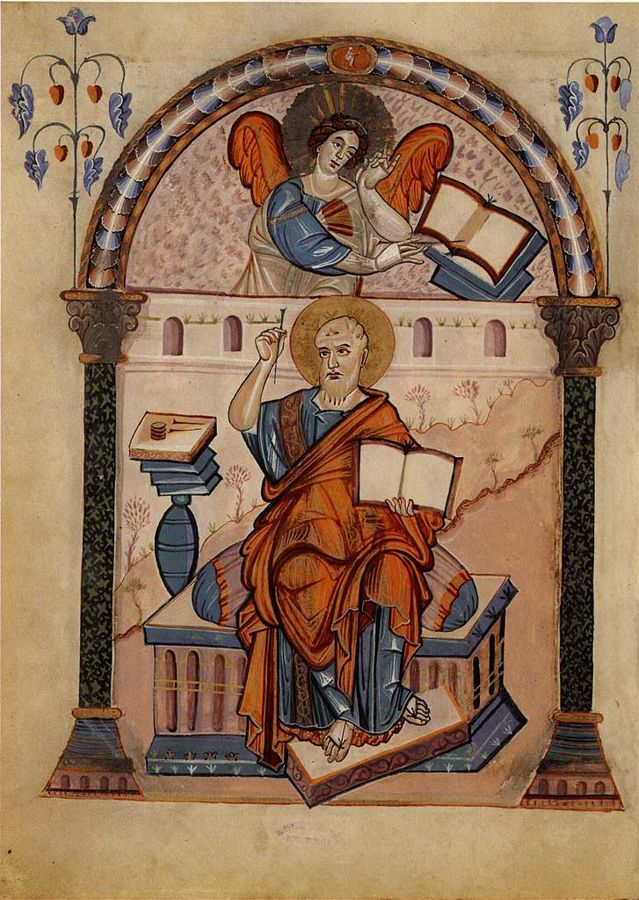
2 Ap. Clement. Alex. Stromat. lib. iv. in Bavaria. In the Court chapel at Brussels the entire head of S. Matthew. Two bones at Tournai, others at S. Sauveur, Bruges; a large part of one arm at Foppens; a thumb covered with skin at Liessgin, Hainault. A head at S. Pol de Leon, another at Beauvais, another at Chartres, another at Rengisval in the diocese of Tulle. When S. Matthew is represented as an Apostle, he usually appears as an old man with a long beard, and has his gospel in his hand. He is also represented with a purse or moneybox, in allusion to his worldly calling; sometimes with a spear or axe.

Feast days

Feast: September 21

Nine days · Free

Pray the novena
with us.

One short email a day for nine days. The day's prayer, a line from St. Matthew's story, and a nudge to keep going.

Also on September 21
St. Alexander

St. Alexander

September 21 · Bishop, Martyr
G

St. Gerulf

September 21 · Martyr
← All 1726 saints in the library
Sources & notes

Feast-day sources

Story sources

Sources

Credits

Image: Codexaureus 17.jpg · Unknown · Public domain, via Wikimedia Commons

From Sabine Baring-Gould, The Lives of the Saints, new edition in 16 vols. (London: John C. Nimmo, 1897–98); text from the Internet Archive scan (OCR, lightly cleaned; errors possible). Public domain.

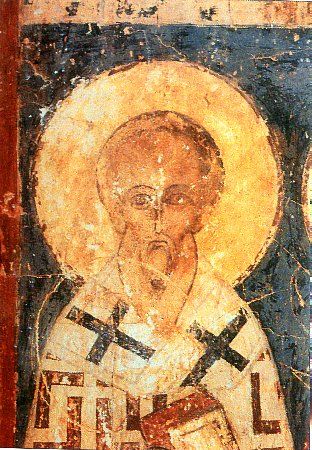
Image: Unknown, Wikimedia Commons (Public domain)

John Henry Newman, “The Danger of Riches” (Sermon 28) · Scripture: Luke vi. 24; Eccles. ix. 7-9; v. 18; Luke x. 41, 42
John Henry Newman, Parochial and Plain Sermons, vol. 2 (London: Rivington, 1835). Written in English; public domain. Published 1835 (before 1931): public domain in the U.S. Read the full text →

From “Catholic Encyclopedia (1913)/St. Matthew,” The Catholic Encyclopedia (New York: Robert Appleton Company, 1907–1914), via Wikisource. Public domain. Matched by name and feast date; text unedited except for our bracketed notes in grey.

From Sabine Baring-Gould, The Lives of the Saints, new edition in 16 vols. (London: John C. Nimmo, 1897–98); text from the Internet Archive scan (OCR, lightly cleaned; errors possible). Public domain in the United States. Reproduced unedited, except for short bracketed notes in grey that we added to explain names and terms (“S.” is the old abbreviation for Saint). Some history and judgments reflect 19th-century scholarship.