St. Maurontius

Mauront was born in 634, the eldest son of Blessed Adalbald and St Rictrudes, and was baptised by St Riquier.

Read the essentials →
May 5 · Abbot

St. Maurontius

St. Maurontius

Mauront was born in 634, the eldest son of Blessed Adalbald and St Rictrudes, and was baptised by St Riquier.

Traditional feast

May 5
1914 / pre-1969 calendar, per Baring-Gould (1897)

Current feast

Not verified yet

Represents

Abbot

Their story

Adapted in modern English from Alban Butler's Lives of the Saints · Baring-Gould original below

Mauront was born in 634, the eldest son of Blessed Adalbald and St Rictrudes, and was baptised by St Riquier. He grew up at the court of Clovis II and St Bathildes, and on his father's death became lord of Douay. He came home to marry a rich young lady.

Then a sermon by St Amand on the vanity of the world moved him so deeply that he went straight to Marchiennes, his mother's monastery, and received the tonsure. He built the monastery of Breuil on his estate at Merville and became its first abbot. He handed his office over to the exiled St Amatus and lived under his obedience, then took it back when Amatus died.

He died at Marchiennes on 5 May. Butler gives the year as 706; Baring-Gould, the text on this page, gives 701. The sources differ.

Early life

Selected sentences from the original account, unaltered.

Maurontius spent his youth at court, but at last resolved to quit the world like his mother and his sisters, and live to God alone in the peaceful cloister. He visited Marchiennes and informed his mother of his intention.

What they represent

How they teach us to live

Drawn from themes in the original account

Pray a little every day. Prayer runs all through this account.

Keep their day. Remember them on May 5 with a short prayer, and ask for their help.

Read more

The full original · 444 words

Read Baring-Gould’s full account

Baring-Gould’s sources: Greven and Molanus in their additions to Usuardus, the Belgian and Gallican and Benedictine Martyrologies. Authority An account of him in the life of S. Rictrudis, his mother, by Hucbald, abbot of Elnone. See May 12th.] Adalbald, and his saintly wife Rictrudis, were the parents of Maurontius. His father was murdered in Perigord, and is numbered among the blessed.1 His S. Mourontius.

…sisters Clotsendis (June 30th), Eusebia (March 16 th), and Adalsendis (Dec. 24th), are numbered among the saints. Maurontius was baptized by S. Richarius (Riquier) when on a visit to Adalbald and Rictrudis. When the saintly priest was mounted on his horse at the door, and about to leave, Rictrudis brought the babe put, and Richarius, stooping in his saddle, took the little one in his arms to kiss it. But something frightened the horse, which reared and plunged, and the babe fell into the grass. Pi evidentially it was unhurt, and when the mother rushed to pick it up, the child crowed and extended its arms to her. Maurontius spent his youth at court, but at last resolved to quit the world like his mother and his sisters, and live to God alone in the peaceful cloister. He visited Marchiennes and informed his mother of his intention. She was uneasy, fearing lest his young mind should change, and then sigh for the life in the world he had so rashly deserted. She consulted S. Amandus, and he bade her and the young man hear mass, and pray God to guide them aright in choosing a course of life for Maurontius. Then he vested himself, and the tapers were lit by the youth, who served him as he said mass. Now all three lifted up their prayer to God that He would show if He had chosen the boy, and during the sacrifice through the little window came a summer bee, flying down the ray of light that penetrated into the chapel, and the bee flew thruming thrice round the head of Maurontius. Then Amandus took it for a sign, and he set apart the youth for the religious life. But, though ordained, he must needs return to the palace, and there, as high honour, to him was given to hold the regal orb of gold, and afterwards King Thierri gave him his signet and constituted him his secretary.

Maurontius built the abbey of Breuil on his own property at the confines of Artois and Flanders, on the river Lys. There he received S. Amatus when driven from his see of Sens [a bishop’s “see” is his diocese, named from his seat (Latin sedes)] by the king. He died when on a visit to Marchiennes, where his sister Clotsendis was abbess after her mother's death, and over which Maurontius exercised supervision, according to dying request of Rictrudis. His relics [the bodily remains of a saint, or objects they used, kept with honor] at Douai, of which city he is patron; at Margival, near Soissons, is a fountain dedicated to him; an object of pilgrimage, at Levergies, is a small relic, and a hill once crowned by a statue of him destroyed at the revolution, but still the object of pilgrimage.
Feast days

Feast: May 5

Nine days · Free

Pray the novena
with us.

One short email a day for nine days. The day's prayer, a line from St. Maurontius's story, and a nudge to keep going.

Also on May 5
M

St. Maximus of Jerusalem

May 5 · Bishop
St. Hilary of Arles

St. Hilary of Arles

May 5 · Bishop
St. Pius, Pope

St. Pius

May 5 · Virgin
← All 1726 saints in the library
Sources & notes

Feast-day sources

Story sources

Sources

Credits

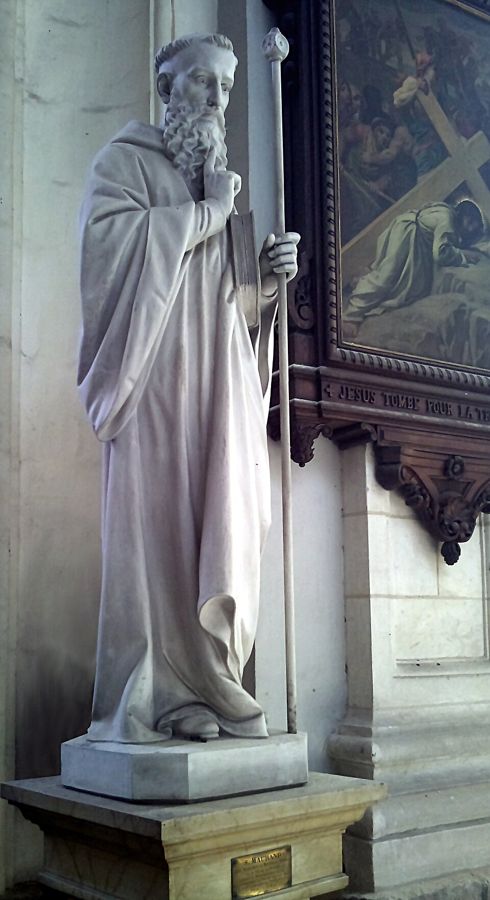
Image: Douai - Collégiale Saint-Pierre - Saint Maurand (2).jpg · Serge Ottaviani · CC BY-SA 3.0, via Wikimedia Commons

From Sabine Baring-Gould, The Lives of the Saints, new edition in 16 vols. (London: John C. Nimmo, 1897–98); text from the Internet Archive scan (OCR, lightly cleaned; errors possible). Public domain.

Image: Serge Ottaviani, Wikimedia Commons (CC BY-SA 3.0)

From Sabine Baring-Gould, The Lives of the Saints, new edition in 16 vols. (London: John C. Nimmo, 1897–98); text from the Internet Archive scan (OCR, lightly cleaned; errors possible). Public domain in the United States. Reproduced unedited, except for short bracketed notes in grey that we added to explain names and terms (“S.” is the old abbreviation for Saint). Some history and judgments reflect 19th-century scholarship.