M

…informed whether his application succeeded Melchiades was accused afterwards of having employed for this purpose a deacon who had delivered up some Church property during the late

Read the essentials →
December 10 · —

St. Melchiades

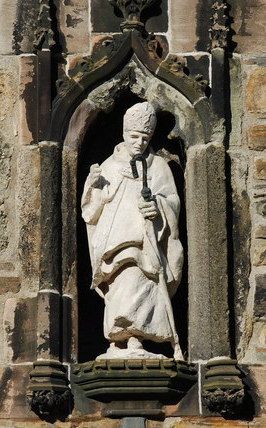
St. Melchiades, Pope

…informed whether his application succeeded Melchiades was accused afterwards of having employed for this purpose a deacon who had delivered up some Church property during the late

Traditional feast

December 10
1914 / pre-1969 calendar, per Baring-Gould (1897)

Current feast

Not verified yet

Represents

Feast

Their story

Adapted in modern English from the Catholic Encyclopedia (1913) · original text below · little is known

Melchiades (Miltiades), a native of Africa, became pope on 2 July, probably in 311, after a long vacancy. Soon after, an edict of toleration ended the great persecution in most of the empire.

The emperor allowed him to recover church buildings and property seized in the persecution, and he brought back the remains of his predecessor Eusebius (bishop of Caesarea, d. c. 339, the first historian of the Church) from Sicily to the Catacomb of Callistus. He saw Constantine enter Rome after the victory at the Milvian Bridge in 312, and the emperor later gave the Church the Lateran Palace, which became the pope's residence.

In 313 he presided at a Roman synod on the Donatist dispute in Africa. He died in January 314.

Early life

The book says little or nothing about early life. This is how the account begins.

…informed whether his application succeeded Melchiades was accused afterwards of having employed for this purpose a deacon who had delivered up some Church property during the late persecution, but he denied the charge. In 313 Constantine wrote to Ursus, chief minister of finance for Africa, to pay a certain sum to the clergy of the Catholic Church in Africa, through Caecilian, the bishop of Carthage; and the pro-consul was directed to announce to him that all persons engaged in the sacred ministry were to be excused from the burden of taking any public office.

What they represent

How they teach us to live

Drawn from themes in the original account

Stay faithful when it costs you. This account is about holding firm under pressure.

Give to people in need. The account records care for the poor.

From the Catholic Encyclopedia

1913 · 918 words

The year of his birth is not known; he was elected pope in either 310 or 311; died 10 or 11 January, 314. After the banishment of Pope Eusebius [Eusebius of Caesarea (d. c. 339), the first historian of the Church], the Roman See was vacant for some time, probably because of the complications which has arisen on account of the apostates (lapsi), and which were not cleared up by the banishment of Eusebius and Heraclius. On 2 July, 310 or 311, Miltiadea (the name is also written Melchiades), a native of Africa, was elevated to the papacy. There is some uncertainty as to the exact year, as the "Liberian Catalogue of the Popes" (Duchesne, "Liber Pontificalis", I, 9) gives 2 July, 311, as the date of the consecration of the new pope (ex die VI non. iul. a cons. Maximiliano VIII solo, quod fuit mense septembri Volusiano et Rufino); but in contradiction to this the death of the pope is said to have occurred on 2 January, 314, and the duration of the pontificate is given as three years, six months and eight days; possibly owing to the mistake of a copyist, we ought to read "ann. II" instead of "ann. III"; and therefore the year of his elevation to the papacy was most probably 311. About this time (311 or 310), an edict of toleration signed by the Emperors Galerius [Diocletian’s co-emperor in the East and driving force of the Great Persecution], Licinius [Roman emperor in the East 308–324], and Constantine, put an end to the great persecution of the Christians, and they were permitted to live as such, and also to reconstruct their places of religious worship (Eusebius, "Hist. Eccl.", VIII, xvii; Lactantius, "De mortibus persecutorum", xxxiv). Only in those countries of the Orient which were under the sway of Maximinus Daia did the Christians continue to be persecuted. The emperor now gave Pope Miltiades in Rome the right to receive back, through the prefect of the city, all ecclesiastical buildings and possessions which had been confiscated during the persecutions. The two Roman deacons, Strato and Cassianus, were ordered by the pope to discuss this matter with the prefect, and to take over the church properties (Augustinus, "Breviculus collationis cum Donatistis", iii, 34); it thus became possible to reorganize thoroughly the ecclesiastical administration and the religious life of the Christians in Rome.

Miltiades caused the remains of his predecessor, Eusebius, to be brought back from Sicily to Rome, and had them interred in a crypt in the Catacombs of St. Callistus. In the following year the pope witnessed the final triumph of the Cross, through the defeat of Maxentius [rival emperor at Rome 306–312, defeated by Constantine], and the entry into Rome of the Emperor Constantine (now converted to Christianity), after the victory at the Milvian Bridge (27 October, 312). Later the emperor presented the Roman Church with the Lateran [St. John Lateran, the pope’s cathedral in Rome] Palace, which then became the residence of the pope, and consequently also the seat of the seat of the central administration of the Roman Church. The basilica which adjoined the palace or was afterwards built there became the principal church of Rome. In 313 the Donatists (q.v.) came to Constantine with a request to nominate bishops from Gaul [roughly modern France and Belgium] as judges in the controversy of the African episcopate regarding the consecration in Carthage of the two bishops, Cæcilian and Majorinus. Constantine wrote about this to Miltiades, and also to Marcus, requesting the pope with three bishops from Gaul to give a hearing in Rome, to Cæcilian and his opponent, and to decide the case. On 2 October, 313, there assembled in the Lateran Palace, under the presidency of Miltiades, a synod of eighteen bishops from Gaul and Italy, which, after thoroughly considring the Donatist controversy for three days, decided in favor of Cæcilian, whose election and consecration as Bishop of Carthage was declared to be legitimate. In the biography of Miltiades, in the "Liber Pontificalis", it is stated that at the time Manichæans were found in Rome; this was quite possible as Manichæism began to be spread in the West in the fourth century. The same source attributes to this pope a decree which absolutely forbade the Christians to fast on Sundays or on Thursdays, "because these days were observed by the heathen as a holy fast". This reason is remarkable; it comes most likely from the author of the "Liber Pontificalis" who with this alleged decree traces back a Roman custom of his own time to an ordinance of Miltiades. The "Liber Pontificalis" is probably no less arbitrary in crediting this pope with a decree to the effect that the Oblation consecrated at the Solemn Mass of the pope (by which is meant the Eucharistic Bread) should be taken to the different churches in Rome. Such a custom actually existed in Rome (Duchesne, "Christian Worship," London, 1903, 185); but there is nothing definite to show that it was introduced byMiltiades, as the "Liber Pontificalis" asserts.

After his death, on 10 or 11 January (the Liberian Catalogue" give it as III id. jan.; the "Depositio Episcoporum" as IIII id. jan.), 314, Miltiades was laid to rest in the Catacomb of St. Callistus and he was venerated as a saint. De Rossi regards as highly probably his [this] location of this pope's burial-chamber (Roma Sotterranea, II, 188 sq.). His feast was celebrated in the fourth century, on 10 January, according to the "Martyrologium Hieronymianum". In the present "Roman Martyrology" it occurs on 10 December.

Read the rest of the article

Liber Pontificalis, ed Duchesne, I, l68-196; Urbain Ein Martyrologium der christl. Gemeinde zu Rom (Leipzig, 1901), 118-119; Langen, Geschichte der römischen Kirche, I, 328 sqq.; Allard, Histoire des persécutions, V, 200, 203; Duchesne, Histoire ancienne de l'Eglise, II, 96, 97, 110-112.
Read more

The full original · 293 words

Read Baring-Gould’s full account

Baring-Gould’s sources: Roman Martyrology. Authorities: — Eusebius, H. E.; S. Optatus, the Epistles of S. Augustine, &c.] Pope S. Melchiades succeeded Eusebius in the chair of S. Peter in 310. Maxentius Had promised to restore their churches to the Christians; but though he had written a letter to this effect, and his commander of the praetorian guards had done the same, nothing was done. Melchiades sent these letters by some of his deacons to the prefect of the city, and claimed a fulfilment of the promise; but we are not S. Melchiades.

…informed whether his application succeeded Melchiades was accused afterwards of having employed for this purpose a deacon who had delivered up some Church property during the late persecution, but he denied the charge. In 313 Constantine wrote to Ursus, chief minister of finance for Africa, to pay a certain sum to the clergy of the Catholic Church in Africa, through Caecilian, the bishop of Carthage; and the pro-consul was directed to announce to him that all persons engaged in the sacred ministry were to be excused from the burden of taking any public office. The Donatists sought to obtain the same immunity for themselves, and they brought a number of charges against Caecilian, and claimed that they were the true Catholic Church of Africa. Constantine ordered Caecilian, with ten bishops of his party and ten Donatist bishops to go to Rome; and he wrote to Melchiades on the subject At the same time he wrote to three Gallic bishops, Rheticius of Autun, Matemus of Cologne, and Marinus of Arles, as well as to some Italian bishops, desiring them to go to Rome and give the rival bishops of Carthage an impartial hearing. Fifteen Italian bishops joined the three from Gaul [roughly modern France and Belgium] and the bishop of Rome in forming this council, which was held in the month of October. The council decided that the election of Caecilian was regular, and that none of the charges had been proved against him; it was added, however, that the bishops who had condemned him, and who were now come to accuse him, were not to be excluded from communion. Donatus, alone, as the chief promoter of the schism, was excepted from this charitable decision. Melchiades died on Jan. 10, 314, and was buried in the cemetery of Calixtus.

Feast days

Feast: December 10

Nine days · Free

Pray the novena
with us.

One short email a day for nine days. The day's prayer, a line from St. Melchiades's story, and a nudge to keep going.

Also on December 10
St. Deiniol of Bangor

St. Deiniol of Bangor

December 10 · Bishop
← All 1727 saints in the library
Sources & notes

Feast-day sources

Story sources

Sources

Credits

From Sabine Baring-Gould, The Lives of the Saints, new edition in 16 vols. (London: John C. Nimmo, 1897–98); text from the Internet Archive scan (OCR, lightly cleaned; errors possible). Public domain.

From “Catholic Encyclopedia (1913)/Pope St. Miltiades,” The Catholic Encyclopedia (New York: Robert Appleton Company, 1907–1914), via Wikisource. Public domain. Matched by name and feast date; text unedited except for our bracketed notes in grey.

From Sabine Baring-Gould, The Lives of the Saints, new edition in 16 vols. (London: John C. Nimmo, 1897–98); text from the Internet Archive scan (OCR, lightly cleaned; errors possible). Public domain in the United States. Reproduced unedited, except for short bracketed notes in grey that we added to explain names and terms (“S.” is the old abbreviation for Saint). Some history and judgments reflect 19th-century scholarship.