St. Methodius of Constantinople

A leader of one of the great churches of the ancient world.

Read the essentials →
June 14 · Patriarch

St. Methodius of…

St. Methodius of Constantinople

A leader of one of the great churches of the ancient world.

Traditional feast

June 14
1914 / pre-1969 calendar, per Baring-Gould (1897)

Current feast

June 14
Secondary source · Wikipedia

Represents

Patriarch

Their story

Adapted in modern English from the Catholic Encyclopedia (1913) · original text below

Methodius was born at Syracuse to a rich family. He came to Constantinople hoping for a place at court, but a monk persuaded him to enter a monastery. When the second Iconoclast persecution began, he went to Rome in 815 and returned with the Pope's letter to Emperor Michael II.

For that he was scourged and shut for seven years in a tomb on the island of Antigoni. Freed in 828, he defended the images again. Theophilus had him scourged and imprisoned once more, but friends helped him escape that same night.

When Empress Theodora restored the images in 842, he was made Patriarch. The solemn procession that brought the icons back to the churches became the first Feast of Orthodoxy. He died on 14 June 846.

Struggles & surrender

What they wrestled with, and how they gave it to God

  • Seven years in a tomb ·
    Scourged for defending the holy images, he was shut for seven years in a tomb on an island. He came out worn but unbroken and took up the same cause again.

Early life

The book says little or nothing about early life. This is how the account begins.

…tion under the Iconoclastic emperor, Leo the Armenian, he escaped to Rome, where he remained till the “tyranny was overpast” On the death of Leo, the pope sent Methodius to Michael the Stammerer to require him to restore Nicephoros to the patriarchal throne, whence he had been banished by Leo. But Michael the Stammerer was as ferocious a persecutor as his predecessor on the throne, and he seized Methodius and shut him up in a dark, horrible cave, narrow like a tomb cut in the rock, and thrust in two thieves to keep him company.

What they represent

How they teach us to live

Drawn from themes in the original account

Stay faithful when it costs you. This account is about holding firm under pressure.

Learn from the kind of life it was. A leader of one of the great churches of the ancient world.

From the Catholic Encyclopedia

1913 · 981 words

Patriarch of Constantinople (842-846), defender of images during the second Iconoclast persecution, b. at Syracuse, towards the end of the eighth century; d. at Constantinople, 14 June, 846. The son of a rich family, he came, as a young man, to Constantinople intending to obtain a place at Court. But a monk persuaded him to change his mind and he entered a monastery. Under the Emperor Leo V (the Armenian, 813-820) the Iconoclast persecution broke out for the second time. The monks were nearly all staunch defenders of the images; Methodius stood by his order and distinguished himself by his opposition to the Government. In 815 the Patriarch Nicephorus I (806-815) was deposed and banished for his resistance to the Iconoclast laws; in his place Theodotus I (815-821) was intruded. In the same year Methodius went to Rome, apparently sent by the deposed patriarch [the title of the bishops of the great ancient sees: Rome, Constantinople, Alexandria, Antioch, Jerusalem], to report the matter to the pope (Paschal I, 817-824). He stayed in Rome till Leo V was murdered in 820 and succeeded by Michael II (820-829). Hoping for better things from the new emperor, Methodius then went back to Constantinople bearing a letter in which the pope tried to persuade Michael to change the policy of the Government and restore the Patriarch Nicephorus. But Michael only increased the fierceness of the persecution. As soon as Methodius had delivered his letter and exhorted the emperor to act according to it, he was severely scourged (with 70 stripes), taken to the island Antigoni in the Propontis, and there imprisoned in a disused tomb. The tomb must be conceived as a building of a certain size; Methodius lived seven years in it. In 828 Michael II, not long before his death, mitigated the persecution and proclaimed a general amnesty. Profiting by this, Methodius came out of his prison and returned to Constantinople almost worn out by his privations. His spirit was unbroken and he took up the defence of the holy images as zealously as before.

Michael II was succeeded by his son Theophilus (829-842), who caused the last and fiercest persecution of image-worshippers. Methodius again withstood the emperor to his face, was again scourged and imprisoned under the palace. But the same night he escaped, helped by his friends in the city, who hid him in their house and bound up his wounds. For this the Government confiscated their property. But seeing that Methodius was not to be overcome by punishment, the emperor tried to convince him by argument. The result of their discussion was that Methodius to some extent persuaded the emperor. At any rate towards the end of the reign the persecution was mitigated. Theophilus died in 842 and at once the whole situation was changed. His wife, Theodora, became regent for her son Michael III (the Drunkard, 842-867). She had always been an image-worshipper in secret; now that she had the power she at once began to restore images, set free the confessors in prison and bring back everything to the conditions of the Second Nicene Council (787). The Patriarch of Constantinople, John VII (832-842), was an Iconoclast set up by the Government. As he persisted in his heresy he was deposed and Methodius was made patriarch in his place (842-846). Methodius then helped the empress-regent in her restoration. He summoned a synod at Constantinople (842) that approved of John VII's deposition and his own succession. It had no new laws to make about images. The decrees of Nicæa II that had received the assent of the pope and the whole Church as those of an Œcumenical Council were put in force again. On 19 Feb., 842, the images were brought in solemn procession back to the churches. This was the first "Feast of Orthodoxy", kept again in memory of that event on the first Sunday of Lent [the forty days of fasting before Easter] every year throughout the Byzantine Church. Methodius then proceeded to depose Iconoclast bishops throughout his patriarchate, replacing them by image-worshippers. In doing so he seems to have acted severely. An opposition formed itself against him that nearly became an organized schism. The patriarch was accused of rape; but the woman in question admitted on examination that she had been bought by his enemies.

On 13 March, 842, Methodius brought the relics [the bodily remains of a saint, or objects they used, kept with honor] of his predecessor Nlicephorus (who had died in exile) with great honour to Constantinople. They were exposed for a time in the church of the Holy Wisdom, then buried in that of the Apostles. Methodius was succeeded by Ignatius, under whom the great schism of Photius broke out. Methodius is a saint to Catholics and Orthodox. He is named in the Roman Martyrology (14 June), on which day the Byzantine Church keeps his feast together with that of the Prophet Eliseus. He is acclaimed with the other patriarchs, defenders of images, in the service of the feast of Orthodoxy: "To Germanus, Tarasius, Nicephorus and Methodius, true high priests of God and defenders and teachers of Orthodoxy, R. Eternal memory (thrice)." The Uniate Syrians have his feast on the same day. The Orthodox have a curious legend, that his prayers and those of Theodora saved Theophilus out of hell. It is told in the Synaxarion for the feast of Orthodoxy.

Read the rest of the article

St. Methodius is reputed to have written many works. Of these only a few sermons and letters are extant (in Migne, P.G., C, 1272-1325). An account of the martyrdom of Denis the Areopagite by him is in Migne, P.G., IV, 669-682, two sermons on St. Nicholas in N. C. Falconius, "S. Nicolai acta primigenia" (Naples, 1751), 39-74. For other fragments and scholia, see Krumbacher, "Byzantinische Litteratur" (Munich, 2nd ed., 1897), 167.

Anonymous Life of Methodius in P.G., C, 1244-1261; Logoteta, Commentarius critico-theologicus de Methodio Syracusano (Catania, 1786); Leo Allatius, de Methodiorum scriptis diatriba in S. Hippolyti opera (Hamburg, 1718), pp. 89-95; Cavel Scriptorum eccles. historia literaria, II (London, 1688), 30; Fabricius-Harles, Bibliotheca Græca, VII (Hamburg, 1790-1806), 273-274.
Read more

The full original · 446 words

Read Baring-Gould’s full account

Baring-Gould’s sources: Greek Mensea and Roman Martyrology. The commemoration of S* Methodius was instituted by his immediate successor in the see of Con. stantinoplc. Authority A life in Greek, apparently by a contemporary, and mention by the Greek historians of the later empire, Cedrenus, Scylitza, Zonaras; also Theophanes in his life of S. Nicephorus. and a contemporary writer in his life of Nicolas of the Studium, &c.] S. Methodius was born at Syracuse, in Sicily; forsaking the world, he retired to the island of Chios, where he erected a monastery; but on the breaking out of persecu.S’. Methodius.

…tion under the Iconoclastic emperor, Leo the Armenian, he escaped to Rome, where he remained till the “tyranny was overpast” On the death of Leo, the pope sent Methodius to Michael the Stammerer to require him to restore Nicephoros to the patriarchal throne, whence he had been banished by Leo. But Michael the Stammerer was as ferocious a persecutor as his predecessor on the throne, and he seized Methodius and shut him up in a dark, horrible cave, narrow like a tomb cut in the rock, and thrust in two thieves to keep him company. One of these thieves died in confinement, and his corpse was left to putrefy in the cramped prison with the two living men. The patience and sweetness of the monk won upon the other robber, and when he was given permission to leave, he refused to desert Methodius. In this gloomy and noisome hole Methodius spent nine years, and was only released on the accession of the orthodox empress Theodora. When he was drawn out of the cave, his appearance was scarcely human, he was shrivelled to the bone, bleached in the darkness, his head bald, and his rags clotted with filth.

Theophilus, the husband of Theodora, again attacked the orthodox. Methodius was brought before the emperor and sharply rebuked by him for so persistently opposing the destruction of images. “Sire!” said the dauntless confessor [in old usage, a saint who was not martyred, or who suffered for the faith without being killed], “be consistent If we are to have the images of Christ overthrown, then down with the images of the emperors also.” Theophilus in a fury ordered the monk's back to be bared on the spot, and lashed with thongs of leather, till he fainted in a pool of blood. He was then thrown into a dungeon of the palace, but was liberated by some of the orthodox party during the night His jaw had been broken by the blows. I On the death of Theophilus in 842, Theodora became Lives of the. Saints.

regent for her son Michael III. and placed Methodius in the patriarchal chair of Constantinople, the intrusive patriarch [the title of the bishops of the great ancient sees: Rome, Constantinople, Alexandria, Antioch, Jerusalem] John Lecomante having been expelled,1 The saint mounted the throne, humble as a monk, and wearing a bandage round his face, to sustain his broken jaw, a living monument of the violence of the persecutors, and of his confessorship of the orthodox faith. He instituted an annual feast of thanksgiving for the restoration of tranquility, and the triumph of the truth, called the Festival of Orthodoxy. Having filled the see four years, he died of dropsy on June 14th, 846.

1 See life of S. Nlcephorus, March 13th, tor details. 88. VITUS, MODE8TU8, AND CRE8CENTIA. After Cahier. June 15. fane ij.] •SVS*. Vitus & Comp

Feast days

Feast: June 14

Nine days · Free

Pray the novena
with us.

One short email a day for nine days. The day's prayer, a line from St. Methodius of…'s story, and a nudge to keep going.

Also on June 14
R

Sts. Ruffinus and…

June 14 · Martyrs
A

St. Aldate of Gloucester

June 14 · Bishop
← All 1726 saints in the library
Sources & notes

Feast-day sources

Story sources

Sources

Credits

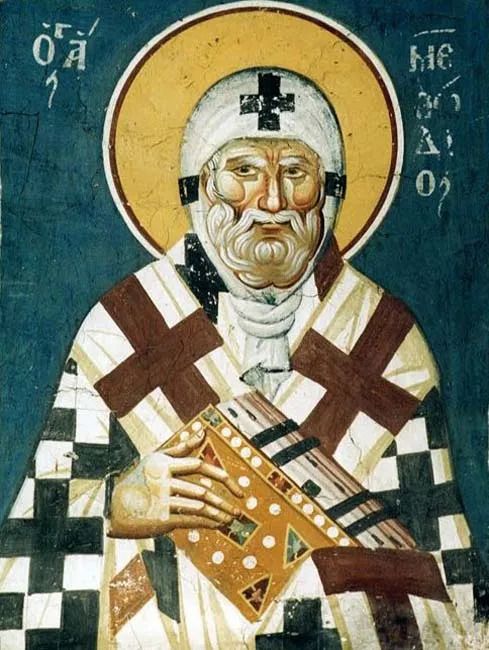
Image: Agios Methodios Peribleptos.jpg · Painters Michael and Eutychios · Public domain, via Wikimedia Commons

From Sabine Baring-Gould, The Lives of the Saints, new edition in 16 vols. (London: John C. Nimmo, 1897–98); text from the Internet Archive scan (OCR, lightly cleaned; errors possible). Public domain.

Image: Painters Michael and Eutychios, Wikimedia Commons (Public domain)

From “Catholic Encyclopedia (1913)/Methodius I,” The Catholic Encyclopedia (New York: Robert Appleton Company, 1907–1914), via Wikisource. Public domain. Matched by name and feast date; text unedited except for our bracketed notes in grey.

From Sabine Baring-Gould, The Lives of the Saints, new edition in 16 vols. (London: John C. Nimmo, 1897–98); text from the Internet Archive scan (OCR, lightly cleaned; errors possible). Public domain in the United States. Reproduced unedited, except for short bracketed notes in grey that we added to explain names and terms (“S.” is the old abbreviation for Saint). Some history and judgments reflect 19th-century scholarship.