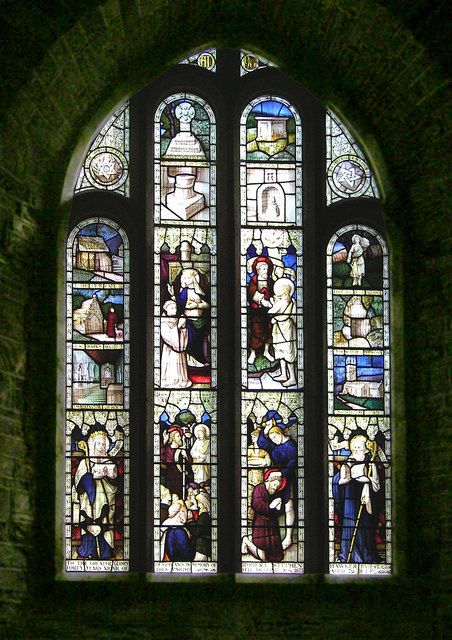
Baring-Gould’s sources: On this day is mentioned S. Modwenna of Burton-on-Trent; no trace remains of the commemoration of S. Morwcnna of Cornwall, but it is probable that she was commemorated on the same day as S. Modwenna, and that the life of S. Modwenna by Concubran may contain incidents from the life of S. Morwenna, as it certainly does contain those from the life of S. Monynna of Ireland. For further account of Concubran see the ensuing article on S. Modwenna.] In the “ Young Women’s Window” at S. Neot’s, near Liskeard, in Cornwall, is represented Brychan, king of Brecknockshire, with his offspring, twenty-four in number, all of whom are said to have been confessors S. Morwenna.
For martyrs in Devon and Cornwall. 1 Among these is S. Morwenna, with her sisters S. Merewenna and S. Mabena. The latter is represented in the adjoining window crowned with a palm-branch in her right hand, and an open book in her left, with the inscription, 44 Sancta Mabena, ora pro nobis.” But there is no other representation of S. Morwenna.
Brychan, prince of Brecknock (d. 450), according to Welsh accounts, had twenty-four sons and twenty-five daughters, in all forty-nine children. Statements, however, vary, of which this is the largest. The smallest statement is twenty-four for the whole number, and as his grandchildren may have been included in the longer list, this may account for the discrepancy. He is said to have had three wives — Ewrbrawst, Rhybrawst, and Peresgri, though it is not said that they were living at the same time. He had also several illegitimate children. Historians are now satisfied that there were three Brychans in succession kings of Brecknock, and this fact has occasioned the confusion in the pedigree and history of the family.
The names of the sons and daughters and grandchildren of Brychan are given in the 44 Cognacio Brychani,” and by Bonnedd-y-Saint, and a critical examination of the list is given by Dr. Rees in his “Essay on the Welsh Saints.” A few, but not many of them, can be identified with those attributed to Brychan, by Leland, and the window of S. Neot’s, and Morwenna does not appear in the list as his daughter. Morwenna is most probably Mwynen, the 1 The following are named: — i. S. John, or Ive, who gave his name to the Church of S. Ives; 2. Endelient, who gave his name to Endelion; 3. Menfre to S. Miniver; 4. Teth to S. Teath; 5. Mabena to S. Mabyn; 6. Merewenna to Marham church; 7. Wenna to S. Wenna; 8. Yse to -S. Issey; 9. Morwenna to Morwenstowe; xo. Cleder to S. Clether; xx. Keri to Egloskerry; 12. Helic to Egloshayle; 13. Ad wen to Advent; 14. Lanent to Lelant. Leland in his Itinerary adds Nectan, Dilic, Wen* senna, Wessen, Juliana, Wymp, Wcnheder, Jona, Kananc, and Kerbender Latin Monyina, daughter of Brynach Wyddel by Corth, one of the daughters of Brychan. 1 King Brychan reigned in Brecknock between 410-450, and it is probable that S. Morwenna was this granddaughter Mwynen, by Brynach Wyddel and Cymorth or Corth, his daughter, who lived in Carmarthen and Pembroke. If so, she had a brother named Gerwyn, who is admitted by the Welsh authorities to have settled in Cornwall, and been slain on the isle of Gerwyn. He does not appear in Leland’s list. That list is evidently very inaccurate, the same person recurs under two forms of his name. Thus John (Ive) and Jona are the same, so also certainly are Merewenna and Morwenna. Kananc is the S. Caian, venerated on September 5th, a grandson of Brychan, and perhaps, therefore, a son of Corth. S. Cleder is S. Cledog, who was buried in Herefordshire at Clodock; he was martyred by the pagan Saxons about a.d. 492, and is commemorated on Aug. 19th. He also was a grandson of Brychan, but is said by the u Co gnacio ” to have been the son of S. Clydwyn, son of Brychan. He is said to have had a sister S. Pedita, and a brother S. Dedyn who may be the Cornish Ad wen. The S. Tedda said to be a sister of S. Morwenna in the list is no doubt S. Tydie, a daughter or granddaughter of Brychan. S. Endelient may be the same as S. Elined, the Almedha of Giraldus Cambrensis, who says that she suffered martyrdom upon a hill called Penginger, near Brecknock. She is venerated on Aug. 1st. The list in Leland, and the similarity of some of the names to those of grand-children of Brechan, is sufficient to dispose of the idea that S. Morwenna and S. Modwenna are the same persons. S. Morwenna we may 1 Her sifters Gwennan and Gwenlliu may perhaps be recognised in the list in the S. Neot's window.
suppose was a Welsh woman, and that, with S. Nectan, her brother, she came to Cornwall and Devon, and settled on the cliffs above the Severn Sea; — S. Nectan on Hartland Point, and S. Morwenna at Morwenstowe; and that she died about the end of the 5th century. Leland, in his Collectanea, quoting an ancient book of places where the bodies of saints rest, says that S. Morwenna lies at Morwenstowe; “In villa, quae Modwenstow dicitur, S. Mudwenna quiescit.” The body of S. Modwenna, on the contrary, reposed at Burton-on-Trent.