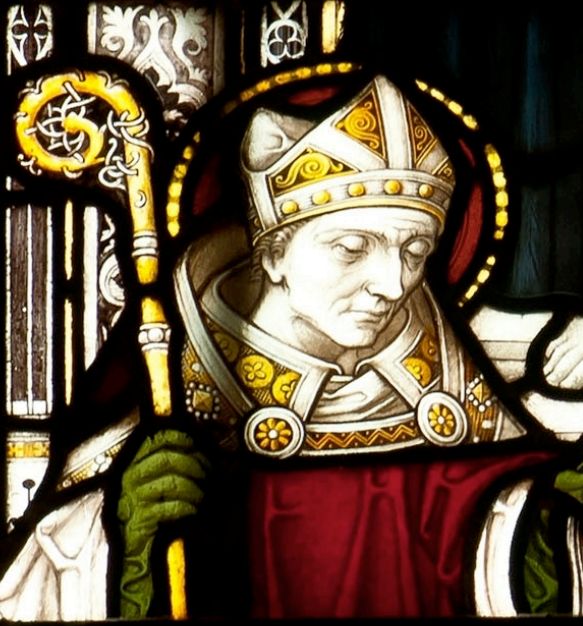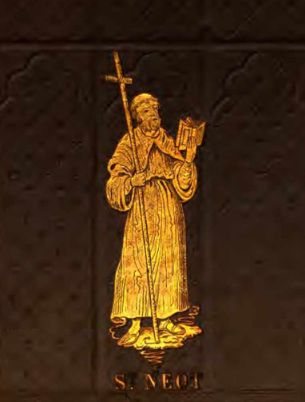
St. Neot

Witnessing to Christ by the way of life, not by death.

Read the essentials →
July 31 · Confessor

St. Neot

St. Neot

Witnessing to Christ by the way of life, not by death.

Traditional feast

July 31
1914 / pre-1969 calendar, per Baring-Gould (1897)

Current feast

July 31
Secondary source · Wikipedia

Represents

Confessor

Early life

The book says little or nothing about early life. This is how the account begins.

Thin entry · the 1897 book gives only 55 words. We have not filled the gap with invented detail.

King Alfred visited his kinsman, who rebuked him for some acts of severity he had committed, and warned him of the woes coming upon England. 1 S. Neot died in his monastery in Cornwall. His body was translated by Alfred to the place now called S. Neot; s 3 in Huntingdonshire, but then called Ainulfsbury.

What they represent

How they teach us to live

Drawn from themes in the original account

Build up the community you belong to. This life was lived with and for a community.

Learn from the kind of life it was. Witnessing to Christ by the way of life, not by death.

Read more

The full original · 55 words

Read Baring-Gould’s full account

Baring-Gould’s sources: From Ordericus Vitalis, who wrote in the 12th cent., we learn that the festival of S. Neot was ohserved in Normandy on July 30th; but according to Mabillon, in the abbey of Bee, it was celebrated on July 31st. Authority: — A contemporary hiographer existed. Asser, in his life of Alfred, speaks of King Alfred lying concealed from the Danes in a peasant's house “as is written in the Life of the holy father Neot." This original life no longer exists, but it may have formed the basis of the life by an anonymous writer of the 12th cent., which we have.] S. Neot was a kinsman of King Alfred, but what relation does not appear. The 12th century biographer is certainly wrong in making him the son of Ethelwulf, father of Alfred. He was perhaps a cousin. His early training was in Glastonbury Abbey. It is said that he was such a little man, that to stand at the altar and say mass he was obliged to have a stool placed for him to stand upon, whenever it was his turn to approach the altar. After a while, desirous of living a more retired life, he fled with one companion, named Barri, into Cornwall, and found a retreat where now stands the church of S. Neots, near Liskeard. There he spent seven years, and then made a journey to Rome. On his return he formed a monastery at the place of his retreat. There he ploughed the soil with oxen, but one night thieves stole his oxen, and next day red deer came from the forest and allowed him to plough with them.

King Alfred visited his kinsman, who rebuked him for some acts of severity he had committed, and warned him of the woes coming upon England. 1 S. Neot died in his monastery in Cornwall. His body was translated by Alfred to the place now called S. Neot; s 3 in Huntingdonshire, but then called Ainulfsbury.

Feast days

Feast: July 31

Nine days · Free

Pray the novena
with us.

One short email a day for nine days. The day's prayer, a line from St. Neot's story, and a nudge to keep going.

Also on July 31
St. Germanus of Auxerre

St. Germanus of Auxerre

July 31 · Bishop
H

St. Helena

July 31 · Widow, Martyr
J

St. John Colombino

July 31 · Confessor
← All 1726 saints in the library
Sources & notes

Feast-day sources

Sources

Credits

Image: SaintNeot.png · Unknown authorUnknown author · Public domain, via Wikimedia Commons

From Sabine Baring-Gould, The Lives of the Saints, new edition in 16 vols. (London: John C. Nimmo, 1897–98); text from the Internet Archive scan (OCR, lightly cleaned; errors possible). Public domain.

Image: Unknown authorUnknown author, Wikimedia Commons (Public domain)

From Sabine Baring-Gould, The Lives of the Saints, new edition in 16 vols. (London: John C. Nimmo, 1897–98); text from the Internet Archive scan (OCR, lightly cleaned; errors possible). Public domain in the United States. Reproduced unedited, except for short bracketed notes in grey that we added to explain names and terms (“S.” is the old abbreviation for Saint). Some history and judgments reflect 19th-century scholarship.