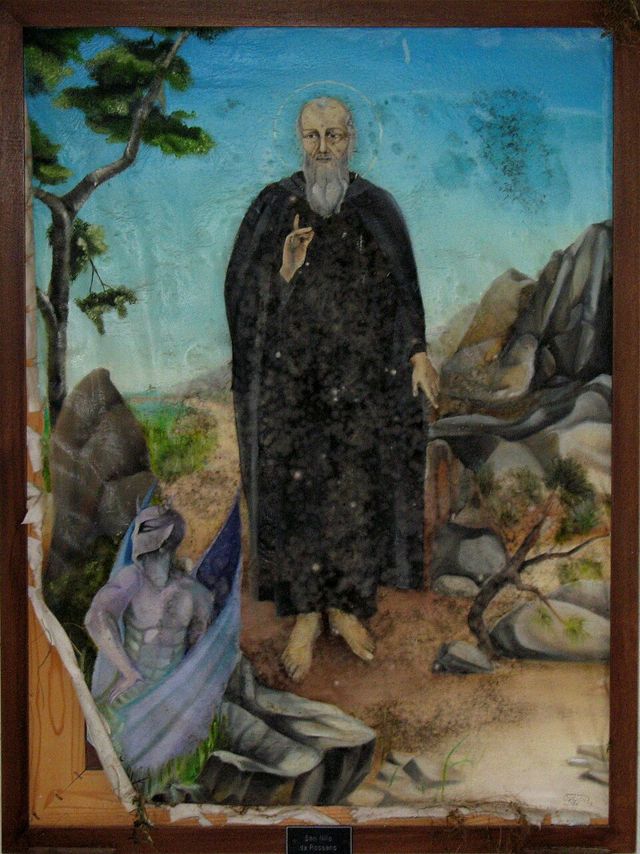
Baring-Gould’s sources: Roman and Benedictine Martyrologies. Authority: — A Greek Life written by a contemporary monk.] This saint, of Greek origin, was born at Rossana in Calabria, in 910. At his baptism he received the name of Nicolas, but he took that of Nilus when he made his religious profession. He married, and was a good and loving husband. But though engaged in the affairs of the world, he did not suffer the world to occupy his whole horizon. Every day he spent some hours in prayer or religious reading. By degrees, however, his former zeal cooled, he became less devoted to religious exercises, and he even fell into grave faults. But he was recalled to his [Sept. a6.
…senses by the death of his wife, whom he passionately loved. In the agony of his solitude, feeling the vanity of worldly pleasures, he resolved to retire into a monastery and end his days in prayer and contemplation. He was thirty years old when he entered the monastery of S. John the Baptist at Rossana. He passed thence to that of S. Mercury, and thence to that of S. Nazarius, where his devotion and fervour of speech made him to be regarded as a second S. Paul.
After some years he obtained permission to retreat with two companions into a forest, and settle in a hermitage near the chapel of S. Michael.
The reputation of the extraordinary sanctity of S. Nilus spread; people came from all parts to consult him. In 976 Theophylact, metropolitan [the archbishop who heads a group of dioceses] of Calabria, accompanied by Leo, Duke of that region, came to visit the saint, not for the purpose of edification, but to test his knowledge. Nilus perceived this. When one of the company asked him whether Solomon were saved or not, he turned sharply on him and replied, “ Whether Solomon be saved or not matters little to you, but what does concern you is how you may escape damnation. Seek to be assured that you are in the way of Salvation, and do not trouble yourself about the state of Solomon.”
When the Emperor Otho III. came to Rome and restored Gregory V. to his throne. S. Nilus hastened to meet him. On the death of John XV. in 996, the clergy, senate, and people of Rome had sent to Otho III., then at Ravenna, to ask him to name a successor to the chair of S. Peter. Otho the German Emperor, at once proclaimed his determination to place his kinsman and chaplain, Bruno, son of the Duke of Carinthia, on the vacant throne. Bruno was a youth of unblemished piety, and of austere morals, though of a somewhat fiery and unforgiving temper. The new Pope appeared S. Nilus.
in Rome, and was received and consecrated with seemingjoy. The more pious monks did not disguise their delight. “ The news that a scion of the imperial house, a man of holiness, of wisdom, and virtue, is placed upon the chair of S. Peter, is news more precious than gold and precious stones/' wrote the holy Abbo of Fleury to his friend. Rome, overawed, had submitted to receive the nominee of the German Sovereign, who quickly followed the Pope, and received the imperial crown at his hands. Bruno assumed the name of Gregory V. But the Consul Crescentius and a party of Romans were impatient of a German pontiff, and when the Emperor and his troops withdrew beyond the Alps, they drove Gregory from the city, and elected as Pope Philagathus, a Calabrian Greek, Bishop of Piacenza. He had been employed in important affairs; had been ambassador more than once to Constantinople, where he had perhaps fostered the ambition, never extinct, in the Byzantine Emperor of resuming his supremacy in Italy. Philagathus had obtained, it was asserted by violent means, the bishopric of Piacenza, he had amassed great wealth by the plunder of that church, and was prepared with his wealth to be the anti-pope of the Roman republic. He assumed the name of John XVI. It might have been expected that Nilus would have supported by his voice and influence a pontiff of the same race and country, speaking the same language as himself; that he would have been proud to see a Calabrian Greek on the throne of S. Peter. He might have argued that the German Gregory was imposed on the Roman Church by a foreign emperor, and that John XVI. was the free choice of at least a considerable portion of the Roman people and clergy. But Nilus, rising above local prejudices, wrote to the Bishop of Piacenza, urging him not to run the risk of climbing to such a giddy elevation, and to shun the temptations of ambition.
The Emperor Otho speedily descended upon Italy at the head of an overwhelming force. Italy was prostrate before him. He reached Rome at the beginning of a.d. 998, and entered the city without the least resistance. Pope John made his escape, but was taken and brought back. S. Nilus heard of this, and hastened to Rome to intercede for his compatriot. With tears he implored the Pope and Emperor to have mercy on the prelate, now very aged, who by unworthy ambition, no doubt, but also at the instigation of unscrupulous men, had dared to usurp the throne of S. Peter? and to implore that they would suffer the old man to hide his head in a cell of a monastery with him. The Emperor consented, and promised to give to S. Nilus the monastery of S. Anastasius, near Rome, in which he might rule as abbot, and shelter the deposed anti-pope. But Gregory V. was of less generous disposition.1 He could not forgive Philagathus for having attempted to pluck the keys from his grasp. Pie tore off the robes of his rival, already blinded by red-hot irons, and with his nose and tongue cut out, and cruelly forced him, in this mutilated and bleeding condition, to parade the streets of Rome on an ass, with his face to the tail, and with a wine-bladder on his head in mockery of the pontifical tiara he had audaciously assumed. When S. Nilus heard this he burst into tears of indignation and shame. An archbishop was sent to excuse the matter to him ■ but the old man rose up, full of wrath, and said: “ Go to the Emperor and the Pope, and say, Thus declares an old man, maddened by your unrighteous acts — you gave me this blinded man, not through fear of me, not because I had power to wrest him from your hands, but for the love of God when I pleaded it. And now, know this, that all those injuries you have done to this man have been done to God himself; and He will recompense them 1 “'0 aypios nairas.*' not spare you, as you did not spare him whom your heavenly Father placed in your power.”
The archbishop began an elaborate defence of the Pope. S. Nilus flung himself on a bench, laid his head between his hands, and pretended to be asleep. At night he mounted his horse, and fled away to his retreat among the forests of Calabria, out of the ambitions, crimes, and revenges of the world. The cruel Gregory did not enjoy his recovered dignity many months. He died, cut off in the flower of his age, as it was commonly believed, by poison.1 The biographer of S. Nilus, a contemporary, says that as he had plucked out the eyes of his opponent, so were his own plucked out, and he was buried with them hanging by the tendons on his cheeks.
The Emperor Otho afterwards made a visit to Monte Gargano and the church of the Archangel Michael. On his way back he visited the monastery of S. Nilus. The old abbot came forth to meet him with incense burning. The Emperor took his hand, and said: “ Our Lord bade His disciples go forth without silver, or purse, or staff, and with but one coat. But as He drew near His passion, He said, ‘ Let him take his scrip and purse/ You, my father, went forth in youth and manhood, poor and destitute; but now that old age and death come on, take purse and scrip, which I now offer you/’ It was gracefully put, but S. Nilus refused the present; and, laying his trembling hand on the Emperor’s breast, he said: “ I ask of you but one thing, sire ! Think of your responsibilities as a king of men. For their welfare you will have to give account to God. Remember that; I wish no more.” He was offered the bishopric of Rossana, his native town. He refused it. The incursions of the Saracens [medieval Christian name for Arab and Muslim peoples] made it impossible for 1 “ Veneno peremptus est."- Vita S. Meinwerci, c. 10. L ives of the Saints.
him to maintain himself in Calabria, and he took refuge on Monte Cassino with the monks of S. Benedict [father of Western monks (d. c. 547), author of the Rule]; but there was too much of life there to please the old man, who desired to die in perfect seclusion, and he retired to Serperi, on the sea-shore, and spent there ten years; then he went with his disciples to Tusculum, and settled in the hermitage of S. Agatha. There he did not long live, for he died in the year 1005, at the advanced age of ninety-five. S. Peter, Ap. See Feb. 22.