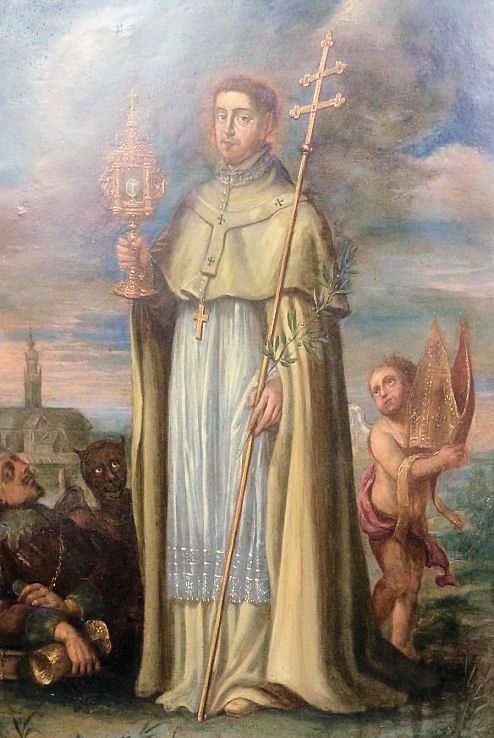
Baring-Gould’s sources: Roman and Norbertine Martyrologies. Canonised by Innocent 111. Gregory XIII., in 1582, ordered his festival to be observed on this day in all churches of his Order, and attached great indulgences to such observance. Pius V. made these indulgences plenary in 1616. Since then this feast has been inserted in the Roman Breviary, and from a semi-double has been elevated into a double. Authorities: — A life by a Norbertine canon, a contemporary, written at the request of Hugh the companion of the saint, also mention in the life of the B. Gotfried Kappenberg, in other writers of that period. J S. Norbert was born at Xanten, in the duchy of Cleves, in the year 1080, of a noble family related to the emperor. He was admitted to the sub-diaconate, that he might be given a rich canonry of the church of Xanten, and for some time he lived at the court of Frederick, Archbishop of Cologne, but left him to follow his kinsman, the Emperor Henry IV. He lived in utter worldliness, dressing richly as a layman, and denying himself no pleasure. But one day as he was riding through a meadow with a serving boy, a storm broke over them, and lightning fell before his horse, so that it reared and threw Norbert, who lay in a swoon for some time.
This shock proved the means of his conversion. He felt that the lightning might have struck him, instead of the soil; and if so, where would he have been then? Hitherto, he had refused to be ordained deacon and priest, but now he prepared for these orders, and received both the diaconate and the priesthood on the same day. He retired to his house at Xanten, and gradually weaned himself from ease and luxury. At last he resolved finally to leave the world, and having made himself a habit of lamb’s-skin, bound round his waist by a cord, he began to preach with remarkable unction, and to endeavour to S. Norbert reform his fellow canons at Xanteru But this was no easy matter. They spoke evil of him, mocked him, one so far forgot himself as to spit in his face. He was denounced as an impostor to Cuno, the papal legate [an official representative sent by the pope] in Germany, but the saint appeared before a council held at Fritzlar in 1118, and justified himself. Then he disposed of all his possessions, and gave everything to the poor, and barefoot he went to the abbey of S. Giles, near Nismes, to see Pope Gelasius II., who had taken refuge there under the protection of the king of France. He confessed to the pope that he had been guilty of contravening the canons by being ordained deacon and priest the same day, and then he besought permission to go preaching everywhere the Word of God. The pope gave him the requisite licence, and S. Norbert at once began preaching in France. He had brought with him from Germany two lay companions, and at Orleans a sub-deacon joined him, but the four died in 1 1 19, at Valenciennes.
Burkhardt, Bishop of Cambrai, having come to Valenciennes, S. Norbert sent word to him that he would be glad to see him, as they had been companions together at court When the prelate saw him barefoot, ill-dressed, and worn with fasting and his apostolic labours, he embraced him, saying, “ Oh, Norbert, that I should see you thus! Who would have expected this of you?” One of the bishop's chaplains, who had introduced S. Norbert, was much surprised to see the bishop exhibit so great affection and respect for the poor mission-preacher, and he asked of his master the reason. “ That man,” said the Bishop of Cambrai, “ was once the gayest and most refined in the emperor's court; if he is now poor and despised, it is because he has refused wealth and honour. The bishopric of Cambrai was offered to him, but he would not take it” This reply so surprised the chaplain that he [Jane 6.
determined to frequent the society of S. Norbert, and it led to his joining him in his mission work, and becoming his disciple. His name was Hugh, and he succeeded S. Norbert as head of the order of Prlmontrd Leaving Valenciennes, where he had preached with great results, S. Norbert went through the villages round about, preaching everywhere to crowds.
In January, 1119, Gelasius II. died in France, and Guido of Vienne was elected in his room, and assumed the title of Calixtus II. The pope summoned a council to meet at Rheims, and never did pope, in Rome itself, in the time of the world's most prostrate submission, make a more imposing display of power, and maintain a loftier position than this first great French pontiff His consistorial throne was placed before the portal of the great church; below him sat the cardinals, fifteen archbishops, above two hundred bishops, and numerous abbots were present. The Archbishop of Mainz attended at the head of seven suffragans, and a body-guard of five hundred armed retainers. S. Norbert was there to ask permission to continue his labours. Calixtus received him cordially, and was about to grant him his request, when the Bishop of Laon, stepping forward, entreated the pope to send S. Norbert to Laon, and lay on him his commands to reform the abbey of S. Martin [St. Martin of Tours (d. 397), soldier turned bishop] there occupied by regular canons. The pope gave the required injunction to S. Norbert, who in vain protested, and the Bishop of Laon, on his return from the council, took Norbert with him. Norbert required the canons to take the oath of poverty, but they refused; he made another attempt to induce them to reform, but finding them stubbornly opposed to his plans, withdrew from the attempt, and took up his quarters for the winter with the bishop. Next spring the Bishop of Laon suggested to S. Norbert that he should found a new S. Norbert order, and promised to procure him lands on which to build.
The saint having agreed to this, the bishop took him to Foigny, but the place did not commend itself to his taste, and then the bishop offered him another site, at Thenaille, but neither did this please him. As they were passing together through the forest of Coucy, a pleasant green valley opened out on their eyes, with a deserted chapel in the midst dedicated to S. John the Baptist. Norbert, the moment he saw this peaceful valley, exclaimed, “ This is the place which the Lord hath chosen for us !” and entering the chapel, he bade the bishop leave him there all night The bishop retired to his house at Anisey, but Norbert remained in the ruined chapel praying. During the night he thought he saw a long procession of white robed men, with cross and tapers, sweep through the chapel and out over the meadow, and wind away out of sight under the trees. On the morrow he told the bishop his vision, and assured him that he would build there, and give a white habit to his brethren. The bishop obtained a grant of the valley, called Prrfmontr^, from the chapter of S. Vincent at Laon, to whom it belonged, and there S. Norbert laid the foundations of the first house of that Order, which took its name of Premonstratine canons from the vale in which his house was built. On the feast of the Conversion of S. Paul, in the year 1120, the Bishop of Cambrai took from S. Norbert and Hugh his companion their penitential habits, and put upon them a white woollen robe, such as that which Norbert had seen in his trance, in the chapel. Many having joined the saint, he placed the brethren under the rule of S. Augustine, and to all he made these recommendations — to observe purity of heart and personal cleanliness; expiation of their faults before all the brethren in chapter; and thirdly, hospitality and Lives oj the Saints.
(June 6. care of the poor. Soon his Order spread, he built another house at Floreffe, near Namur, and Gotfried, count of Kappenberg (Jan. 13th), converted his ancestral castle into a Norbertine house. Thibault, count of Champagne, would have followed the example of the count of Kappenberg, but S. Norbert restrained him, assuring him that God had other views for him, and that he could best serve God in a state of matrimony. He recommended to the count Mathilda, the beautiful and pious daughter of Angilbert, a count of Bohemia, and he went in company with the count to Spires to obtain her hand for him. It was whilst he was at Spires that the archbishopric of Magdeburg fell vacant, and Lothair the Saxon, emperor of Germany, appointed Norbert to it He would have refused, but the papal legate, Cardinal GerarJ, who afterwards ascended the throne of S. Peter, under the title of Lucius II., exercised his authority to force the saint to accept the little coveted honour.
But before this he had done a good work in Antwerp, whither he had been called to oppose the fanaticism of a certain Tankelin, a mystic, who rejecting the priesthood and episcopacy as institutions of men, preached that he was the Messiah, God Incarnate, dressed as a king with a circle of gold in his hair, and went about surrounded by an armed body-guard. Like so many fanatical sects, that of Tankelin combined frantic licentiousness with their mystic ecstacies. Norbert was given the church of S. Michael, and his preaching was so successful that he completely broke the power of the heresiarch, gathered in his disciples to the true fold, and Tankelin, deserted by all, in attempting to escape, was taken and executed. On S. Norbert assuming the mitre, he found that the Church of Magdeburg needed reformation. He enforced vigorously clerical celibacy as insisted upon by the late Pope Gregory VII. The great majority of the German bishops had either openly refused to carry out the decrees of Gregory VII., or had connived at their being disregarded. S. Norbert waged an inveterate war with the married clergy, and stirred up better hostility against himself by so doing.1 His entrance to the episcopal palace was characteristic. He arrived at Magdeburg unannounced, unexpected. In his poor old habit, and barefoot, he knocked at the palace door. The porter looked out and said, “We admit no beggars. Away fellow 1" His favourite poverty was not lost when he became a wealthy archbishop, his gates were thrown open to all beggars, and the revenues of the see were employed in the advancement of religion, not in the enrichment of kinsmen, as had hitherto been the rule.* He founded in the diocese several houses of his order, and endeavoured to raise the tone of his clergy, and through them to elevate the people. He met with sullen, sometimes furious opposition, and his life was attempted by private assassination, and then by an insurrection of the citizens who besieged him when he was in his cathedral, so that he was obliged to fly up one of the towers in his episcopal vestments, from the altar at which he had been standing. The tower held out for two days, and then some of the mob broke in, his chamberlain was cleft through the skull, but the archbishop advancing towards the armed men, rushing upon him up the narrow winding stair, with his mitre on, and a purple chasuble over his 1 u Initia dolorum, et occaslo persecutionum omnia haec.** ’The people said to him, ** Quid am ex prsedecessoribus tuis, nimium su® carnal! tat i indulgentes, fratribus carnallbus, et quibusdam ex parentibus et pro* pinquis suit aliud praedium concesserunt, aliud praestiterunt." Caesarius of Heisterbach relates the saying of a priest of Paris, “ 1 hare faith to believe all things, but l cannot believe in the possibility of the salvation of a German bishop.’* Dialog. Miracul. I., c. 97; also Homil. II., p. 99. (Jane 6.
shoulders, they recoiled with awe. At that moment the count of Magdeburg came to his assistance and dispersed the rioters. The archbishop calmly descended to the church, mounted to the altar and said mass, as if nothing had happened. Finding that he was without deacon or subdeacon, none of his clergy having courage to attend on him, he read the Epistle and Gospel himself with unwavering voice.
But though the tumult was allayed, the discontent was not abated, and so formidable a conspiracy was formed against him — a rumour of which having reached the archbishop’s ears through the revelations of some drunken conspirators — that he deemed it advisable to leave the city for a while, and he took refuge in his castle of Halle. The citizens fearing that he would gather his troops, appeal to the emperor, and severely castigate the town, hastened with offers of money and promises of amendment, to recall their archbishop, and he returned in triumph to Magdeburg amidst the greatest affectation of enthusiasm.
The archbishop was now called to take a part in political affairs, from which it was not possible for him to hold aloof. Peace had reigned in the empire and the Church whilst Lothair the Saxon occupied the imperial throne, and Honorius II. sat in the apostolic chair. But the death of Honorius in February, 1130, was the signal for a violent collision between the ruling factions of Rome. They watched the dying pope with indecent impatience. In secret (it was asserted before the death, certainly on the day of the death, and before the funeral of Honorius) a minority of the cardinals elected Gregory, the cardinal of S. Angelo, who took the name of Innocent II. The more numerous party, waiting a more decent and more canonical time for their election, chose the Cardinal Peter Leonis, a man of Jewish descent He called himself Anacletus II. On his side Anacletus had the more canonical election, the majority of the cardinals — there were sixteen for Innocent and thirty-two for Anacletus — and the strongest party in Rome. He made overtures to Roger, duke of Sicily, who had been excommunicated by Honorius, and tempted him with the prospect of a crown. The powerful family of Peter Leonis and the Normans were on the side of the pope, afterwards reputed the antipope; the emperor and all northern Christendom united eventually for the successful pontiff. Innocent had in Rome the Frangipanis, a strong minority of the cardinals, the earlier though questionable election; he had the indelible prejudice against his adversary — his name and descent from a Jew and an Driven from Rome, Innocent dropped down the Tiber and reached the port of Pisa. Messengers were immediately despatched to secure the support of the Transalpine sovereigns, more especially of Louis the Fat, king of France. The king summoned a council of bishops at Etampes, and referred the matter to the decision of S. Bernard of Clairvaux. S. Bernard decided in favour of Innocent, and the pope at once took refuge on the hospitable shores oi France. At Clermont he held a council, and received the allegiance of two of the great prelates of Germany, those of Salzburg and Munster. Near Orleans he was welcomed by the king, at Chartres by Henry I. of England, who had been persuaded, contrary to the advice of the English prelates, to embrace the cause of Innocent In Germany the Emperor Lothair assembled a council at Wurzburg, which was attended by sixteen bishops, amongst whom was S. Norbert, who enthusiastically took the part of Innocent, and Innocent was acknowledged in Germany. The pope held a council at Rheims, and thither S. Norbert VOL. VI. 5 [Jane 6.
hastened to salute him. On March 22nd, 1131, the pope entered Li^ge, and was met by the emperor, who, according to custom, held the reins of the pope’s white palfrey. S. Norbert, in Germany, did what S. Bernard had effected in France, and Innocent was now acknowledged, and chiefly through their influence, by the kings of France, England, Spain, and by the emperor. The more powerful clergy beyond the Alps, all the religious communities were on the same side. But Innocent could not re-enter Rome without the armed support of the emperor against his rival It was not till November, 1132, that the emperor, urged on by S. Bernard and S. Norbert, undertook to reinstate Innocent in the possession of Rome. S. Norbert accompanied the emperor, to excite his tepid zeal. In March, 1133, the emperor and the pope advanced to Rome, Bernard and Norbert still by the side of the conquering pontiff Anacletus did not venture to defend the city; he retired beyond the Tiber, occupied the Vatican, and maintained the castle of S. Angelo. The pope rewarded the emperor’s fidelity by crowning him and his empress Richilda with great solemnity in the Lateran [St. John Lateran, the pope’s cathedral in Rome] church, and showed his gratitude to S. Norbert by conferring on him the pallium [a woolen band the pope gives to archbishops as a sign of their authority] and constituting him primate [the leading bishop of a country] Over the whole of Germany. Lothair swore to protect the pope and the royalties of S. Peter to the utmost of his power; to enforce the restoration of all the rights and possessions withheld by violence from the see, and then, exhausted with the summer heat, retired from Rome and re-crossed the Alps into Germany.
No sooner had the emperor retired, than Innocent, unable to maintain himself unsupported in Rome, took refuge in Pisa. S. Bernard and S. Norbert now incessantly assailed the emperor, reminded him of his oaths, appealed to his zeal, rebuked him for his ingratitude, and exhausted their efforts to make him resume the defence of Innocent, and crush Anacletus and his Sicilian supporter. In 1137 Lothair again entered Italy and subdued the marches of Ancona, the principality of Capua, and almost the whole of Apulia. The king of Sicily had quietly withdrawn his troops, and waited his opportunity, when the emperor should return to Germany, to resume the offensive. Anacletus, in his impregnable fortress of S. Angelo defied his enemies. His timely death relieved Innocent from his obstinate antagonist But ere this, in 1134, S. Norbert had been called to his rest He was then fifty-two; twenty years had been spent in the service of Christ. His body was carried into all the churches of Magdeburg, and was laid in that of his Order, dedicated to S. Mary. But in 1627 the sacred relics [the bodily remains of a saint, or objects they used, kept with honor] were taken by the Emperor Ferdinand II. from the Lutheran city, which no longer valued them, to Prague, where they are still preserved.