Was authentic.” — Potthast) in Mabillon, Acta SS. O.S.B. saec. iii. p. 2. Also a Life by an almost contemporary writer, of which a fragment has been published by Grandidier, “Hist, (le I’^glise de Strasbourg,” L The legend of S. Odilia is as follows; it must not be regarded as serious history, at least in its details: — Adalric, duke of Elsass, by his wife Berchsind, maternal aunt of S. Leodegar, became the father of a little girl who was bom blind. Disgusted at this, he ordered the child to be exposed or put to death, but the mother committed it to a poor woman, and then, when the child had grown to girlhood, sent her to the convent of Baume.
There she remained twelve years unbaptized, till a Bavarian bishop, named Erhardt, in obedience to a dream, travelled to Baume to baptize the child. No sooner was she baptized than her eyes were opened. Her brother Hugo brought her to her father, but the duke A Lobineau, however, says 668 or 669. If the date of the abdication of Jadicae! could be fixed, that of the death of Judoc could be fixed approximately. 5'. Odilia.
fell on the young man and struck him with his dagger, so that he died. Adalric, horror-struck at what he had done, felt the most poignant repentance, and did all in his power to make amends, by showing love to his daughter. He wished to marry her to the duke of the Allemanni, but Odilia fled from home, and when she was pursued by her father, a rock opened and received her in its bosom and concealed her from pursuit. The scene of this miracle is supposed to be a nook in a spur of the Black Forest Mountains that stretches to Freiburg in Breisgau. The spot is marked by a chapel built over a cave in which flows a spring of pure water. Probably the truth is that this was a cave in which S. Odilia took refuge, and where she remained in concealment for some years. Adalric then gave up his attempt, and promised her a convent and nuns, if she would become abbess. He built her a house at Hohenburg, and she retired to it and spent there the rest of her days. On her death, she was buried there.
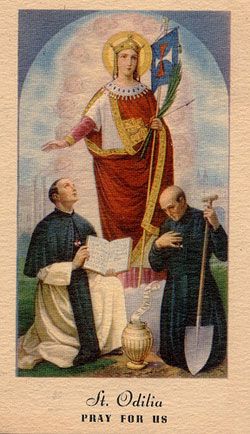
Her shrine is an object of much resort by pilgrims, and their offerings are considerable; so much so, that in 1849 the pilgrimage church and the relics [the bodily remains of a saint, or objects they used, kept with honor] of the saint were put up to public auction, as a profitable speculation for the investment of capital, in spite of an energetic remonstrance from the bishop of Str^sburg. The convent of Hohenburg, most picturesquely perched on the summit of a rock, is now occupied by Sisters of the Third Order of S. Francis. S. Odilia is represented in art with a couple of eyes reposing on the pages of a book. She is vested as an abbess, and may thus be distinguished from S. Lucy, who has the same symbol, and is commemorated on the same day. It is possible that some confusion between the saints has given rise to the fable of Odilia’s miraculously obtaining sight by baptism. She, like S. Lucy, is invoked in cases of ophthalmia and inflammation of the eyes. The spring in the cave at S. Odilien, near Freiburg, is much resorted to by those suffering with ophthalmia. They wash their eyes in the water.